 Guide On Map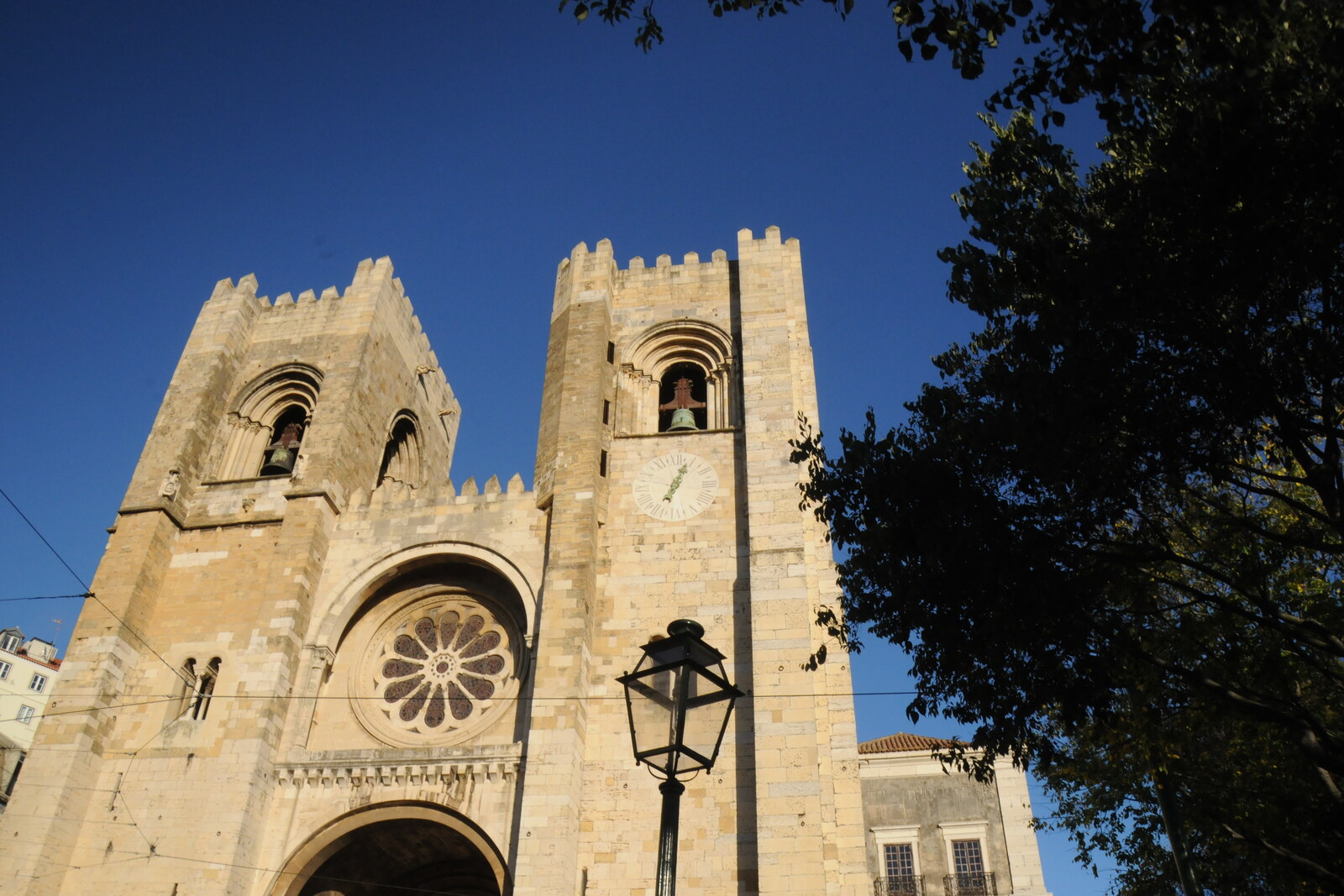
Look around first
What to notice
- The two towers of the façade
- The round rose window
- The bishop's throne
- The cathedral bells
The story of the place
The name “Sé” came from the Latin word “sedes,” meaning chair; it refers to a church with a bishop's throne. After the capture of Lisbon, the king restored the city's diocese, and the cathedral became its center. The two towers and round window on the façade seem ancient, but the south tower collapsed in an earthquake, and later restorers redesigned the façade, the rose window, and the tops of the walls.
On December sixth, thirteen eighty-three, the Bishop of Lisbon, Martinho Anes de Zamora, interrupted his lunch in the rooms above the galleries of the cathedral courtyard, ordered the church locked, and went up to the bells. The cathedral was both his home and his place of service: Martinho lived here to attend the daily services, governed the diocese from here, and intended to settle all the cathedral canons nearby.
The Portuguese word “Sé” comes from the Latin “sedes”—“place” or “chair.” This is what they call a church where the bishop's throne stands. After the capture of Lisbon in eleven forty-seven, King Afonso Henriques restored the city's diocese, and its first bishop of the new era was the English crusader Gilbert of Hastings. Since then, this has been the principal church of the ecclesiastical district, and a decision by its bishop could echo far beyond the church walls.
A few weeks before Martinho's death, King Fernando I of Portugal died. His only legitimate heir was his daughter, Beatriz of Portugal, the wife of the King of Castile. Until she had a son, Beatriz's mother, Queen Leonor Teles, was to rule the country. Many Lisbon residents feared that the Portuguese crown would end up with the Castilian monarch.
The regent's opponents gathered around João I of Portugal, the illegitimate brother of the late king and head of the Order of Aviz. João wanted to remove Leonor's closest advisers and lead the resistance to her supporters. On that December day, he and his accomplices killed the regent's leading confidant in the nearby royal palace. To bring the townspeople out into the streets, the conspirators spread a false cry: João is being killed.
Church bells served as the city's alarm at the time. They rang at São Martinho and in other parishes, but the bells of Lisbon Cathedral remained silent. Martinho, who had been born in Castilian Zamora, already seemed suspicious to the crowd. The silence of the main cathedral was quickly turned into proof: the bishop supposedly knew of the plot against João and supported the regent.
Martinho himself, according to the account of the chronicler Fernão Lopes, did not understand the cause of the alarm. He knew that a strike of the cathedral's great bell could rouse the entire city, and he did not want to ring it in response to cries from the street. So he locked the doors and took refuge in the tower with two guests.
The townspeople set ladders against the opening, got inside, and opened the church. Two officials of the city council climbed to the bishop by a narrow staircase where only one person could walk at a time. Martinho admitted them only after they promised him safety. He explained why he had not ordered the bells rung, and the envoys found his answer convincing.
The crowd below demanded that the bishop be thrown down. When the envoys hesitated, they were threatened with the same fate: if Martinho remained above, everyone would be sent flying down. The people who had just vouched for his life chose to save their own. The bishop was wounded, killed, and thrown from the tower. Two clerics who happened to be beside him were also killed. Martinho's body was stripped, dragged to Rossio, and left there; they dared to bury him only the next day.
Fernão Lopes recorded this scene about sixty years later at the request of João I of Portugal's son; João I of Portugal was by then the founder of a new royal dynasty. His reported speeches therefore cannot be taken as a transcript. But there is no doubt about the bishop's death and its consequences. João became King João I of Portugal, and the bishop's throne was taken by João Anes, a Portuguese cleric close to him. Later, the pope elevated João Anes to the rank of the first Archbishop of Lisbon.
The present façade still has two towers, but it is impossible to point out the exact opening from which Martinho was thrown. The south tower collapsed in the earthquake of seventeen fifty-five, and at the beginning of the twentieth century restorers remade the façade, the rose window, and the tops of the walls. Below, the bishop's throne is still there; above are the bells whose silence once led to the killing of the man who occupied it.
Useful on site
November—May: Monday—Saturday from 10:00 to 18:00. June—October: Monday—Saturday from 09:30 to 19:00. Closed on Sundays and church holidays. Hours checked 2026-06-29.
Checked: June 29, 2026. Check the official source before visiting.The building's defensive character is easy to read from outside. If you decide to go in, allow separate time for the interior and bear in mind that worship takes priority over tourist visits.