 Guide On Map
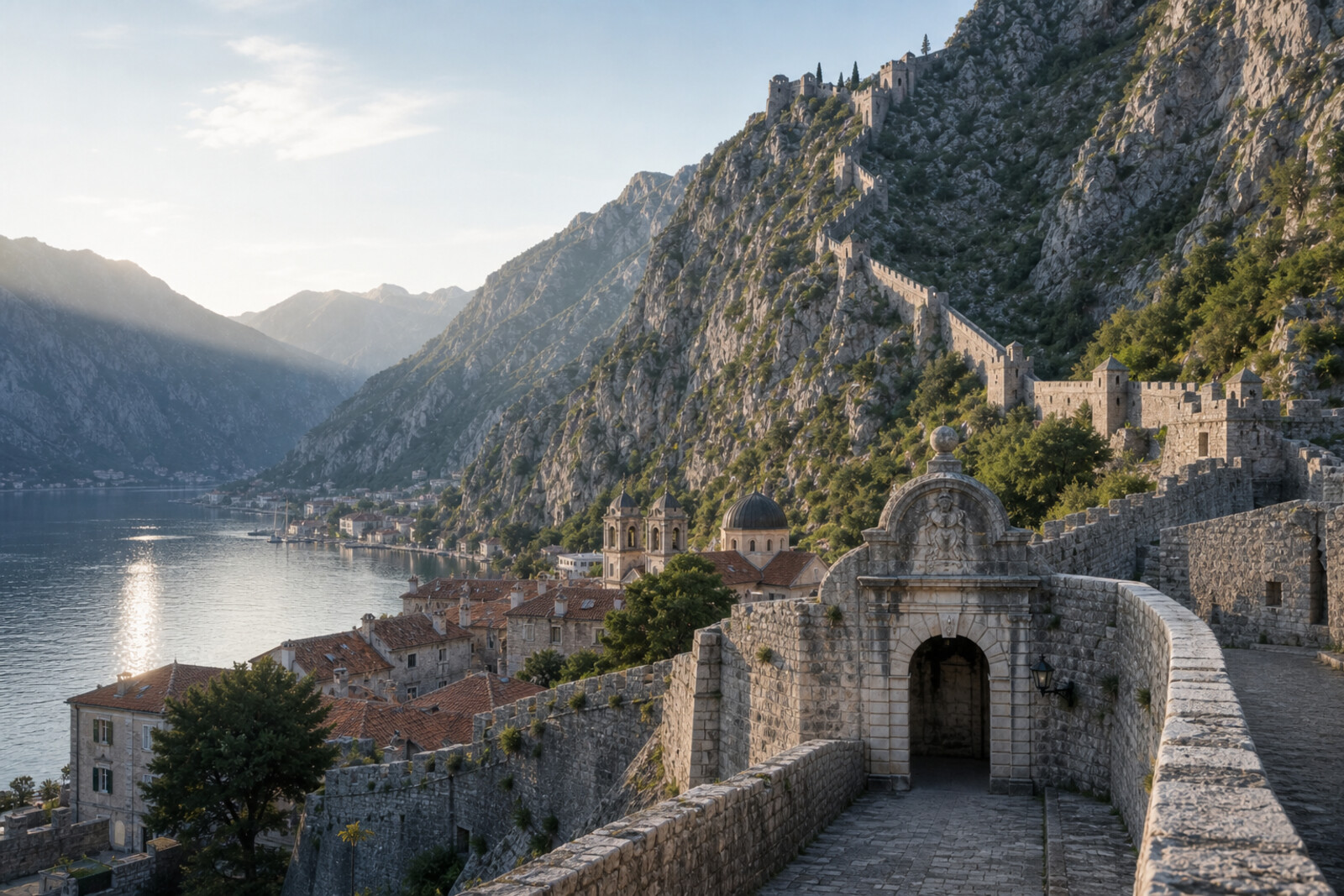
Kotor City Walls: From the Bay to the Fortress
From Sea Gate through squares and bastions to St. John's Fortress
Guide On Map on your phone
Open the walk like a regular app
It takes about 10 seconds to install. No app store needed.
The whole path
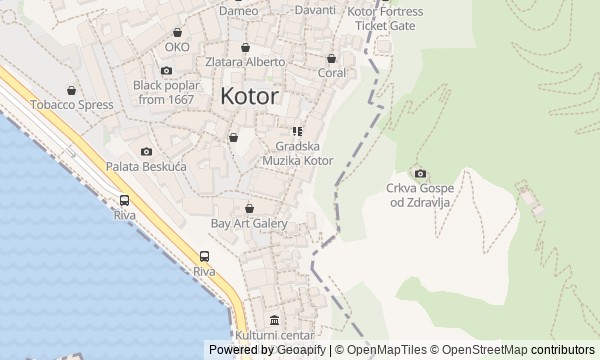
Route map
About the walk
You will enter Kotor through Sea Gate, cross its close-packed squares, and make your way to Škurda. From the river, the route turns along the bastions, then takes the fortress stairway toward a small church on the slope and the upper fortress.
Below, there will be arches, the Clock Tower, a cathedral, and two rites under one roof. Higher up come gun galleries, stone steps, and the bay beyond the roofs. But this route is not a catalog of old buildings. It pieces Kotor together from decisions made by ordinary people: winding the clock weights each day, sharing one church, filling in newly built vaults, hauling heavy guns to places where no one expected them.
The story separates documents from local legends and shows exactly what an inscription or surviving object can prove. By the end of the walk, you will read Kotor City Walls as traces of specific work: civic, military, and family work.
Why this order
Sea Gate sets the first urban threshold, and Arms Square just beyond the arch shows how the entrance was tied to shared time and daily service. From this administrative center, the route heads to St. Tryphon's Cathedral: after the city clock comes the shrine around which Kotor built its festive calendar. The next small church stands near the cathedral as a contrast, where communities had to share one close-built church. From there, the northern streets lead naturally to Škurda and North Gate, where tight space already served defense. Beyond the bridge, the route follows the river to Campana Bastion, joining a separate arch and the bastion into one line of fire. It then returns inside the walls and climbs upward: after the protection of artillery, the church on the slope tells of a threat against which batteries were useless. The same stairway reaches St. John's Fortress, where the lower gate, the river boundary, and Campana Bastion first come into view together.
Those interested in the people who kept a fortified city running Those who like distinguishing documents, legends, and later inscriptions Those ready to combine Kotor Old Town with a long climb
Those looking for a level walk without steep stone steps Those who want to limit themselves to the main squares and cathedral facades Those uninterested in military engineering and urban history
Before you go
Wear shoes with grippy soles and bring enough water: the upper section runs over uneven stone, and shade and services along the way are not guaranteed. Use the official entrance at Parile for the climb, and check local access to the walls in advance; route conditions may depend on weather and ongoing work. Do not climb in rain, a thunderstorm, intense heat, or without enough time for an unhurried descent. The cathedral and churches remain active places of worship: enter only when visits are permitted, keep quiet, and do not interrupt a service. The main story still holds together if you view the churches only from outside.
When to go
Lower part of the route — 75–90 minutes
Walk to the official entrance — 10–15 minutes
Climb to the fortress — 55–75 minutes
Stop at the summit — 20–25 minutes
Descent by the same route — 45–60 minutes
Backup plan
If the walls are closed, the stone is wet, or the weather makes the climb unsafe, end the walk at Campana Bastion. After North Gate, see Škurda, the bridge, the bastions, and the point where the river meets the bay, then return through the lower city to Sea Gate. This version takes about 80–100 minutes and requires no mountain section. It keeps the route's central sequence: arrival by sea, urban order, religious life, and water turned into a defensive boundary. Do not try to replace a closed official entrance with an informal trail.
Route conditions
Surface. Paved — 2.1 km (data covers 88% of the route)
Stairs. Flights: 6, 665 m in total
Access. Wheelchair — no; stroller — limited (stairs)
Facilities. Toilets — 5; drinking water — 3
Elevation. Ascent — 213 m; descent — 10 m
OpenStreetMap extract of July 3, 2026: database data, not a check on the ground. Data © OpenStreetMap contributors, ODbL licence
Walk plan
Open in maps ↗- 1
Sea Gate
The arch will show how an old entrance to the city acquired a new date, coat of arms, and political phrase. - 2
Arms Square
A family workshop will explain what daily work still keeps the city clock face moving. - 3
St. Tryphon's Cathedral
The history of the relics will link the early martyrium, the present basilica, and the continuing city ritual. - 4
St. Luke's Square
One church will show how two communities shared limited space within the walls for a century and a half. - 5
North Gate by the Škurda
The bridge, river, and neighboring fortifications reveal how the city's most vulnerable entrance was arranged. - 6
Campana Bastion
The rebuilding of the battery will show why the garrison sacrificed relatively new rooms for a more reliable position. - 7
Church of Our Lady of Health
A thanksgiving procession will recall a danger from which the city walls and guns offered no protection. - 8
St. John's Fortress
The finale will explain how the height of the neighboring ridge decided the outcome of a siege considered almost impossible.
Route features
Everything you need stays in the browser
Progress, saves and your trip plan are stored on this device.
Add Guide On Map to your home screen so the walk opens outside the browser.
How we handle sources, maps and corrections: our editorial standards