 Guide On Map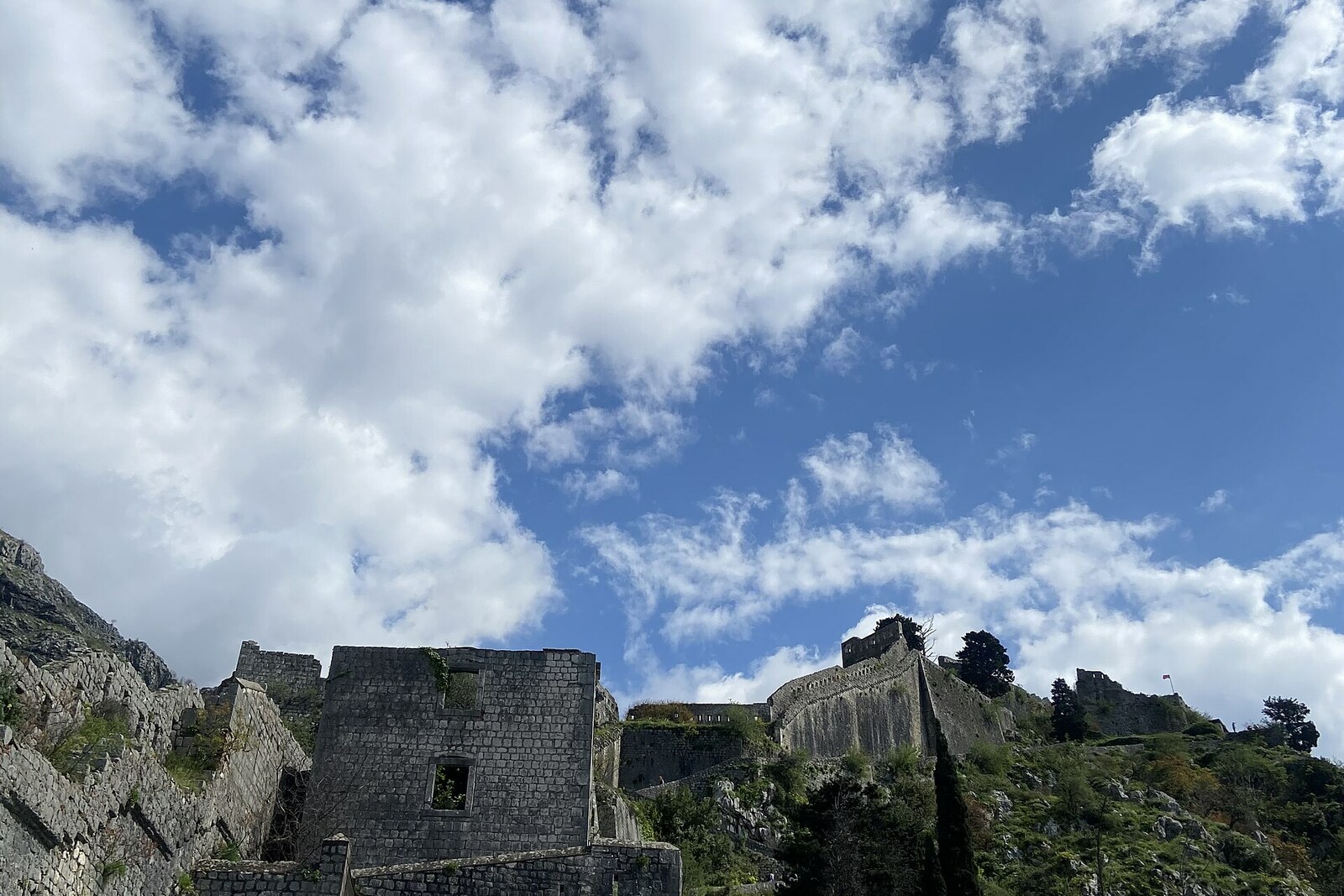
Look around first
What to notice
- The fortress courtyards
- The fortress walls
- The opposite ridge
- Kotor and the bay below
The story of the place
The Saint John in the fortress's name is John the Baptist, the biblical preacher who baptized Jesus in the Jordan. The church at the summit was consecrated in his name; written sources mention it as early as the middle of the fifteenth century. From the church, the name passed to the mountain and to St. John's Fortress, which closed off the city walls rising up the slopes.
In December eighteen thirteen, the French general Jean-Joseph Gauthier brought about six hundred soldiers here. He commanded the Kotor garrison and intended to hold the last French fortified point in Boka. The lower positions had already been lost, British and Montenegrin forces had encircled the city, but Gauthier counted on the steep slopes around the fortress. He believed help would arrive before the enemy could raise heavy artillery to the neighboring height.
Captain William Hoste, commander of the British frigate HMS Bacchante, received orders to drive the French troops out of the bay. Having inspected the fortifications from the opposite ridge, he chose Mount Theodore: its summit stood several hundred yards above St. John's Fortress. From there, the guns could fire down on Gauthier's position.
Fifty-four British officers and sailors landed on shore. They had to haul two shipboard eighteen-pounder guns and two mortars up the rocks. Each long gun weighed more than two tons. These men lived by naval service and knew how to work with ropes, pulleys, and anchors; now they had to adapt familiar shipboard equipment to the mountain. To secure the tackle, the sailors cut grooves into the rock. Where the rock crumbled, they buried a small ship's anchor in the rubble and pulled the gun from it. The stone tore their shoes apart, there was nowhere to change their wet clothes, and for seven nights the men did not sleep in beds. So few crewmen remained on the ship that the frigate could barely be moved around the bay.
The first gun was raised to the summit in six days. Hoste wrote to his mother that Gauthier had allowed six months for such work. These are Hoste's own words, not a record of a conversation between the two commanders, but the French general's calculation is also known from accounts of the siege: he really did consider a battery at that height practically impossible.
On December twenty-fifth, the British opened fire from four positions at once. The sailors then raised several more guns, and on January first the bombardment intensified. Gauthier initially rejected an offer to surrender. When the British prepared a general assault and a Montenegrin detachment joined them, the general sent Hoste a letter and began negotiations.
On January fifth, eighteen fourteen, Gauthier capitulated. He and the remaining two hundred ninety-seven soldiers were sent to Italy as prisoners of war, on the condition that they would not fight against Britain and its allies until an official exchange. During the siege, the British lost one sailor.
The mountain batteries were dismantled immediately after the capitulation, and the guns, mortars, and supplies were returned to HMS Bacchante. Another part of this story has survived: the courtyards and walls of St. John's Fortress, where Gauthier waited for help and from which he descended as a prisoner.
Useful on site
The latest official schedule found for the walls: 1 March — 30 April 08:00–18:00; 1 May — 30 September 07:00–20:00; 1 October — 30 November 08:00–17:00. Outside these dates, the official operating hours are not specified in the publication.
Checked: date not specified. Check the official source before visiting.Do not approach the open edges or climb onto the walls; before descending, keep some water, strength, and daylight in reserve.