 Guide On Map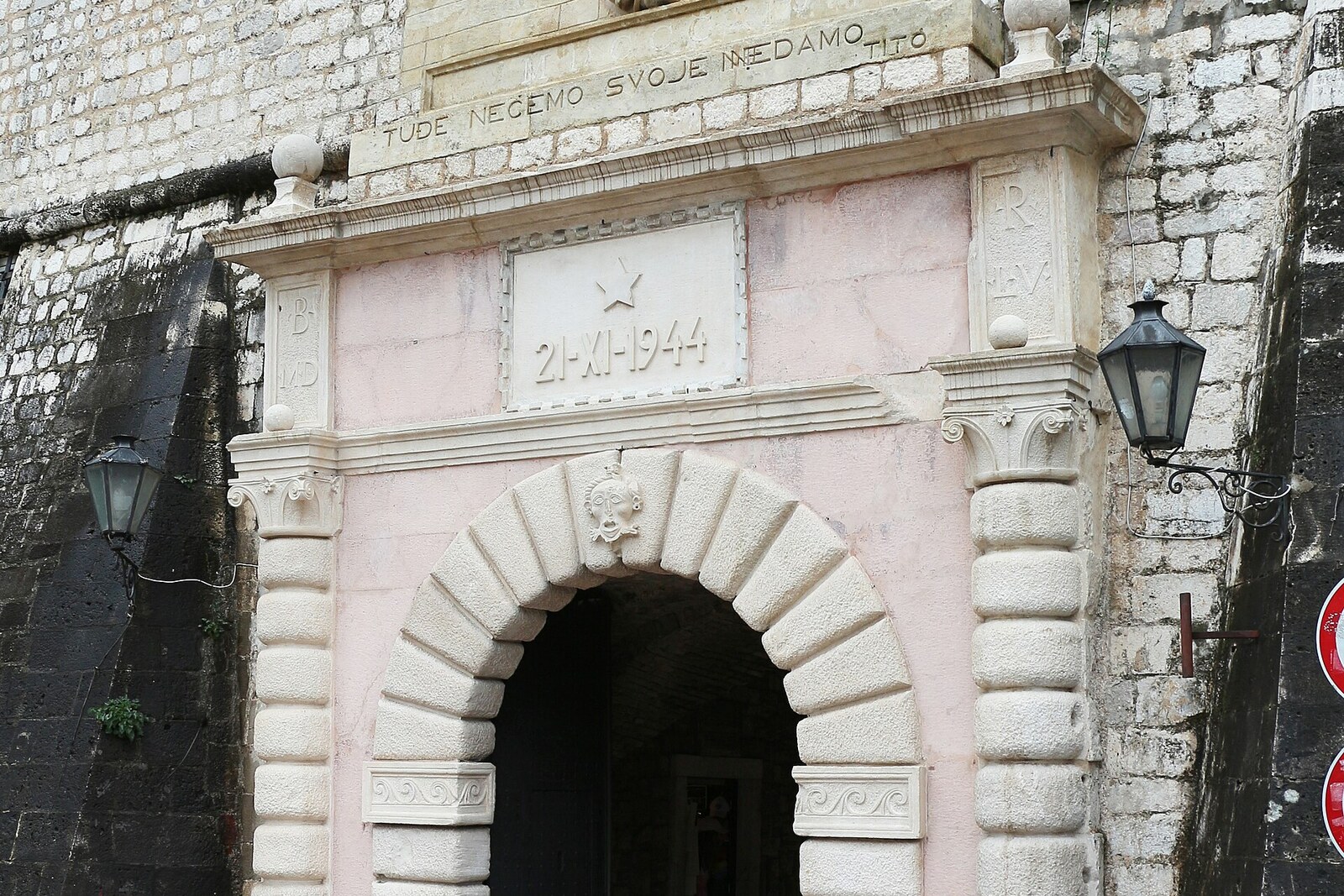
Look around first
What to notice
- Stone arch
- Date: 21 November 1944
- Inscription with Tito's words
- Coat of arms above the passage
The story of the place
At the stone arch, the sea route into old Kotor once ended: the water came right up to the fortifications, and boats moored at the main entrance. The present portal was installed in fifteen fifty-five under Venetian rule of the city. A waterfront now lies between the passage and the bay, but the name preserves the memory of the time when people arrived here from the water.
Above the arch, these words are carved: “We do not want what belongs to others, and we will not give up what is ours.” Beneath them is a date: November twenty-first, nineteen forty-four. Beside it is a signature: “Tito.”
The passage itself is much older. The present portal was built in fifteen fifty-five under Bernardo Renier, the provveditore—Venice's appointed civil and military governor of Kotor. At that time, the sea reached the city walls, and people approached the main entrance by boat. That is where the name Sea Gate comes from.
During the Second World War, Kotor was first incorporated into the Province of Cattaro, occupied by Italy—the city's Italian name. After Italy's surrender, German troops occupied it. In the autumn of nineteen forty-four, they were retreating along the bay, while the partisans pressed them along the narrow coastal road.
The First Boka Brigade was formed only a month and a half before the city's liberation. Of its roughly eight hundred first fighters, most were residents of Kotor, Tivat, Budva, Herceg Novi, and the settlements around the bay. Their task was to liberate their own coast. The cost of this return is visible in the lists of the dead. Twenty-one-year-old Marija Klarić from the Dalmatian Kaštel Štafilić was registered as a housewife, joined the Second Dalmatian Brigade, and was killed in Dobrota on November seventh—two weeks before the partisans entered Kotor.
On the night of November twenty-first, German units left Risan and retreated toward Kotor. The Fourth Battalion of the Boka Brigade advanced from Dobrota and Škaljari, while the First Battalion of the Second Dalmatian Brigade came from liberated Tivat. The Germans were pushed back toward Trojica and the road to Budva. At about six in the morning, one company of the Boka Brigade entered Kotor; the Dalmatian troops arrived at around eleven. The very next day, two Boka battalions moved on and took Budva. For the participants, the campaign did not end there: Bar, Ulcinj, Podgorica, and a winter crossing of the mountains lay ahead.
Military accounts do not say through which gate the first company entered. The connection between the liberation and this arch was established after the war. On the city's main facade, they placed the coat of arms of the new Yugoslavia, the date of the partisans' entry, and words by Josip Broz Tito—the commander in chief, who sought to liberate the country and define its postwar borders.
Tito himself did not say this phrase in Kotor. On September twelfth, nineteen forty-four, on the island of Vis, he addressed the First Dalmatian Brigade and spoke of the lands of the Adriatic Sea that still had to be liberated. After the war, his words were moved here, to the site of the former Venetian sign.
The sea is now separated from the arch by the waterfront. Below remains the name from the route by which people arrived in Kotor from the water; above the passage is the date of the local brigade's return by land.
Useful on site
The passage through the gate is open as a city street; temporary restrictions are possible during events.
Checked: date not specified. Check the official source before visiting.First examine the facade from outside, then walk beneath the arch and compare the spacious waterfront with the narrow inner passage.