 Guide On Map
Merchant Kostroma and the House of Romanov
From Susanin Square, along the Volga bank, to Ipatiev Monastery
This entire route and all recorded chapters are free.
Guide On Map on your phone
Open the walk like a regular app
It takes about 10 seconds to install. No app store needed.
The whole path
Route map
About the walk
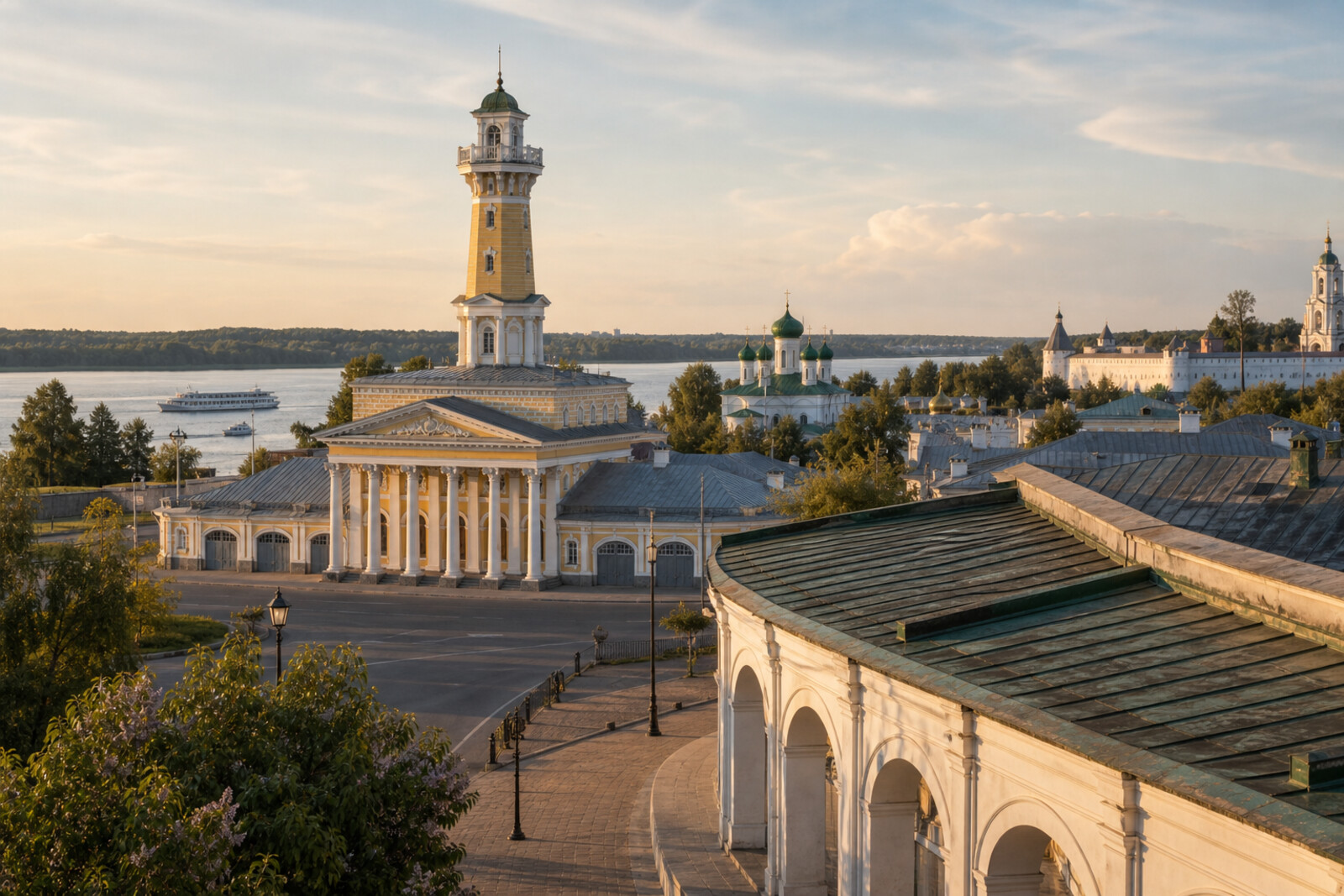
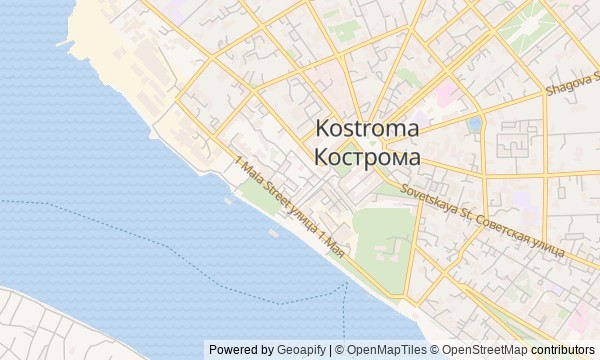
You will begin on Susanin Square. From its open semicircle, you will head up to the Fire Tower and the museum, then return to the arcades of the Red Rows. From there, you will cross the former Kremlin to the high Volga bank, descend to a parish church, and finish beyond the Kostroma River, at the walls of Ipatiev Monastery.
At the center of the route are formal facades, a market, and a restored cathedral; by the water, a pavilion, the embankment, and a seventeenth-century church. You will hear about people who never got to see the finished result: an architect without a post, a donor without a consecration, collectors without money. The story will test later legends against documents and notice what survived arguments, fires, and the dismantling of buildings.
By the end, you will be able to point out where the House of Romanov in Kostroma was the name of a museum, where it was a monument, and where it was a mother's difficult decision.
Why this order
The sequence moves from the dynasty's public image to the place of its real choice. Susanin Square first shows how monarchy was shaped into urban space; the Fire Tower at its edge immediately tests what imperial approval cost one architect. Prospekt Mira then leads to a museum where the dynasty's jubilee became a public institution. Returning to the Rows shifts from official patronage to merchant contracting, and beyond the arcades stands the Epiphany Cathedral of the Kostroma Kremlin, placing the commercial and religious centers side by side. A short walk along the former rampart leads to the Ostrovsky Pavilion: after the restored building, the vanished relief of the fortress becomes easier to see. You will then follow the Volga to a parish church built with merchant money back in the seventeenth century. The final crossing of the Kostroma River completes the idea: from the city's monuments to the House of Romanov, you will reach the monastery where sixteen-year-old Mikhail Fyodorovich Romanov had to decide whether to accept power.
People who enjoy urban history told through human choices Those who want to connect central Kostroma with the Volga and Ipatiev Monastery Those who value documents, caveats, and the fate of visible details
Those who want to keep to a short loop around the central square Those who find a long city walk and crossing a bridge on foot difficult Those primarily looking for a detailed overview of church interiors
Before you go
Check access in advance for the Romanov Museum, the Epiphany Cathedral of the Kostroma Kremlin, the Church of the Resurrection on the Debra, and Ipatiev Monastery. The route still works from the outside, but some important details are indoors. Choose appropriate clothing for churches and keep your headphones off during services; it is easier to finish the audio before entering or once you are back outside. Do not count a visit inside the Fire Tower or a climb to the top as a guaranteed part of the walk—those options need to be checked separately. Wear comfortable shoes and decide in advance whether you want to walk the whole way to the final stop.
When to go
Without extended visits indoors, allow about four hours. Stops at the museum, cathedrals, and within the monastery grounds will bring the walk closer to five hours, not including any waiting time. It is best to start in the first half of the day, leaving time for the long final stretch without cutting short the stops in the center.
Backup plan
If the weather turns or you have less energy, walk the central section from Susanin Square to the Volga bluff, skip the separate detour to the Church of the Resurrection on the Debra, and continue to the monastery by transport. A closed museum or church does not mean skipping the stop: the facade, the building's mass, and its position in the city support the main story. If you cannot enter Ipatiev Monastery, end the route before its walls and gates—the fortified refuge is what matters to Mikhail Fyodorovich Romanov's story. Save the inaccessible interiors for a separate visit.
Route conditions
Surface. Paved — 6.7 km; unpaved — 50 m (data covers 81% of the route)
Stairs. Flights: 2, 38 m in total
Access. Wheelchair — no; stroller — limited (stairs)
Facilities. Toilets — 6; drinking water — 2
Elevation. Ascent — 69 m; descent — 82 m
OpenStreetMap extract of July 3, 2026: database data, not a check on the ground. Data © OpenStreetMap contributors, ODbL licence
Walk plan
Open in maps ↗- 1
Susanin Square
Here you will see how a state monument changed its name, center, and composition of figures. - 2
Fire Tower
The stop will show what the emperor's praise was worth to an architect who had already lost the government post that supported him. - 3
Romanov Museum
Here, a dynastic jubilee meets the everyday work of a society that collected and preserved the city's antiquities. - 4
Red Rows
The arcades preserve the result of a dispute between the approved design and the decisions of an independent contractor. - 5
Kostroma Kremlin
This stop will link the saving of a shrine with the disappearance and later restoration of the cathedral ensemble. - 6
Ostrovsky Pavilion
Here, a documented visit will be distinguished from the later habit of associating the playwright with the present rotunda. - 7
Church of the Resurrection on the Debra
The story of a patron will show how a project unfinished during his lifetime became his memorial in the church. - 8
Ipatiev Monastery
The finale will recall the day when a mother’s fear collided with the demand to end the struggle for the throne.
Route features
Everything you need stays in the browser
Progress, saves and your trip plan are stored on this device.
Add Guide On Map to your home screen so the walk opens outside the browser.
How we handle sources, maps and corrections: our editorial standards