 Guide On Map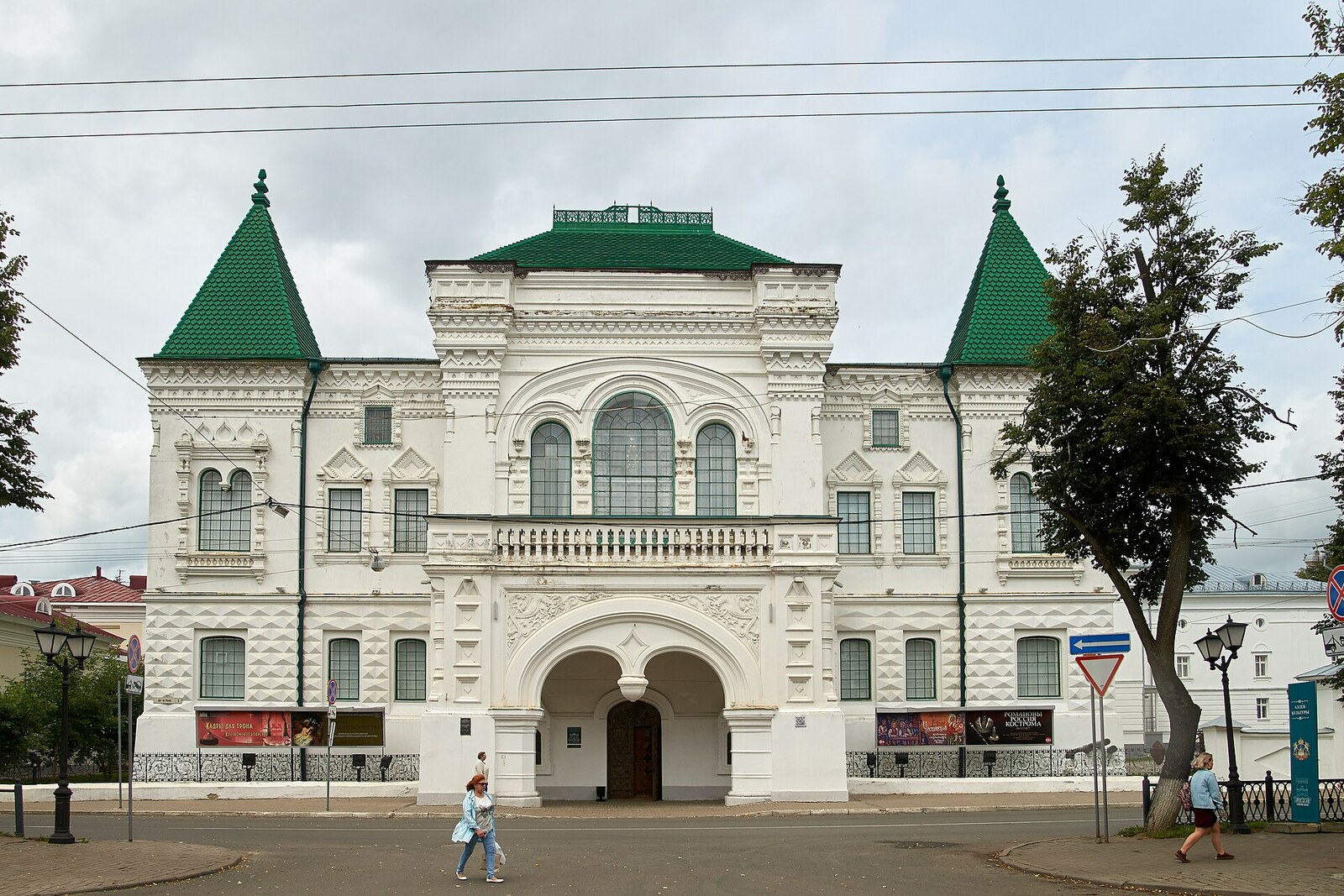
Look around first
What to notice
- Terem-style facade
- Balcony above the entrance
- Ornamental window surrounds
- The inscription “Romanov Museum”
The story of the place
The ornamental window surrounds, balcony, and terem-style facade belong to the building constructed for the governorate's collection of antiquities. Before that, the collection was crowded into two rooms of the neighboring Kostroma Assembly of the Nobility: the objects stood in cabinets, and chiefly researchers could work with them. Funds for the new building came from a private donation and subscriptions throughout the governorate; many forms were returned with a note that no donors had been found. Later, the local-history collections were taken to Ipatiev Monastery, while these rooms were occupied by paintings and Old Russian art.
On May nineteenth, nineteen thirteen, Nikolai II and his family became the first visitors to this museum. The emperor walked through rooms containing archaeological finds, coins, church antiquities, and peasant clothing. Only one department was devoted to the House of Romanov—the tsarist dynasty that began with Mikhail Fyodorovich Romanov. Yet it was this department's name that helped the collectors obtain a building.
The collection was created by the Kostroma Governorate Scholarly Archival Commission—a society of local historians that sorted through old records of local institutions, saved documents designated for destruction, conducted excavations, and accepted donated antiquities. The commission's chairman, Nikolai Selifontov, was a senator and pursued history at his own expense: he sorted through family archives and paid for their publication. Thanks to his petition, the nobility ceded the commission two rooms in the neighboring Kostroma Assembly of the Nobility, and in eighteen ninety-one the first museum in the governorate opened there. The objects were kept in cabinets and made available chiefly to researchers.
Selifontov wanted to move the collection out of these rooms and make it public. At the same time, he proposed creating the Romanov Department—to search for documents about the ancestors of Mikhail Fyodorovich Romanov and his family's ties to the Kostroma region. Imperial patronage gave researchers access to closed state archives. Permission to open the department was granted in eighteen ninety-seven: the word “Romanov” entered the museum's history sixteen years before Nikolai II's visit.
Obtaining a separate building proved more difficult. The first design was prepared in eighteen ninety-nine, but no money was found for construction. Selifontov died without seeing the museum for which he had sought premises and brought people together. The effort could be resumed in nineteen eight, when Grigory Yudin, a manufacturer and bibliophile from Krasnoyarsk who came from a Kostroma family, donated ten thousand rubles—one tenth of the estimate at the time.
The remaining money was raised through subscription sheets. Local officials sent about two thousand forms around the governorate; one thousand two hundred sixty-four were returned, and many bore the note that no one in that volost wished to donate. Nikolai II ordered another thirty-five thousand rubles to be issued for finishing work, furniture, and preparing the exhibition. This sum made it possible to complete the work in time for the dynasty's three-hundredth anniversary. The terem-style facade with its balcony belongs to the design personally selected by the emperor.
After the ceremony, the founders asked for permanent paid positions to be established. The Ministry of Internal Affairs replied with one condition: the commission had to transfer the museum to the Ministry of Public Education and give up independent control of the collections. Alexander Chernitsyn, secretary of the construction committee, objected that the museum and the society of researchers formed a single whole. The conditions were not accepted, and no permanent funding was received. The commission's meetings nearly ceased, its council lost its powers, and temporary custodians had to watch over the objects. In nineteen seventeen, the museum was transferred to the city, and another Kostroma Scientific Society then took charge of it.
In nineteen fifty-six, the local-history departments were moved to Ipatiev Monastery, while the art collection remained here. The building's official name today is the Art Museum, or Romanov Museum. Inside, paintings and Old Russian art are displayed; outside, the facade selected by Nikolai II remains, and above the entrance is the name of the department Selifontov devised for documents about the ancestors of the dynasty's first tsar.
Useful on site
Daily 11:00–19:00.
Checked: September 24, 2026. Check the official source before visiting.From outside, you can examine the building's jubilee image. To see the collection, check museum access in advance and allow extra time.