 Guide On Map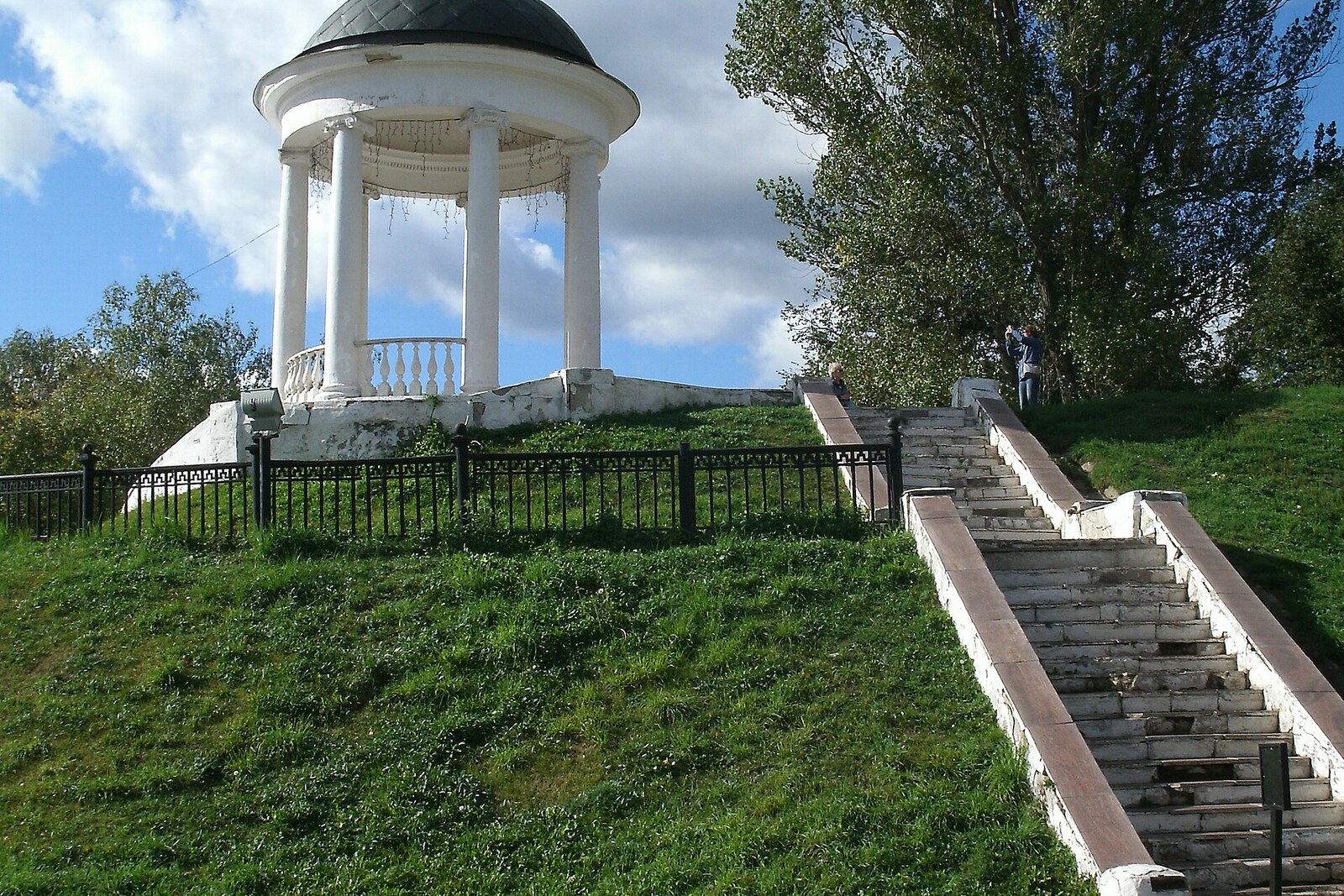
Look around first
What to notice
- Seven columns
- Hemispherical dome
- Balustrade
- Volga
The story of the place
Maly Boulevard stretches toward the Volga along the preserved part of the old Kremlin embankment. When the earthworks were leveled and the moats filled in, a public garden and a walking route to a high riverside platform were laid out here. It is now finished by a rotunda with seven columns, a balustrade, and a hemispherical dome. The boulevard once continued farther toward the water, but the railway shortened the embankment along with the former viewing platform.
Ostrovsky never stood beneath these seven columns. The stone rotunda was built in nineteen fifty-six—seventy years after the playwright's death. It inherited his surname from another pavilion, a wooden one that stood closer to the Volga.
That pavilion appeared thanks to the Kostroma governor Karl-Wilhelm Baumgarten. At the beginning of the nineteenth century, he ordered the old Kremlin earthworks to be partly leveled, the moats filled in, and a public garden laid out here. A narrow Maly Boulevard was extended along the remaining embankment toward the river, with a pavilion at its end. The townspeople were given a walking route ending at a high viewing platform above the Volga.
In the spring of eighteen forty-eight, twenty-five-year-old Alexander Ostrovsky came here. He was not yet a famous playwright. His plays did not support him: at his father's insistence, Ostrovsky worked as a clerk at the Moscow Commercial Court, which examined merchants' transactions, while receiving lodging and meals at his parents' home. He obtained twenty-eight days of leave to accompany his family to Shchelykovo, the estate his father had bought at auction.
In Kostroma, the young clerk climbed Maly Boulevard and entered the wooden pavilion. Below, barge haulers pulled a barge. Ostrovsky recorded both their song and his exact impression of the platform in his diary: “The view from this pavilion downriver and upriver along the Volga is unlike any we have seen before.”
This entry connected the pavilion with his name. It is unknown whether the name appeared by an official decision or first took hold in the speech of Kostroma residents. One thing is certain: Ostrovsky was remembered here for one documented visit, not for working on a play beneath this dome.
In the summer of nineteen thirty-two, builders were laying a railway branch along the shore. The wooden pavilion was dismantled, much of the embankment stretching toward the Volga was leveled, and the boulevard became shorter. Twenty-four years later, urban planners were deciding how to finish the remaining embankment and chose the stone design by architect Gennady Zosimov over a wooden pavilion. This is how the present seven columns, balustrade, and hemispherical dome appeared.
The old pavilion and the end of the embankment on which it stood disappeared. The present rotunda stands a little farther from the water. Ostrovsky's name was moved here together with the view he recorded in his diary.
Useful on site
It is more convenient to listen near the pavilion, without blocking the passage or disturbing others looking at the river. The panorama, rather than entry into the structure, matters for this story.