 Guide On Map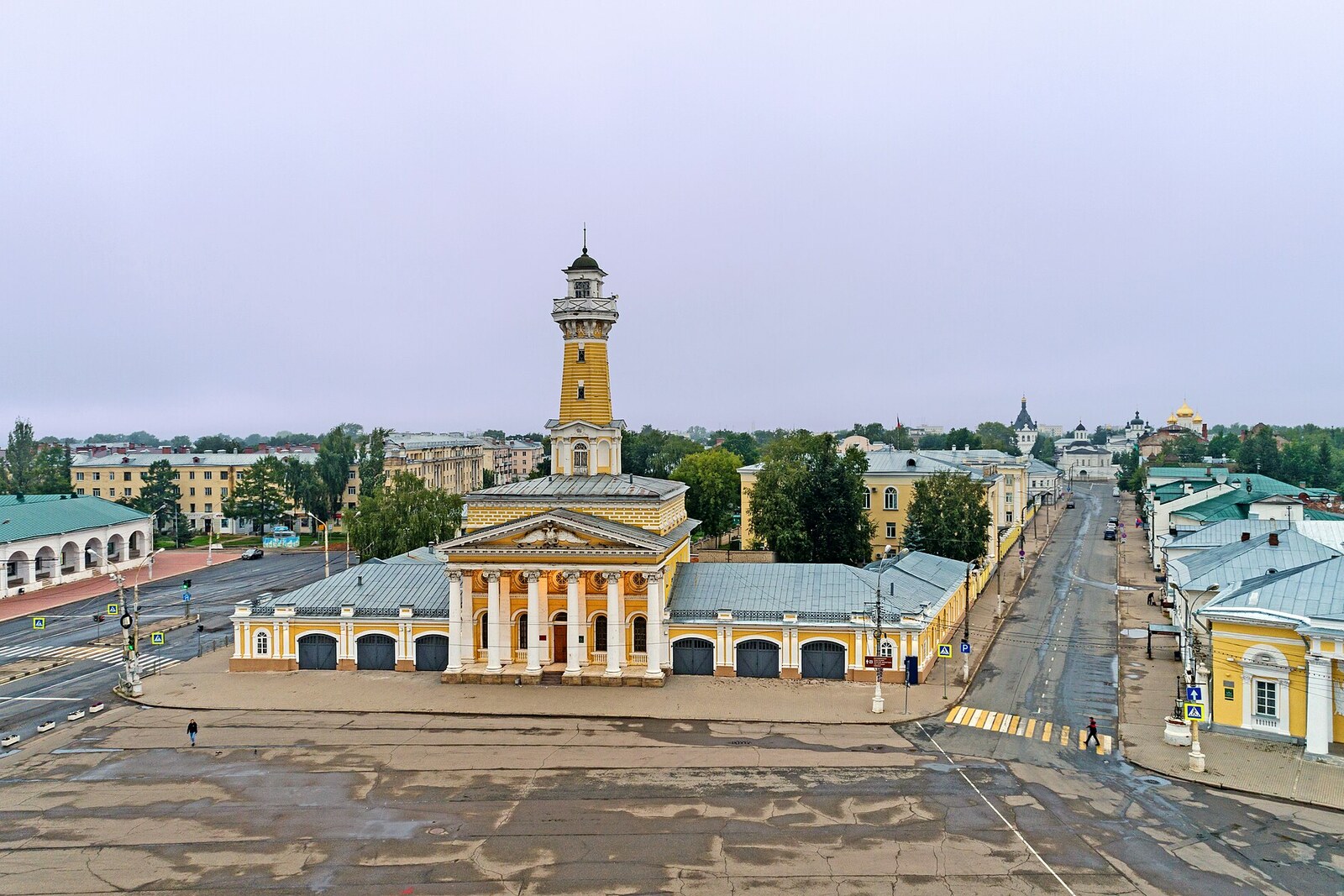
Look around first
What to notice
- Six-column portico
- Triangular pediment
- Octagonal lookout tower
- Side wings of the former depot
The story of the place
Six columns raise the facade of the former fire depot above the square, and an octagonal lookout tower stands above the pediment. Below, the on-duty brigade lived alongside horses, water barrels, pumps, ladders, and hooks. The watchman spotted smoke above the rooftops, gave the signal, and the horse-drawn fire train set out for the required district. Side wings were added to the building later, and its rooms are now occupied by the museum's excursion department.
In eighteen twenty-three, Karl-Wilhelm Baumgarten, the governor of Kostroma, decided to assemble the city's first professional fire brigade here. It needed a place from which a watchman could see the roofs of Kostroma and the horse-drawn fire train could quickly set out for any district. A suitable site was found on Ekaterinoslavskaya Square—what is now Susanin Square—beside the city police, which oversaw the firefighters. The land belonged to Captain Sumarokov. Baumgarten ordered it bought out: he saw no other suitable site in the center.
The governor gave the provincial architect Pyotr Fursov two tasks. The Fire Tower was to protect city residents during fires and adorn the square. Fursov combined a fire depot with the facade of an ancient temple: six columns support a pediment, and above them rises an octagonal lookout tower. Construction proceeded from eighteen twenty-four through eighteen twenty-seven.
The firefighters lived and kept watch in the lower rooms; in the courtyard stood horses, water barrels, hand pumps, ladders, and hooks. A watchman kept watch over the city from the tower. When he noticed smoke, he rang a bell and raised a signal ball, or a lantern at night. At the signal, the brigade led out the horse-drawn fire train. At first, about twenty men served in it. Later the firefighters ran out of space: in the eighteen seventies, side wings were added to the building for the Main Fire Depot.
By then Fursov had already lost the government post that supported him. The new governor, Sergei Lanskoy, wanted to get rid of the architect and called his work useless. In eighteen thirty-one, the ministry dismissed Fursov “for lack of corresponding knowledge in architecture” and because he managed construction affairs slowly. After his dismissal, he scraped by on private commissions.
Three years later, Nikolai I came to Kostroma. The emperor studied the Fire Tower for a long time and, according to a contemporary's recollections, said: “I have no such one in St Petersburg.” The praise did not restore Fursov's post. Information about his final years trails off; all that is known is that by the end of the eighteen forties, he was no longer alive.
In two thousand five, the firefighters handed the building over to a museum. An excursion-and-tourism department now operates there, and above the former stables, guard rooms, and sheds for barrels remains the tower designed by an architect who was dismissed for a lack of architectural knowledge.
Useful on site
Fire Tower 10:00–18:00; the Archaeological Portal tour requires advance booking.
Checked: September 24, 2026. Check the official source before visiting.The main architectural details are clearly visible from the square. Access inside and the possibility of going up must be checked and arranged separately.