 Guide On Map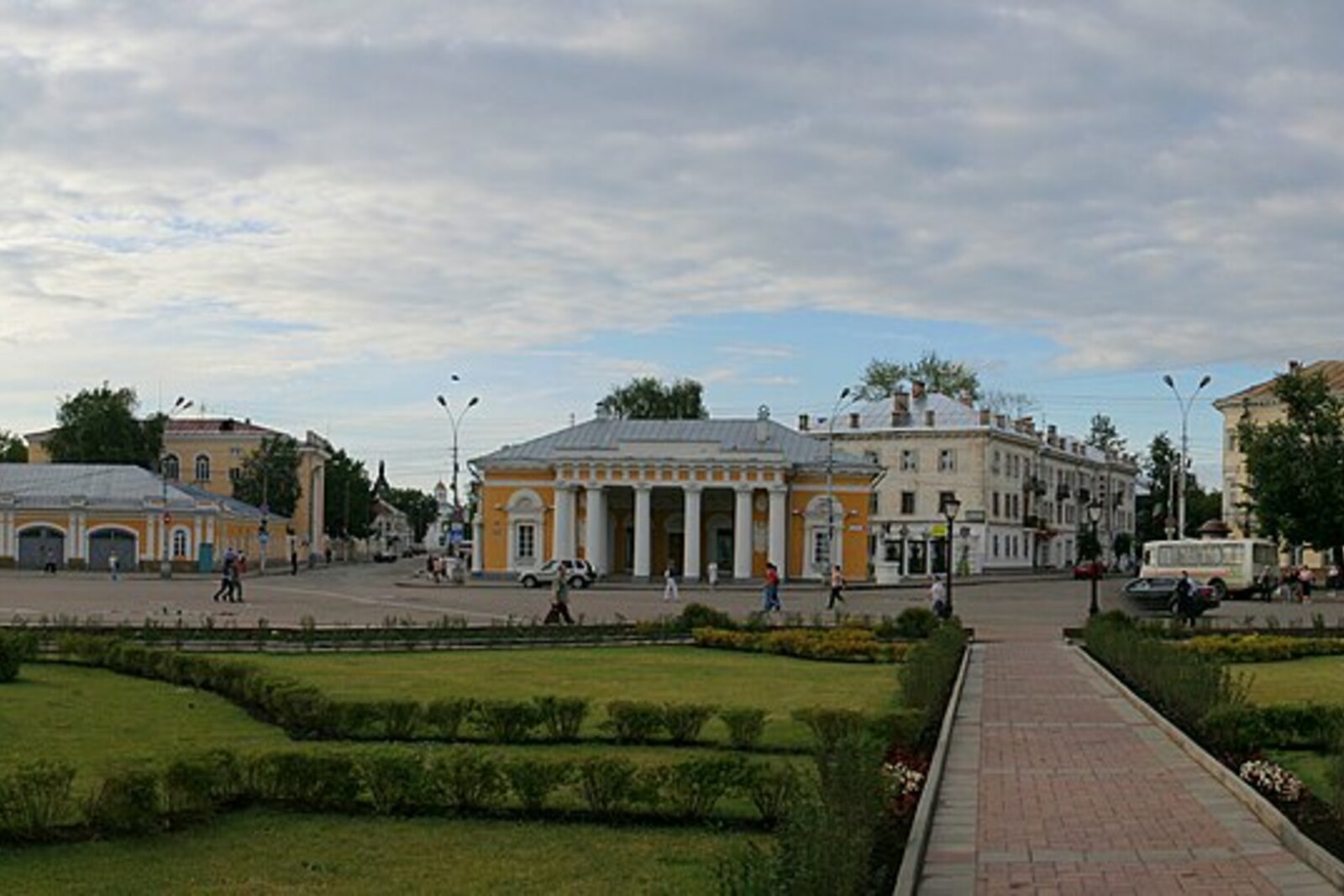
Look around first
What to notice
- Semicircular line of facades
- Radial streets
- Red Rows by the descent
- Ivan Susanin Monument
The story of the place
Susanin Square took its name from a monument that is no longer in its center. The site for it was prepared long before the idea itself appeared. After the fire of seventeen seventy-three, planners from the capital laid out a semicircle here, opening toward the Volga, and brought the main streets together at it. Merchants occupied the side by the descent with Red Rows, and officials the opposite side with government buildings. People still cross the square along those same directions today; fairs are held by the rows, and the open space is used for city celebrations.
In the autumn of eighteen thirty-four, Kostroma's nobility learned that Nikolai I was coming and gathered to prepare a petition for the emperor. They sought a monument to Mikhail Fyodorovich Romanov, the first tsar of the House of Romanov. At first, it was to be placed at Ipatiev Monastery. Nikolai gave permission to begin the undertaking, but required that the money first be raised and a design submitted. At the same time, a proposal arose to include Ivan Susanin in the monument. The emperor combined the two fund-raising efforts into one and chose the central city square. Soon, the former Ekaterinoslavskaya Square was renamed Susanin Square.
Ivan Susanin was a peasant from the village of Domnino, which belonged to the House of Romanov. For a peasant of his time, land meant both his family's livelihood and tax dues; after Susanin's death, his relatives were compensated with land. The firmly known part of the story was recorded in a tsar's charter of sixteen nineteen. Six years earlier, Polish and Lithuanian people seized Susanin and, by torture, tried to make him reveal the whereabouts of the recently elected Tsar Mikhail. Susanin knew where Mikhail was hiding, but did not tell them and was tortured to death. The account of how he volunteered to be a guide and led the detachment into an impassable swamp appeared later: it is a legend, and the charter mentions neither a guide nor a swamp.
Mikhail survived and became the first tsar of the House of Romanov. On his mother's advice, he granted Susanin's son-in-law Bogdan Sobinin half of the village of Derevnishchi and exempted that land from taxes and obligations forever. The exemption was inherited by the children and grandchildren. The descendants were called Korobov Belopashtsy, peasants who owned land without the usual tax dues.
The sculptor Vasily Demut-Malinovsky brought this outcome to the very center of the square. At the top of a granite column stood a bronze bust of the young Mikhail Fyodorovich Romanov. Below, at its base, Susanin prayed on his knees; beside him lay two scrolls of charters granting privileges to his family. A bas-relief depicting the murder of the peasant was placed on the pedestal. Nikolai I personally approved this exact arrangement of the figures.
The unveiling was scheduled for March eighteen fifty-one, on the anniversary of Mikhail's consent to accept the throne. More than thirty thousand people filled the square, the roofs of the Red Rows, balconies, and windows. Among the invited guests stood the Korobov Belopashtsy: the descendants came to the monument because of the very charters that the sculptor had placed at their ancestor's bronze knees.
The monument stood here for sixty-seven years. In September nineteen eighteen, the city executive committee ordered both figures removed. Mikhail's bust and Susanin's statue did not survive. The column and pedestal were covered by a wooden reviewing stand; its fabric tore, and the words of the old inscription began to show through again beneath it. Ten years later, the column was buried here, within the monument's fence, and was later discovered accidentally during roadworks.
In the late nineteen sixties, the figure of Susanin was placed on the opposite side of the square, by the descent to the Volga. There he is depicted alone, standing at full height and holding a staff. The old center was left without Mikhail and the kneeling peasant. In November two thousand twenty-five, the surviving granite column was moved to the entrance of the Epiphany Cathedral of the Kostroma Kremlin.
Useful on site
This stop takes place entirely in the open air. Choose a spot from which you can see both the square and several streets radiating away from it.