 Guide On Map
Old Tatar Settlement: Lake Kaban, Merchants, and the Tatar Stage
From the New Kamal Theatre through the settlement to the Karim Tinchurin Theatre
Guide On Map on your phone
Open the walk like a regular app
It takes about 10 seconds to install. No app store needed.
The whole path
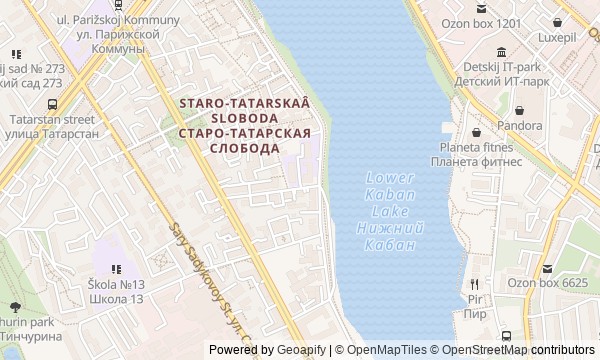
Route map
About the walk
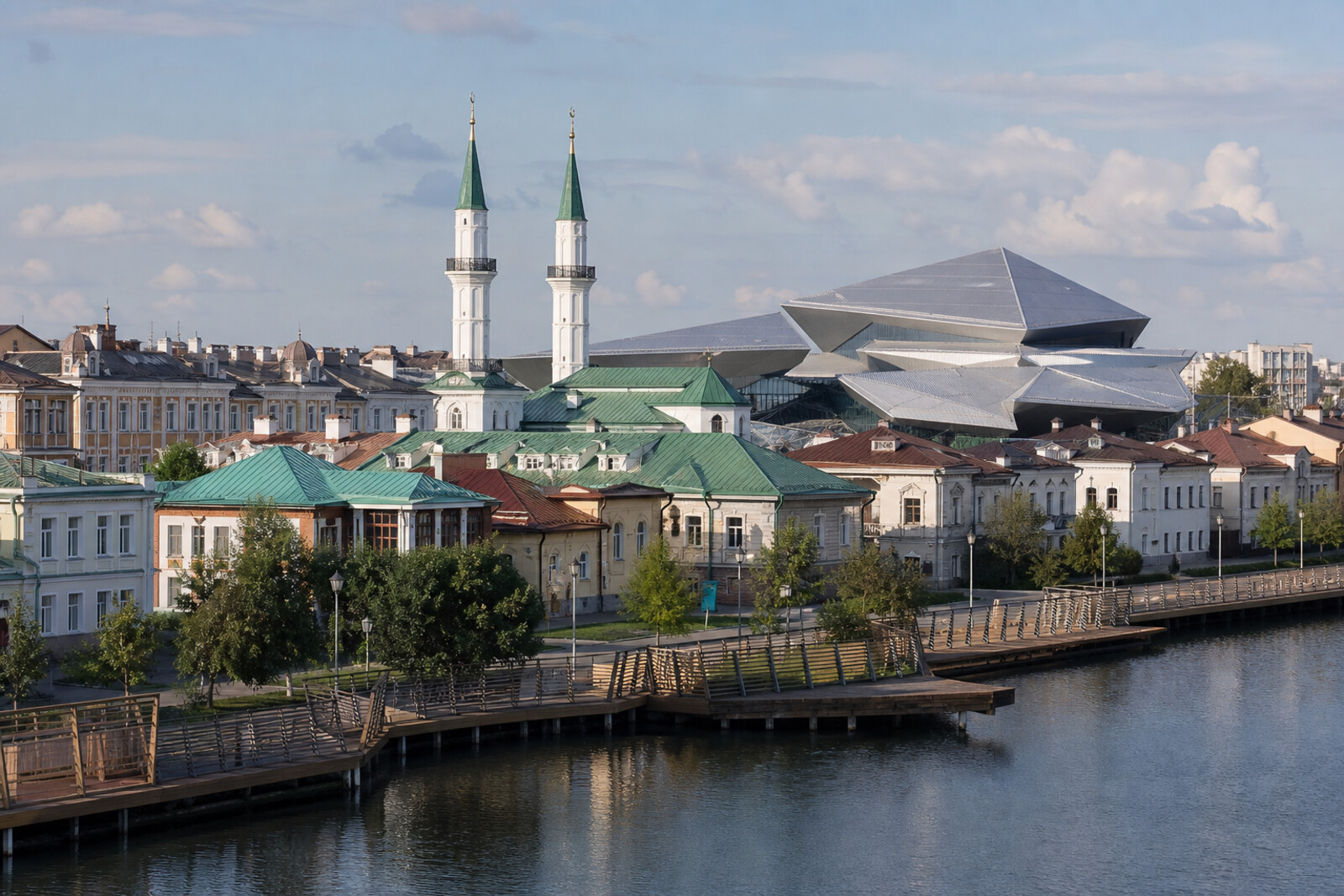
You will begin at the New Kamal Theatre on the southern shore of Lake Kaban. The route leads to Yunusov Square, then through the Old Tatar Settlement—past merchants' houses, working mosques, a madrasa, and a small museum in a restored house. It ends at the Former Kamal Theatre Building at the far end of the lake.
This is a walk through a district where trading money paid for prayer halls, classrooms, books, and the stage. You will come across a mansion whose familiar name differs from the archival record of its owner. You will find out why a wealthy couple carried bricks alongside the workers, and why shopkeepers would not leave their stalls even for communal prayer.
The story is unhurried, without the usual sightseeing grandeur. It separates documents from city memory. By the end, you will be able to explain how Lake Kaban, merchants' courtyards, mosques, a Tatar school, and 2 theatres made the Old Tatar Settlement into a city of its own inside Kazan.
Why this order
The beginning and the end face one another across Lake Kaban: the new and former homes of the Galiaskar Kamal Theatre frame the whole walk. From the New Kamal Theatre, the route heads to the House of Shamil, because the residential, merchant quarter of the settlement begins beyond the shore. From Yunusov Square, the nearby Apanaevskaya Mosque shifts the story from a private house to a congregation built with trading money. Further along the same street, Marjani Mosque shows how a dispute and an independent madrasa emerged beside a prayer hall. The Qayum Nasiri Museum continues the theme of education on the scale of 2 rooms; Galeev Mosque and Muhammadiya Madrasa expand it into a large school. Nurulla Mosque places this system beside a vanished market, where the community depended on the working day of its merchants. From the former stalls, it is only a short walk to the northern tip of Lake Kaban: the Karim Tinchurin Theatre closes the route with the story of a building visible from the very first stop.
Those who have already seen the Kazan Kremlin and want to understand Tatar Kazan beyond its best-known postcards Those interested in the merchants' city, Islamic education, and Tatar theatre Those who enjoy closely drawn human stories tied to surviving buildings
Those looking only for a walk through the ceremonial city center Those uninterested in religious and educational stories Those who prefer brief summaries to fully developed stories
Before you go
Check access to the Tukay Museum and Qayum Nasiri Museum separately before you go. The route does not depend on going inside, but a visit adds considerable detail. Theatre interiors and performances also require independent planning. The mosques along the route are religious spaces, not museum scenery: choose modest clothing, remove your shoes where customary, and women should bring a headscarf. Do not enter during communal prayer unless necessary, do not photograph worshippers, and ask permission before taking photos inside. Bring headphones: much of the story is easy to hear from the street or a courtyard, without disturbing worshippers or visitors.
When to go
Start during the day, so you have time to look at the facades, courtyards, and both shores of Lake Kaban in natural light. Check the current opening hours of museums and theatres before setting out. Do not plan mosque visits for Friday communal prayer; if it coincides with your walk, simply view the building from outside and continue along the route.
Backup plan
If it is windy or slippery by the water, or access along the embankment is limited, do not force yourself to follow the shoreline: keep the order of the stops and travel between them on city streets. If a museum is closed, use the story as a companion to the facade—at the House of Shamil, the architectural fantasy matters; at the Qayum Nasiri Museum, the restored appearance itself recalls the loss of the original. The mosques can also be meaningfully explored from outside without intruding on congregational life. In bad weather, spend less time by Lake Kaban, but keep the beginning and the end: the comparison between the 2 theatre buildings holds the composition of the whole walk together.
Route conditions
Surface. Paved — 2.5 km; unpaved — 100 m (data covers 66% of the route)
Access. Wheelchair — limited; stroller — limited
Facilities. Toilets — 3
Elevation. Ascent — 20 m; descent — 14 m
OpenStreetMap extract of July 3, 2026: database data, not a check on the ground. Data © OpenStreetMap contributors, ODbL licence
Walk plan
Open in maps ↗- 1
New Kamal Theatre and the southern shore of Lake Kaban
This stop connects the modern waterfront with the return of the lake to the city and the theatre to its audiences. - 2
House of Shamil — Tukay Museum
The mansion shows how a private home became an address of remembrance for a poet who never lived here. - 3
Apanaevskaya Mosque
Here you will see how one builder's efforts and the support of several generations created a lasting congregation. - 4
Marjani Mosque
This stop turns the neighboring mosque and madrasa into the story of a dispute over a school and the right to run it. - 5
Qayum Nasiri Museum
This small house shifts the conversation from parish schools to private work on the Tatar language. - 6
Galeev Mosque and Muhammadiya Madrasa
Here, the personal choice of a merchant’s son will grow into a system of education for hundreds of students. - 7
Nurulla Mosque and Sennoy Bazaar
This stop connects the organization of the congregation with the daily routine of a vanished marketplace. - 8
Karim Tinchurin Theatre
The finale will bring together on one stage two moves, two companies, and a long struggle for workable space.
Route features
Everything you need stays in the browser
Progress, saves and your trip plan are stored on this device.
Add Guide On Map to your home screen so the walk opens outside the browser.
How we handle sources, maps and corrections: our editorial standards