 Guide On Map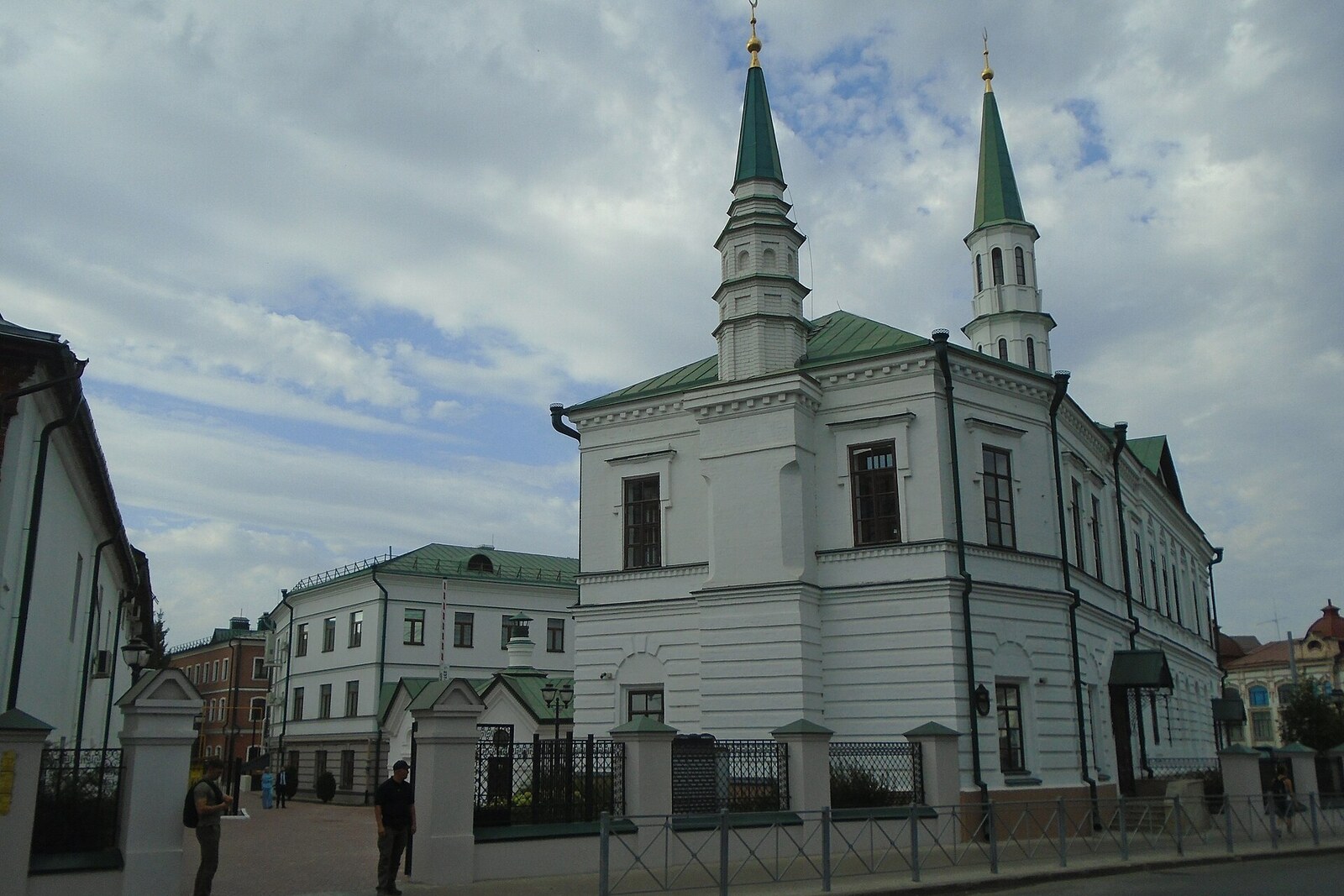
Look around first
What to notice
- The minaret of Galeev Mosque
- The stone prayer building
- The buildings of Muhammadiya Madrasa
The story of the place
The minaret rises above the mosque’s stone building, and the educational buildings of Muhammadiya Madrasa stand nearby. The congregation still gathers here for prayer, while future imams and teachers receive their education next door. The madrasa grew from a small stone house used for classes at the mosque; later, it needed new buildings and teaching materials when students began arriving from different parts of the Russian Empire. Its name preserves the memory of the merchant who paid for the first premises.
The merchant Musa Mamyash paid for the construction of this mosque in seventeen ninety-eight; it was completed by eighteen oh one. People in Kazan called the building Musa-bay Mosque and the Fifth Cathedral Mosque. It came to be called Galeev Mosque later, after the actual surname of Imam Galimjan Barudi.
Twenty-five-year-old Galimjan Galeev returned to Kazan after seven years of study in Bukhara and, in eighteen eighty-two, received the position of second imam here. He led prayers and taught lessons at the mosque. He had a reliable way to earn money very differently: his father, Muhammadjan Galeev, owned a factory making Tatar footwear and headwear and traded in several cities. Later, Galimjan wrote plainly that he had turned away from his father’s business for the sake of books and teaching.
Muhammadjan used part of his trading capital to support his son’s choice. He paid for a one-story stone building beside the mosque, and in eighteen eighty-three Galimjan began classes there. The madrasa was named Muhammadiya in honor of Muhammadjan; official papers also used another name: Galeev Madrasa.
After a trip to the Ottoman Empire, Egypt, and Mecca, Barudi reshaped the education. Beginners were taught to read by sounds, rather than putting the names of letters together into syllables. Barudi compiled primers and required students to understand a short text rather than memorize long phrases without analyzing them. The Quran, hadiths, and Islamic law remained in the curriculum, but he gave about half of the instructional time to mathematics, geography, natural science, medicine, history, and pedagogy. Here, for the first time among madrasas in the Russian Empire, the Tatar language began to be taught as a separate subject.
Students came from different parts of the Russian Empire. By the beginning of the twentieth century, their number had grown to more than eight hundred. Benefactors paid for new buildings and teaching aids, while Barudi trained people who, after graduating, became imams and teachers and introduced the same method of education in other towns and villages.
In nineteen oh seven, Barudi organized summer courses here for teachers at Tatar schools. After a teachers’ congress, he was detained: officials saw political agitation in these ties among Muslim educators. The following year, Barudi was exiled to Vologda Governorate. His brother Gabdrakhman took over the leadership of the madrasa, and the students continued their classes. Galimjan later returned to Kazan and again took up teaching and publishing textbooks.
Today, prayers are held at Galeev Mosque, while the neighboring buildings of Muhammadiya train imams and teachers. The madrasa retains Muhammadjan’s name; the mosque bears the surname of the Galeev family, whose son began teaching at this very congregation.
Useful on site
The mosque is active; the madrasa is an educational institution, not a museum site open for unrestricted visits.
Checked: date not specified. Check the official source before visiting.Do not enter educational and service rooms without an invitation. Visit the mosque according to the same rules of respectful conduct as at the previous religious stops.