 Guide On Map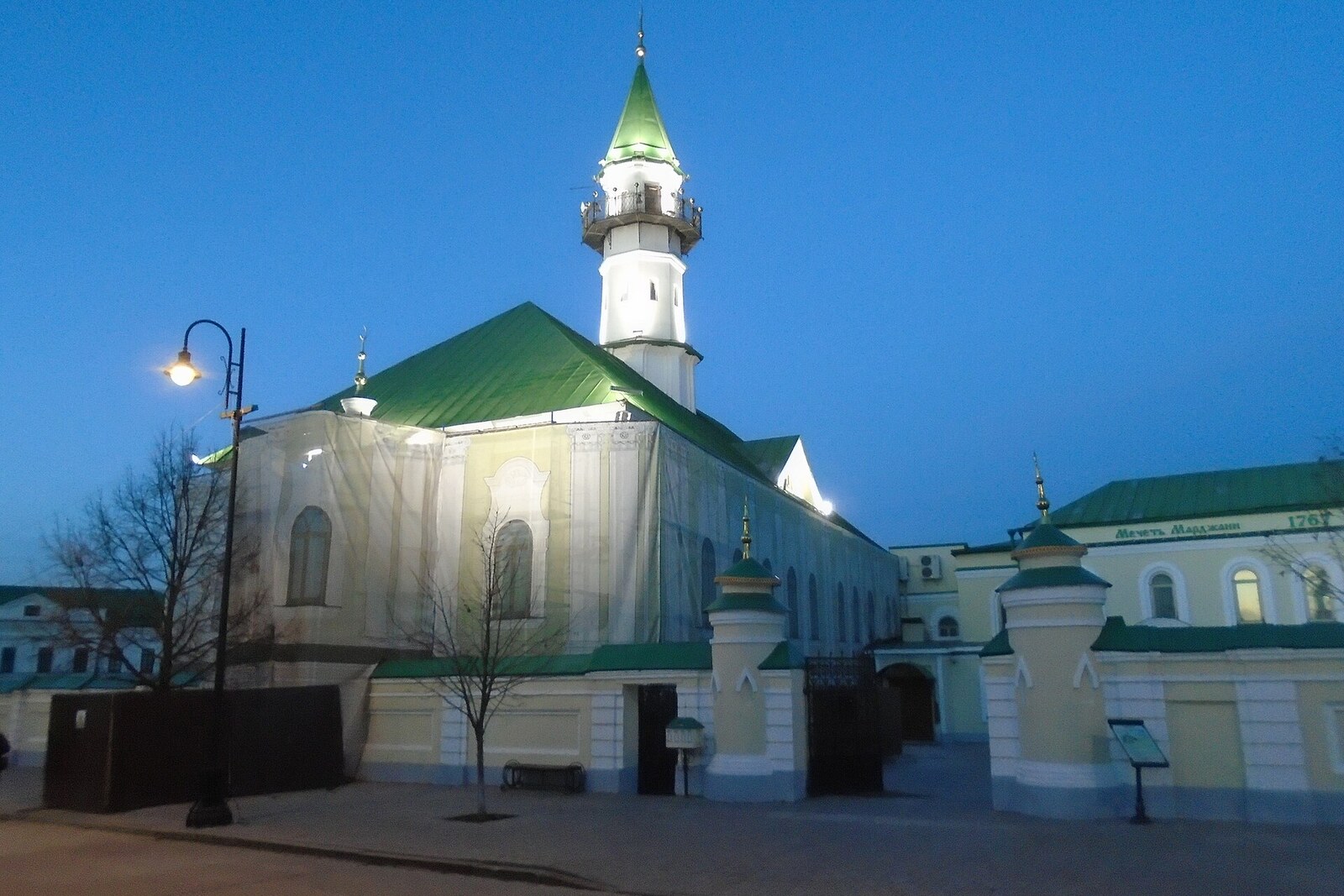
Look around first
What to notice
- The minaret above the gabled roof
- The northern brick extension
- The madrasa building across Zaini Sultan Street
The story of the place
The minaret rises directly from the gabled roof, and a later brick section adjoins the north wall. The congregation still gathers at the active Marjani Mosque. Across Zaini Sultan Street, young men from the congregation studied at the madrasa, the school attached to the mosque; the building, restored with donations, is now occupied by Kazan Islamic College.
The building was initially called the First Cathedral Mosque: people gathered here for the communal Friday prayer. It was built between seventeen sixty-six and seventeen seventy with money from the congregation, after receiving permission from Catherine the Second. It was one of the first stone mosques in Kazan built after the city was captured in the sixteenth century.
Later it acquired another name—Yunusovskaya. The Yunusov merchants were not among the first builders, but in the nineteenth century they paid for the imams’ upkeep, repairs, and the building’s expansion. Ibragim Yunusov, Kazan’s wealthiest Tatar merchant and the informal head of the congregation, was accustomed to choosing for himself the people on whom the community’s life depended.
In the winter of eighteen forty-nine, Yunusov invited Shigabutdin Marjani here—a young theologian who had returned after many years of study in Bukhara and Samarkand. Yunusov wanted the best teacher for his congregation. After examinations, Marjani was confirmed as imam-khatib and mudarris: he led the Friday prayer, delivered sermons, and directed the teaching at the mosque.
Marjani rebuilt the curriculum. The students studied the works of theologians and, alongside religious subjects, learned mathematics, astronomy, and history. More than one hundred young men attended the madrasa. The teacher’s reputation grew, yet his salary, the premises, and the very possibility of teaching depended largely on the Yunusovs’ money.
In eighteen seventy, Ibragim Yunusov refused to pay for a new building for the madrasa. Marjani appealed to other merchants in the congregation. They raised the money, bought a plot opposite the mosque, and created a board of trustees that managed donations without the Yunusovs’ involvement. In eighteen seventy-one, a new two-story madrasa appeared here.
The Yunusovs responded by building a school of their own. Two madrasas operated in the same congregation at the same time and competed for students. According to Marjani’s memoirs, there were several attempts to set fire to his building. In eighteen seventy-five, while the congregation was at prayer in the mosque, it burned down; many books perished with it. Marjani did not name the arsonists, so the fire cannot be attributed to the Yunusovs.
The merchant Akhmetzyan Rakhmatullin repaired the surviving part, and classes resumed. Then the congregation raised money again and, by eighteen eighty-one, built a stone madrasa. The Yunusovs’ school soon closed, while the one created by Marjani’s supporters continued to operate. The merchant stopped supporting his former protégé, Marjani was temporarily stripped of his position, but he remained the imam of this congregation until his death. When Ibragim Yunusov himself died in eighteen eighty-six, Marjani performed the funeral prayer over him.
After the imam’s death at the end of the nineteenth century, the name Marjani became attached to the mosque. The brick northern extension still belongs to the works paid for by Yunusov. Across Zaini Sultan Street stands the madrasa restored with donations from the congregation; it now houses Kazan Islamic College. And the active mosque itself bears the name of the man Yunusov invited here, who remained here until the end of his life after breaking with him.
Useful on site
An active mosque; access to the courtyard and inside is subject to the prayer schedule, with no separate visitor schedule.
Checked: date not specified. Check the official source before visiting.Do not enter during the communal prayer just to view the interior. You can listen to the entire story from outside without disturbing the mosque’s usual rhythm.