 Guide On Map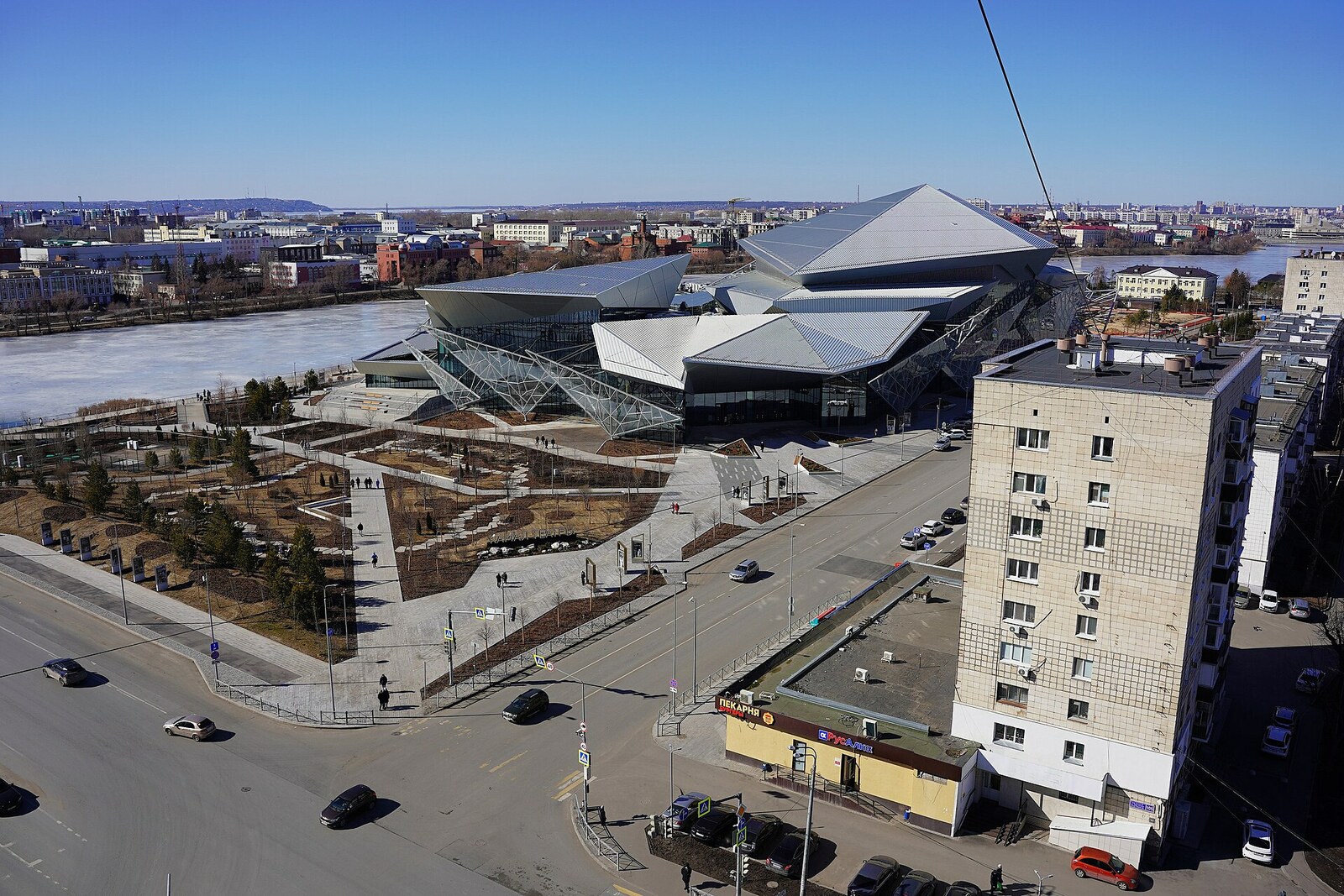
Look around first
What to notice
- Glass triangles on the facade
- Cascades of shoreline plants
- Amphitheater and pier
- Former Kamal Theatre Building across Lake Kaban
The story of the place
In nineteen eighty-seven, the hydrobiologist Nafisa Mingazova stood on the shore of Lower Lake Kaban and cried. After an emergency discharge, dead fish lay on the surface. A few years earlier, Mingazova and her colleagues had been working toward exactly the opposite: restoring oxygen and fish to a lake already called dead.
For her, it was personal work. Mingazova grew up on Lake Kaban, practiced competitive rowing, and became a Master of Sports. The study of lakes became the start of her scientific career and the subject of her Candidate of Sciences dissertation. She knew this body of water both from a boat and through laboratory samples.
By the early nineteen eighties, almost all the fish in Lower Lake Kaban had disappeared. Since the second half of the nineteenth century, wastewater had been discharged here through factory and city pipes. Polluted silt accumulated on the bottom, while the connection with other bodies of water was gradually disrupted. Twenty-five wastewater outlets were counted in the lake system.
Mingazova's publications and public attention helped secure a resolution on restoring Lake Kaban. Scientists joined a special commission. Under its program, the outlets were sealed with plugs or filled with concrete, deposits were removed from the bottom, the water was oxygenated, and water flow was restored. The extremely polluted lake moved into the moderately polluted category, and fish reappeared.
People on the shore needed the result as well. Across the water, the Former Kamal Theatre Building is visible from here. By its opening in nineteen eighty-six, the lake no longer had the former hydrogen sulfide smell that made residents try to leave for somewhere farther away in spring. The following year's accident destroyed part of what had been done, but Mingazova continued her work and later assembled a laboratory that took up the restoration of urban bodies of water. The present cascades of shoreline plants along the waterfront also do practical work: they were arranged as biofilters for the water.
At the beginning of the twentieth century, the area by the southern tip of Lake Kaban looked different. The eastern shore was low and flooded in spring, and city maps marked wet hay meadows here. Dense development bypassed this place for a long time. Now the New Kamal Theatre's four stages stand here, and a public space has been created among them, the foyer, terraces, amphitheater, and pier, open even when there are no performances.
The name on the facade belongs to Galiaskar Kamal, a playwright, translator, and one of the organizers of Tatar theatre. He worked to bring the Tatar language from home circles onto the public stage. On December twenty-second, nineteen oh six, Kamal helped prepare the first public performance in the Tatar language in Kazan. The initiative begun then grew into a professional troupe, and in nineteen thirty-nine the theatre was named after Kamal.
At the opening of the new building on January twentieth, two thousand twenty-five, the troupe's oldest actor, Ravil Sharafiev, brought onto the stage the key that had opened the former theatre on the other shore on November fifth, nineteen eighty-six. Sharafiev passed it to the youngest performer, Asfandiyar Shamsuarov. On March first, audiences came here for the first performances, concerts, and tours.
The glass triangles of the new facade were designed in the shape of ice flowers that form on Lake Kaban in winter. The troupe's former home remains visible across the lake: the architects repeated its triangular geometry in the facets of the New Kamal Theatre.
Useful on site
The outdoor areas are accessible as public urban space; entry inside is with a ticket for an event or on an announced tour.
Checked: date not specified. Check the official source before visiting.Viewing the building from the shore is enough to get acquainted with its architecture. Plan a performance or a visit to the interior spaces separately.