 Guide On Map
Swayambhunath: the eastern ascent and the hill's shrines
From Bhagwanpau up the eastern stairs to the Karma Kagyu monastery
Guide On Map on your phone
Open the walk like a regular app
It takes about 10 seconds to install. No app store needed.
The whole path
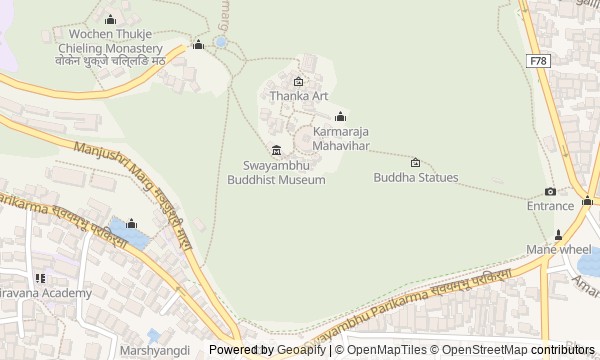
Route map
About the walk
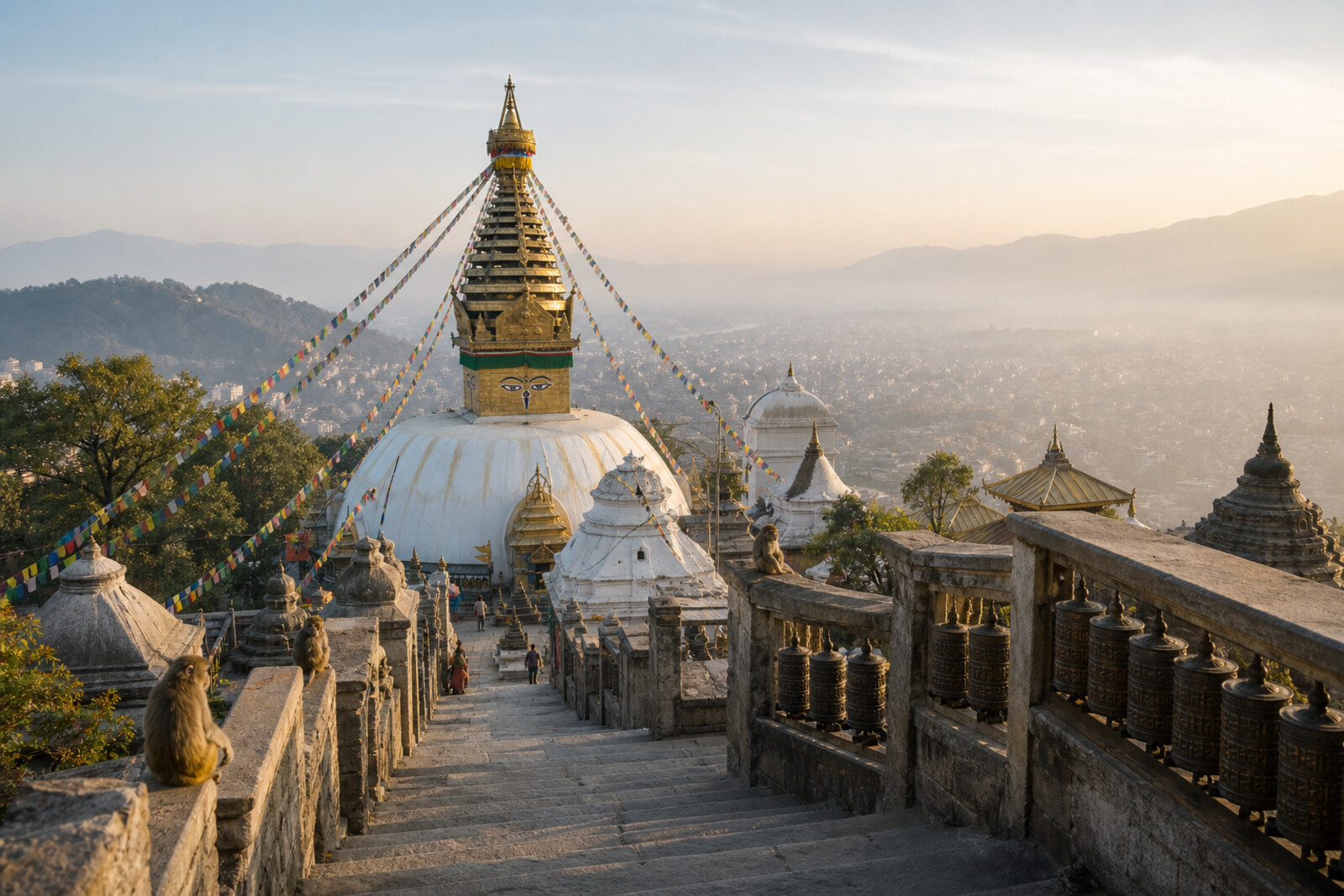
You will climb from the lower threshold of the eastern stairs to Swayambhunath, then walk clockwise around the main stupa. At first the way will be steep and straight: stone steps, lions, an enormous gilded vajra. At the top, it will tighten into a circle between the white dome, prayer wheels, small shrines, and closed doors.
This is not an overview of Kathmandu's temples, but a close reading of one sacred hill. You will hear how Newar priests, merchants, and kings left vows here and changed the order of pilgrimage. Why would gratitude for the birth of a child lead to boiled wheat? Why would a merchant stake all his property on repairs? What would a king seek where priests would not go?
The story will calmly separate inscriptions and historical records from local traditions. By the end, you will see a royal stairway, merchants' prayer wheels, family shrines, and a monastery of an exiled Tibetan lineage gathered around one stupa.
Why this order
The lower threshold comes first because here a personal vow became a rite for the whole priestly community, while just beyond the mandala the royal stairway begins. It leads to the vajra and the lions: after the story of who used this ascent, the order of entry at the top will make sense. Passing between the lions brings you to the stupa circuit, where the prayer wheels show how a later restoration changed the movement of pilgrims. The same circle then leads to Dipankara and shifts the theme of vows from priests to merchants. The next shrine, Hariti, shows how a family misfortune could turn into a king's punishment of a goddess. The closed door of Shantipur continues the royal thread through a trial faced by the ruler himself. The final stretch joins the white towers he commissioned with a neighboring monastery founded 3 centuries later: beside one stupa, Newar and Tibetan traditions stand together.
Those interested in Newar Buddhist tradition Those who enjoy stories of vows, risk, and the consequences of decisions Those who want to see Swayambhunath as a whole complex rather than a single stupa
Those looking for an overview of Kathmandu's main sights in one walk Those who only want architectural dates and styles Those who prefer routes without religious traditions
Before you go
Wear shoes that are comfortable on uneven stone, and keep your hands free. Put food and small belongings into a closed bag: macaques watch closely for what visitors are carrying. On the upper platform, the route passes among pilgrims and active shrines, so do not block the way near prayer wheels or entrances. Treat Shantipur as a stop at a closed temple: the story matters more here than seeing the interior. Restoration work on individual buildings may still be underway, and barriers and the towers' appearance may change.
When to go
Choose daylight hours and leave extra time after the climb: the circuit around the stupa is best walked without rushing, at the pace of the pilgrims.
Backup plan
If the full climb feels too demanding, do not turn the stairs into an endurance test: shorten the lower section and focus on the upper platform, the vajra, and the stupa circuit. If an entrance is closed, a ritual is underway, or an area is cordoned off, stay outside—the description of the door, facade, and traces of restoration is already part of the story. If time is short, follow the stops from the main stupa to Shantipur, then finish the route at the two white towers.
Route conditions
Surface. Paved — 398 m (data covers 65% of the route)
Stairs. Flights: 3, 419 m in total
Access. Wheelchair — no; stroller — limited (stairs)
Facilities. Toilets — 3; drinking water — 1
Elevation. Ascent — 64 m; descent — 2 m
OpenStreetMap extract of June 18, 2026: database data, not a check on the ground. Data © OpenStreetMap contributors, ODbL licence
Walk plan
Open in maps ↗- 1
Lower threshold of the eastern stairway
Here, a temple priest's private act of gratitude becomes an annual rite for the whole community. - 2
The Vajra Between the Stone Lions
The monument shows how a king set a pilgrim’s precise order of entry onto the upper platform. - 3
The Stupa and the Moving Circle
The restoration will explain why the modern pilgrims’ route runs precisely outside the metal ring. - 4
Stone Dipankara
A merchant’s vow will link the immovable figure on the hill to a great ceremony at its foot. - 5
Hariti Ajima
A king's family loss will show how a prayer for protection turned into the destruction of a goddess's image. - 6
Shantipur
The closed passage will preserve the boundary between the documented royal ritual and the tantric account of the underground route. - 7
White Towers and the Karma Kagyu Monastery
The finale links the seventeenth-century royal shrines with the Tibetan community that appeared by the stupa in the twentieth century.
Route features
Everything you need stays in the browser
Progress, saves and your trip plan are stored on this device.
Add Guide On Map to your home screen so the walk opens outside the browser.
How we handle sources, maps and corrections: our editorial standards