 Guide On Map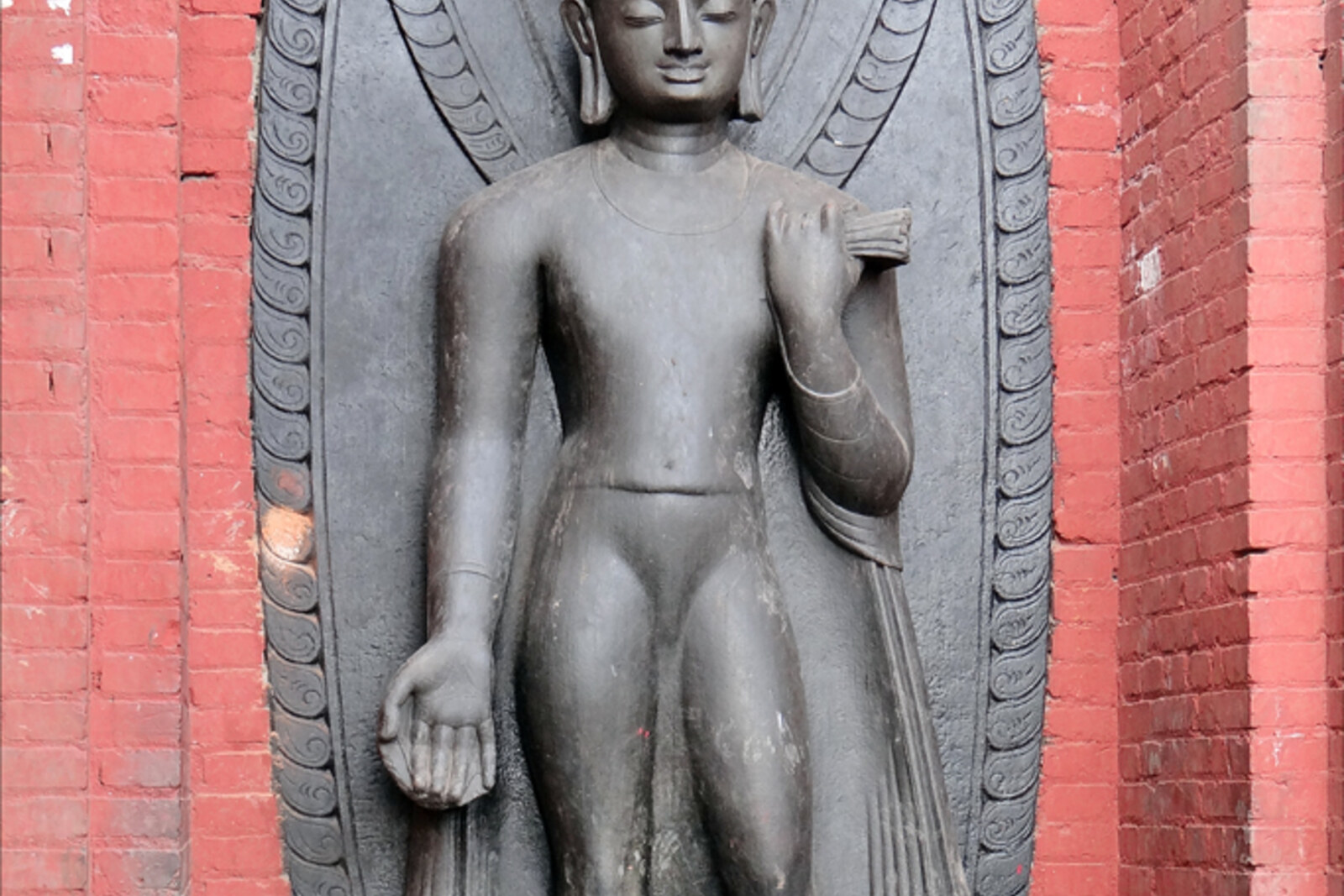
Look around first
What to notice
- The dark figure of Dipankara
- Small stupas
- A single stone block
The story of the place
Among the small stupas stands a dark figure depicting one of the Buddhas regarded as predecessors of the historical Buddha. It was carved from a single stone and left on the hill’s upper platform as an immovable image. In the Kathmandu Valley, such figures were especially venerated by merchants returning from Tibet. Similar but portable statues are made with a wooden frame inside, so that a bearer can carry the tall figure during a procession.
The dark figure behind the small stupas was carved from a single block of stone. It is Dipankara, a Buddha from one of the eras preceding the historical Shakyamuni. According to Buddhist tradition, he foretold to the ascetic Sumedha that in one of his future rebirths, Sumedha would attain awakening and become Shakyamuni. Dipankara is therefore linked to a future that begins with an act performed now.
In the Kathmandu Valley, merchants held him in especially high regard. In the time of the Malla kings, traders who returned safely from Tibet held Samyak—a great almsgiving ceremony in honor of Dipankara. They turned part of their earnings into rice, grain, and food for Buddhist priests and monastic communities. Images of Dipankara received these gifts as participants in the ceremony.
One such Samyak had to wait until the struggle for the Nepalese throne was over. In nineteen fifty, the merchant Samyak Singh Tuladhar promised to fund a special ceremony at Swayambhunath and sent out invitations. His family owned a trading house in Lhasa; Samyak Singh and his sons made their living from trade between Kathmandu, Tibet, and the transit town of Kalimpong. During the preparations, the father died. His son Bhakta Bir Singh Tuladhar decided to fulfill his vow.
Meanwhile, King Tribhuvan left Nepal, seeking an end to the rule of the hereditary Rana prime ministers. Representatives of the Rana regime proclaimed his young grandson king. This created a dangerous problem for the Tuladhar family: by tradition, Samyak took place in the presence of the head of state. The Ranas demanded that the ceremony be held with the boy in the place of honor—so the ancient rite would confirm their choice. Opponents of the regime threatened Bhakta Bir if he agreed.
The merchant did not cancel his father’s vow and did not name any of the claimants. He cited mourning and postponed the Samyak. A few months later, the Rana regime fell, and Tribhuvan returned to Kathmandu. On January fifteenth, nineteen fifty-two, Bhakta Bir and his brothers finally held the promised ceremony on Bhuikhel field at the foot of this hill. Images of Dipankara were brought there from monasteries and private homes, communities distributed food and offerings, and Tribhuvan took the place intended for the head of state. The family fulfilled the promise of their dead father, avoiding the ceremony that had been demanded of them a year earlier.
Portable Dipankaras are made differently from the stone figure on the upper platform. Some contain a wooden frame: a person climbs inside it and carries the tall image in the procession with their own legs. The stone Dipankara, carved from a single block, is left here, while its movable counterparts gather below.
The trace of the Samyak of nineteen fifty-two is on Bhuikhel itself: a commemorative stone mandala was installed there. Before us remains another stone—Dipankara, in whose honor the merchant family first postponed the almsgiving and then, after all, led a whole procession of Buddhas to the foot of the hill.
Useful on site
Outer upper platform; access for a close look depends on offerings and current rituals.
Checked: June 28, 2026. Check the official source before visiting.Listen to the story beside the image itself, without expecting to see the ceremonial figures of Samyak: they are brought out only for special occasions.