 Guide On Map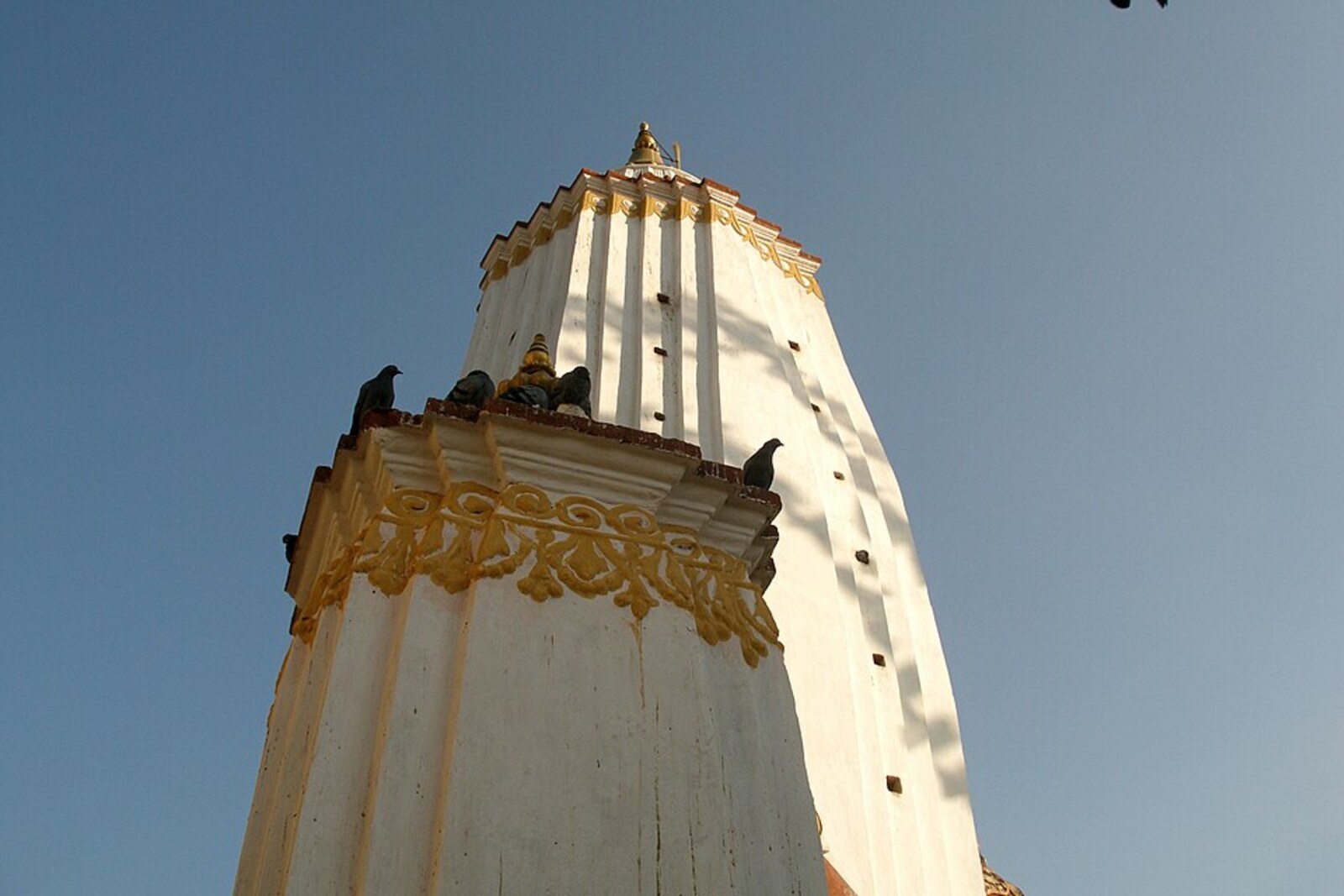
Look around first
What to notice
- White Pratappur tower
- White Anantapur tower
- Four-story monastery building
- Locked tower doors
The story of the place
The two white towers on the eastern side of the stupa are closed tantric shrines. The northern one is called Pratappur, the southern one Anantapur. In the middle of the seventeenth century, the same Jaya Pratap Malla who built the staircase and the vajra erected them as a pair. The king named one tower after himself and the other after his second wife, Queen Anantapriya. Inside are images of Bhairava and Bhairavi; the king and queen are shown beside them as their devotees. The doors are almost always locked and are opened only for certain rituals.
The temple chronicle tells how Jaya Pratap Malla secured permission for this construction. The king decided that the stupa lacked a grand setting, but he did not receive approval for two new shrines. He then ordered all the temples of Swayambhunath closed for half a year. According to tradition, permission was granted after that. It is only a tradition; the stone inscription beneath Anantapur confirms something else—that both towers were built and consecrated according to the prescribed ritual. The result of the king's pressure remained in their names: Pratappur stands opposite Anantapriya's tower.
North of Pratappur stands Karma Raja Maha Vihar, a Karma Kagyu monastery, one of the lineages of Tibetan Buddhism. Its present role began with the efforts of several people who had to gather private donations for construction.
Lama Dagmar Tsamba Lobsang Yangphe, a monk from Drepung in Lhasa, wanted to establish a gompa here—a community with a temple and housing for monks. Nono Dechen Dorje helped him. They had donations but no land beside the stupa itself. Nati Buddhacharya and Sanukaji Buddhacharya, representatives of a Swayambhunath priestly family, gave them a plot. Thus, beside the main shrine of Newar Buddhists, a monastery of the Tibetan tradition appeared. Construction was completed by the end of the nineteen fifties; its first name was Visva Santi Mahavihara, the “monastery of universal peace.”
The founders then handed it over to the 16th Karmapa Rangjung Rigpe Dorje, head of the Karma Kagyu lineage. After leaving Tibet in nineteen fifty-nine, he needed places where monks could continue their training and practice. The donated monastery became his Nepalese residence and the lineage's second center outside Tibet, after Rumtek in Sikkim.
In the winter at the turn of nineteen sixty-nine and nineteen seventy, the Karmapa lived here for several months. He gave initiations, taught hundreds of students, and began renewing the monastery. After that, the traditional Karma Kagyu program of monastic training and meditative practices was maintained here.
The earthquake of two thousand fifteen toppled Anantapur and damaged the five-story monastery building so severely that it had to be dismantled. The white tower was restored to its former form, while the monastery was rebuilt with four stories. In the current building, Green Tara practice is held in the morning, and the ritual of Mahakala, protector of Buddhist teaching, in the evening.
Useful on site
The towers are usually closed; the monastery is active, and access depends on the current rules on site. Checked against sources on 2026-06-28.
Checked: June 28, 2026. Check the official source before visiting.Barriers and construction work may affect access; view the architecture only from areas open to visitors.