 Guide On Map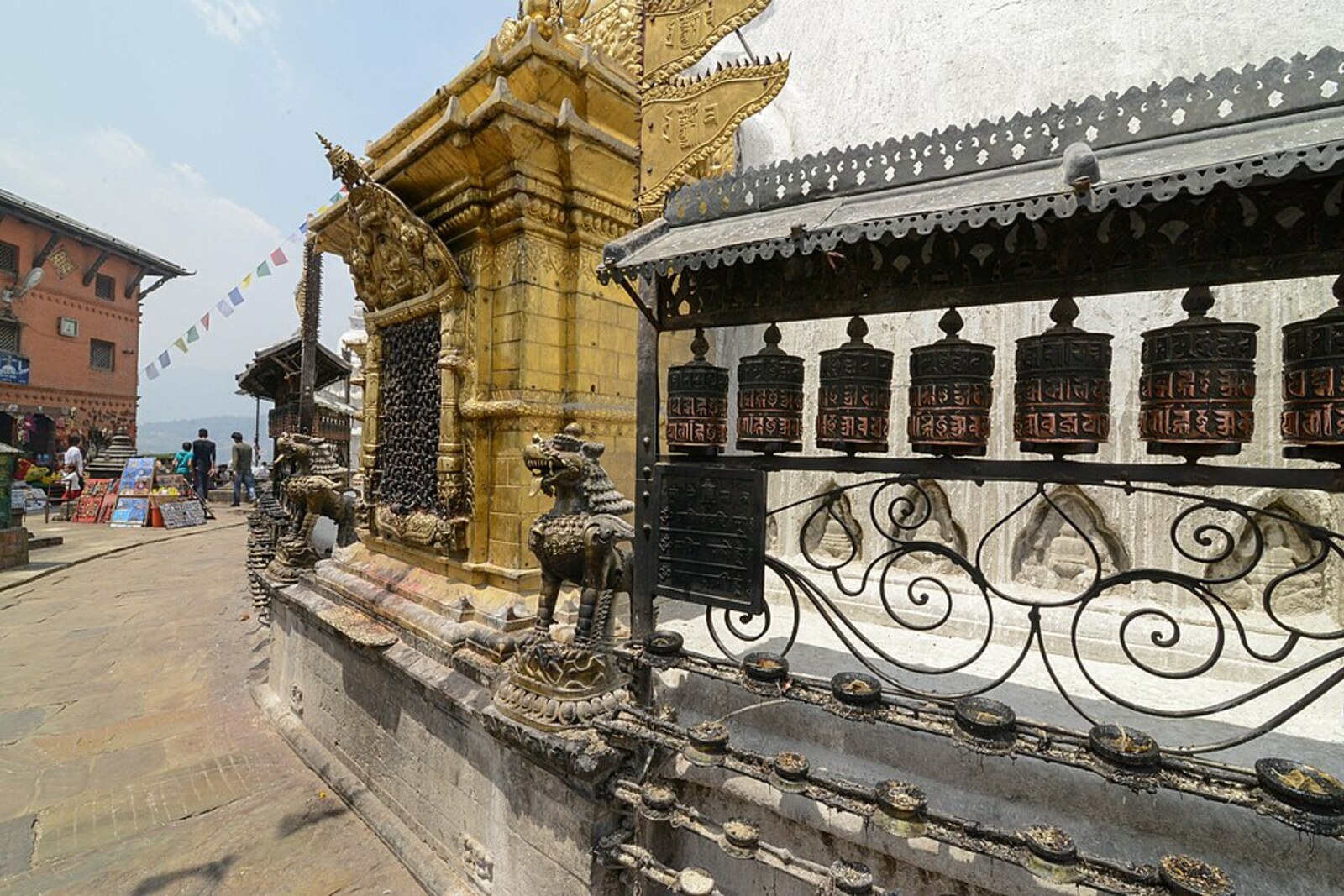
Look around first
What to notice
- The white dome of the stupa
- Metal prayer wheels
- The outer circumambulation route
- Gilded copper figures
The story of the place
Swayambhunath occupies the hilltop, a Buddhist stupa with no inner hall for pilgrims. Its white dome stands over a rock that rises more than three meters from the summit. This shrine has been known to exist since at least the fifth century, and its name is translated as “self-arisen.” Above the dome gleam figures covered with gilded copper, while small shrines cluster nearby.
Pilgrims walk clockwise around the white dome, keeping the stupa on their right, and push one metal cylinder after another with the palm of their hand. The mantra “Om Mani Padme Hum” is inscribed on the drums. In Buddhist practice, each turn is considered a repetition of the sacred words that are written there, and circling a shrine is a way of accumulating merit. This creates a moving circle: the person walks around the stupa, and the prayer turns with them.
There is no room for pilgrims beneath the dome. It conceals a rock that rises more than three meters above the hilltop. Neither historical records nor local tradition place the remains of the Buddha or another saint here. According to the Swayambhu Purana, when a lake still filled the valley, a light arose by itself above a lotus at this spot—a manifestation of the enlightened principle. The bodhisattva Manjushri wanted to open a path to it for people, cut an outlet for the water, and drained the valley. Later, people covered the sacred place with a stupa to protect it. This is a religious tradition; historians can confidently say only that the shrine already existed in the fifth century or earlier. Its name, Swayambhunath, means “self-arisen.”
By the beginning of the twentieth century, the structure concealing the self-arisen shrine itself needed human help. Dharma Man Tuladhar, a Newar merchant and Buddhist benefactor who sought the restoration of his community’s main stupa, undertook a complete renewal. His fortune had grown from caravan trade between Kolkata and Lhasa: the family firm carried musk, brocade, coral, pearls, and textiles across the passes of the Himalayas. These same trading connections enabled Tuladhar to seek donations from the lamas, monasteries, and merchants of Nepal, Tibet, Bhutan, and Sikkim.
The repair required the consent of the king and the prime minister. According to a family account, the Rana regime required Tuladhar to sign a commitment: if the work stopped because of a lack of money, he would sell all his property and still see it through to the end. The merchant staked on the stupa the fortune earned by the caravans.
The work went on from nineteen seventeen to nineteen twenty-one. Craftsmen dismantled and reassembled the top of the stupa, renewed the shrines by the dome, and covered the figures with gilded copper. At the same time, continuous frames with prayer wheels were installed around the base. Before that, pilgrims had walked along a narrow, uneven path almost right beside the dome. The metal ring cut off the old trail, and the circumambulation route was moved outside, to a wider path between the wheels and neighboring shrines.
Tuladhar completed the repair and kept his property; after leaving trade, he continued to spend money and time on Buddhist shrines. Today’s rows of wheels continue the arrangement created during his work: pilgrims move along the route the merchant laid out around the stupa after risking everything the roads through the Himalayas had brought him.
Useful on site
External circumambulation of the stupa; no single confirmed schedule was found in the checked sources.
Checked: June 28, 2026. Check the official source before visiting.Move with the flow clockwise and do not linger across the path by the prayer wheels.