 Guide On Map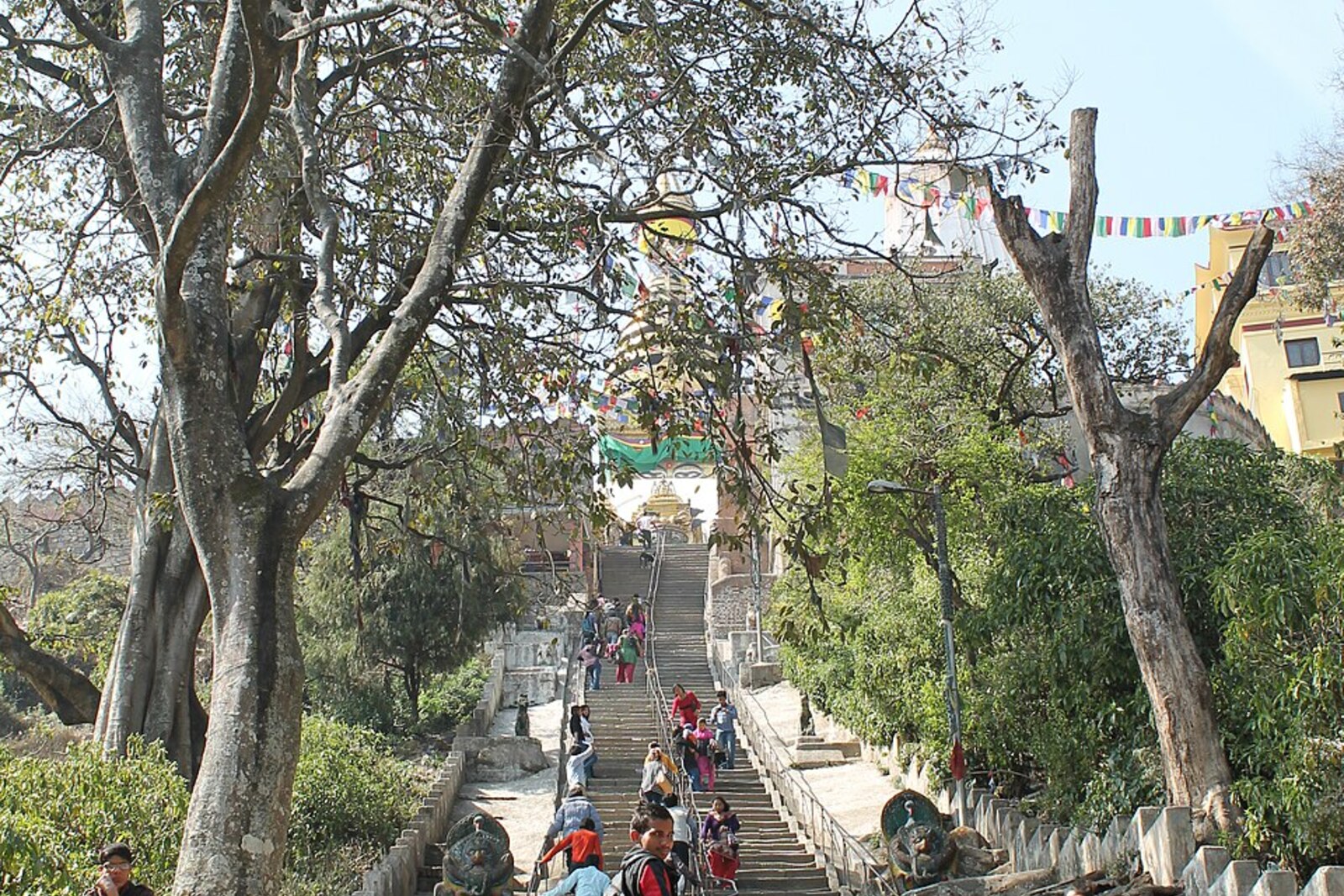
Look around first
What to notice
- Painted figures of the Buddha
- A stone with a pair of carved feet
- A square recess with a mandala
The story of the place
Immediately beyond the square recess with a mandala begin the stone steps that rise up the eastern slope of Swayambhunath toward the stupa. The staircase was laid in the seventeenth century by order of Jaya Pratap Malla, king of Kathmandu, and it became the main pilgrimage route from the city. Local Buddhists still use it. Below, at the start of the ascent, the first reliefs already show the birth of the Buddha.
At the bottom step stand several large painted figures of the Buddha, and by the road lies a stone with a pair of carved feet. This is the origin of the local name Bhagwanpau—“feet of a deity.” According to a local explanation, the stone footprints were left below for those unable to manage the difficult climb to the stupa: they could worship without ascending the hill.
The eastern ascent itself was built in the seventeenth century by order of Jaya Pratap Malla, king of Kathmandu. He was a Hindu, yet the city's kings were also responsible for major Buddhist shrines. By his order, a long stone staircase was laid to Swayambhunath. This made the eastern slope the main route for pilgrims from the city; local Buddhists still climb to the stupa this way.
In front of one of the stone Buddhas is a square recess with a mandala. The family of Buddhacharyas, hereditary priests and custodians of Swayambhunath, connects a separate legend with it. Their service is passed down through several family lines: the families take turns on weekly duty, assist pilgrims, and perform rites.
The legend tells of a guruju, a temple priest who remained childless and sought the birth of a child. For a man from a hereditary priestly family, this also concerned the continuation of his line of service. He performed rites, and, as the legend says, a child was born. The priest then came to the lower threshold of the staircase, made a mandala here, and in gratitude fed a cow boiled wheat.
His act did not remain a private vow. Once a year, members of the Buddhacharya community gather at this recess, boil wheat, and then feed it to cows. Representatives of the entire priestly family must take part.
Some local Newars call the mandala Janmadwar—“gate of birth”—and understand it as a passage to the next existence after death. This is a religious interpretation, not an established history of the stone. Nearby, the first reliefs of the staircase show the birth of the Buddha. The stone feet and the square mandala remain below; Jaya Pratap Malla's steps begin immediately beyond them.
Useful on site
Outdoor ascent; no separate confirmed schedule for the staircase was found. Check the entry point on site.
Checked: June 28, 2026. Check the official source before visiting.Put away food before beginning the ascent, and do not approach macaques for a photo.