 Guide On Map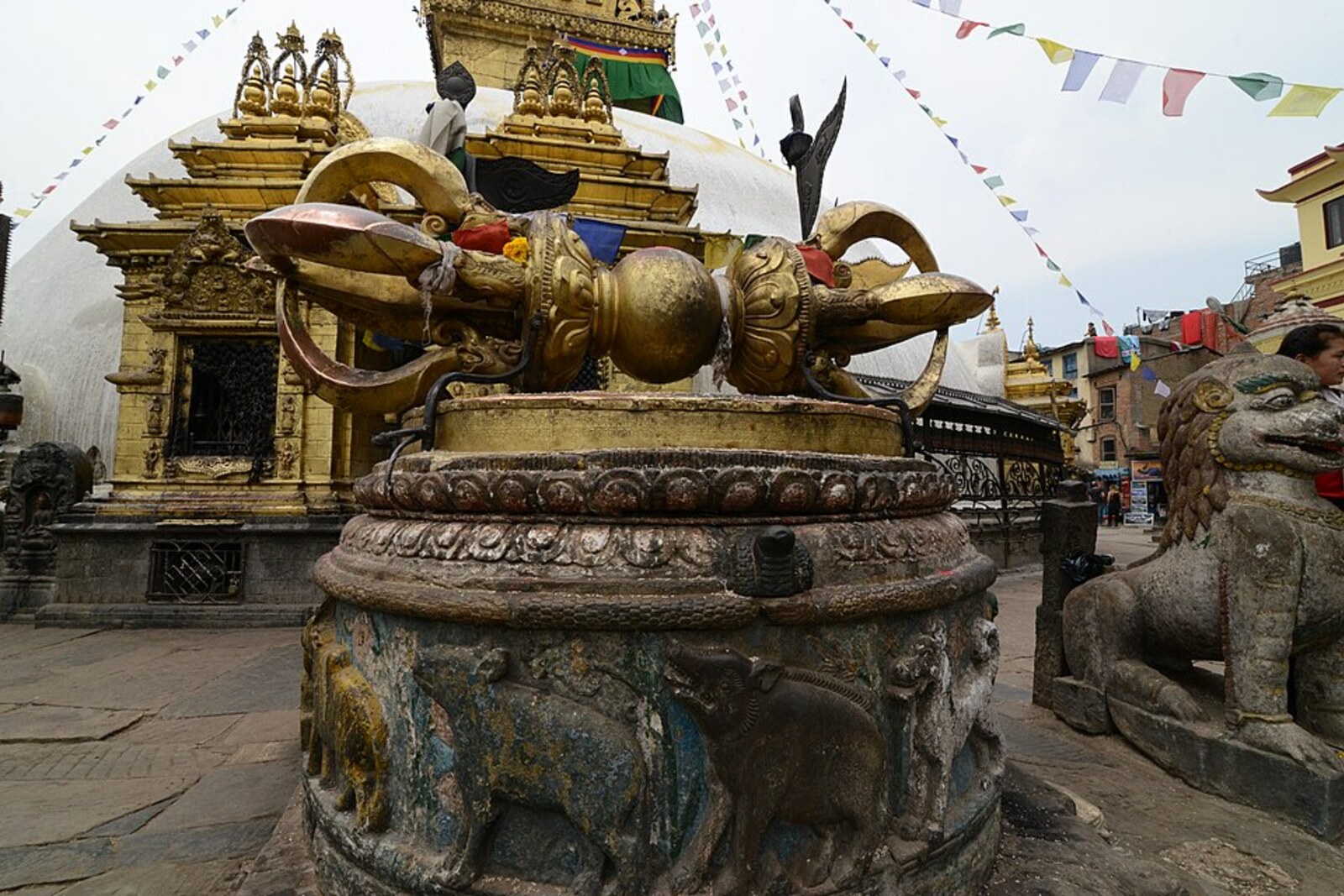
Look around first
What to notice
- Gilded vajra
- Copper mandala
- Stone lions
- Ring with twelve animals
The story of the place
Jaya Pratap Malla, the king of Kantipur—the name of the kingdom centered on present-day Kathmandu—rebuilt the eastern approach to Swayambhunath. He ordered a long stone staircase built to the summit and, where the ascent ended, an enormous gilded vajra and two stone lions placed there. The king sought to have a person enter the upper platform through a precisely arranged Buddhist sign.
The donor is identified by an inscription, not by later legend. It gives the sixth day of the month of Ashadha in the seven hundred eighty-eighth year of Nepal Sambat—the end of the seventeenth century. Pratap Malla was a Hindu monarch, but he ruled a Newar city where Swayambhunath was revered by both Buddhists and Hindus. By commissioning the staircase and the vajra, he publicly took the hill’s principal shrine under his patronage. It was no longer courtiers who used the result: the new ascent became a pilgrimage route from the city.
A vajra usually fits in the hand of a ritual master. It is a scepter shaped like a thunderbolt weapon, a sign of indestructibility and the power of awakening. Pratap Malla enlarged it to monumental scale and placed it on a gilded copper Dharmadhatu Mandala—a diagram of a world ordered around the Buddhas of five directions. Twelve animals of the calendar cycle are carved on the lower stone ring, so the circle beneath the vajra is part of the mandala, not a base for a heavy ornament.
The site was chosen according to the same scheme. The eastern direction belongs to Akshobhya—the “Immovable” Buddha and head of the vajra family. His shrine stands directly behind the golden scepter. The staircase arrives from the east at the emblem of the eastern Buddha; pilgrims then pass between the stone lions and begin their clockwise circuit of the stupa.
Pratap Malla did not place his own figure here. The order he commissioned survives: the staircase ends before the vajra, the lions mark the passage, the image of Akshobhya stands behind them, and the first turn leads to the circle around the stupa.
Useful on site
Outer platform; no separate schedule for the Vajra was found.
Checked: June 28, 2026. Check the official source before visiting.View the composition from a few steps away: up close, its scale and its connection to the top of the staircase are harder to make out.