 Guide On Map
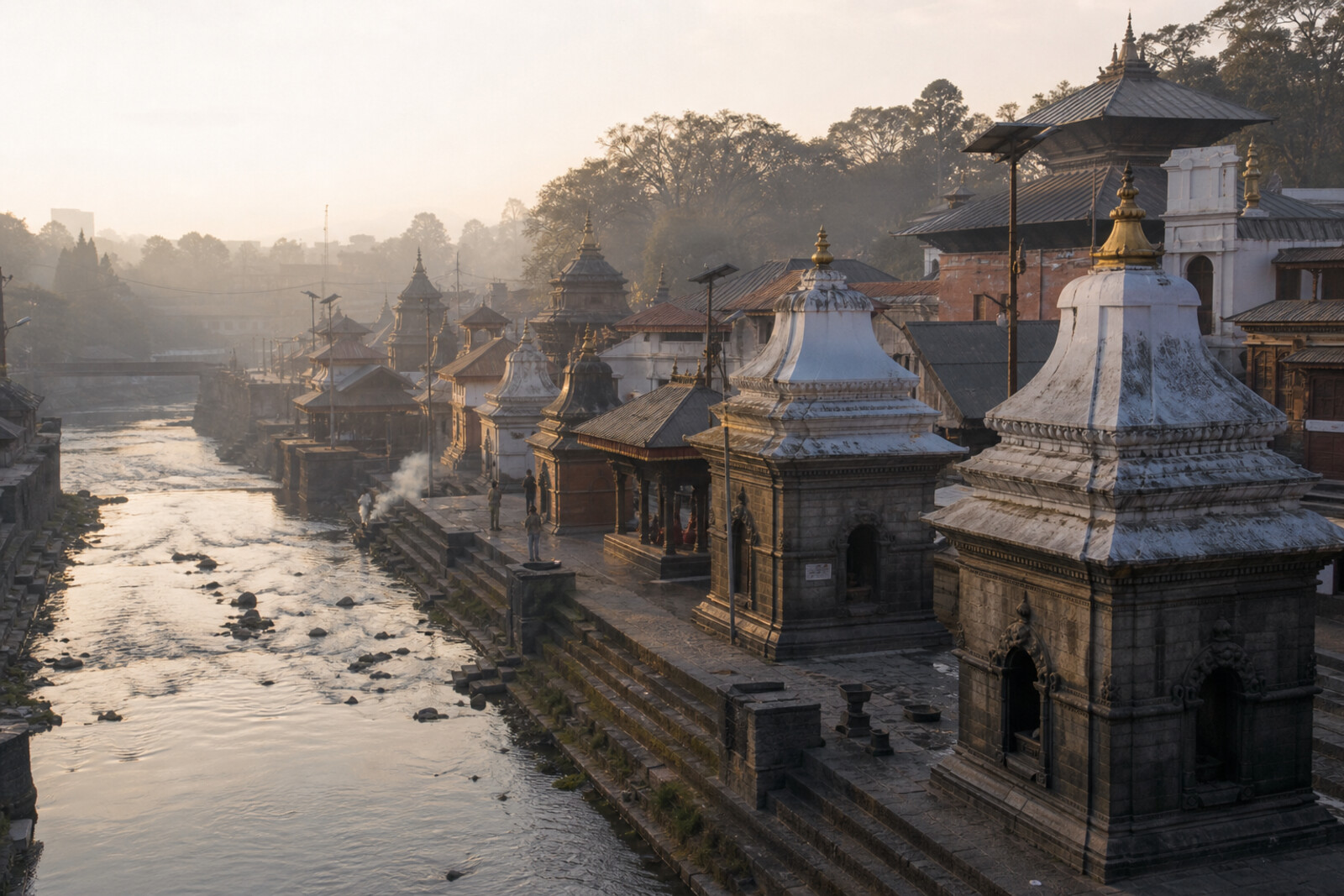
Pashupati Sacred District Along the Bagmati: Kathmandu's Sacred Riverbank
From Gaushala Gate through Pashupatinath Temple and Guhyeshwari Temple to Panch Deval
Guide On Map on your phone
Open the walk like a regular app
It takes about 10 seconds to install. No app store needed.
The whole path
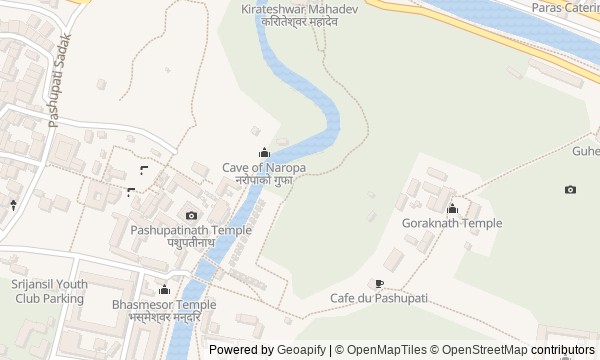
Route map
About the walk
You will enter Pashupati Sacred District through the noisy Gaushala Gate, descend to the Bagmati, cross to the forested slope, and return to the river at the Panch Deval courtyard.
Along the way, the golden pagoda will be only one part of a much larger sacred district. There will be ghats, an open linga on the hill, a temple above a silver basin, a deer enclosure, and a former pilgrims' home.
The stories will rest on individual cases and precise objects. Why will an elderly pilgrim pause at a sign before the gate? How will a garland end up on a hunter's head? Why will a woman in a shelter twist cotton wicks?
Here, legend will be kept apart from the record, and devotion will appear alongside daily work and renunciation. By the end, you will understand why Pashupatinath Temple cannot be reduced to its golden roof: the Bagmati, the cremation grounds, the forest, the shelters, and the people who sustain this order all continue it.
Why this order
Gaushala will first explain how facilities for animals and pilgrims gave their name to the western entrance and the whole district. Beyond the gate, hospitality will immediately meet the limits on entry to the main temple; from the closed courtyard, the route will descend to Arya Ghat, where the sacredness of Pashupati Sacred District is tied not to entry but to the river and the final rite. Crossing the Bagmati and climbing toward Kirateshwar will replace human work with Shiva's epic trial. Farther upstream, the route will move from Shiva's weapon to Guhyeshwari and the pair of male and female shrines. From the temple, the path will enter Mrigasthali, where the forest, deer, and Gorakhnath continue local traditions of divine presence. The descent to Panch Deval will end the route where pilgrims' lodging became a permanent home, and a temple ritual gave one resident a small income.
Those who want to see Pashupati Sacred District as a whole sacred district Those interested in living religious traditions without promotional enthusiasm Those ready to distinguish documents, personal testimony, and legend
Those looking only for an easy walk among postcard-perfect temples Those who find it difficult to be near active cremation grounds Those who prefer a route without religious subjects
Before you go
Wear modest clothing and sturdy shoes: the route includes temple courtyards, stone steps by the water, and uneven forest paths. At Arya Ghat, keep your distance from families, do not point a camera at the dead or the grieving, and do not treat the ceremony as a spectacle. At closed entrances, follow the attendants' instructions; viewing from outside is a complete part of this route. In Mrigasthali, watch your belongings around the monkeys and do not feed the animals. At Panch Deval, remember that a residential institution stands behind the temples: do not look into rooms or photograph residents without clear consent.
When to go
Walk the route in daylight: it is easier to find your way around the river steps and safer on the forest section. Morning is especially good for seeing the everyday life of Gaushala's roads and pilgrims; later, the temple area is usually busier. During major religious festivals, expect crowds, processions, and changing access boundaries. Full-moon concerts at Kirateshwar are a separate event: do not expect music during an ordinary visit, and check the program with the organizers in advance.
Backup plan
If an inner courtyard or sanctuary is inaccessible, remain at the permitted boundary: at Pashupatinath Temple, Nandi, the roof, the gate, and the movement of pilgrims all matter, while at Guhyeshwari Temple the story can continue through the complex's exterior details. Arya Ghat can be observed from a distance or skipped if what is happening feels too difficult. After rain or when paths are in poor condition, do not climb into Mrigasthali; keep the quieter part of the route by taking an accessible way from Guhyeshwari Temple to Panch Deval. If there is no performance at Kirateshwar, visit the temple courtyard as a place with a long musical tradition, without trying to enter a rehearsal or lesson without an invitation.
Route conditions
Elevation. Ascent — 66 m; descent — 59 m
OpenStreetMap extract of June 18, 2026: database data, not a check on the ground. Data © OpenStreetMap contributors, ODbL licence
Walk plan
Open in maps ↗- 1
Gaushala Gate
Here it will become clear which establishment gave its name to the western entrance and the whole surrounding neighborhood. - 2
The Outer Zone of Pashupatinath Temple
This stop shows how the admission rule shapes an encounter with the main shrine. - 3
Arya Ghat
A human story will explain how the rite is arranged and the unobtrusive work of the person who tends the fire to the end. - 4
Kirateshwar Mahadev Temple
A local shrine will link a stone representation of Shiva with a legend about a weapon the hero never used against people. - 5
Guhyeshwari Temple
Here the route links Pashupati with the place where Sati is revered and shows how a legend is marked by an object in the ground. - 6
Mrigasthali and Gorakhnath
This forested area brings together Shiva’s deer, traces of reverence for a yogi, and a legend about the return of rain. - 7
Panch Deval
The finale will show how a pilgrims’ overnight shelter became a permanent home and a place for a modest income.
Route features
Everything you need stays in the browser
Progress, saves and your trip plan are stored on this device.
Add Guide On Map to your home screen so the walk opens outside the browser.
How we handle sources, maps and corrections: our editorial standards