 Guide On Map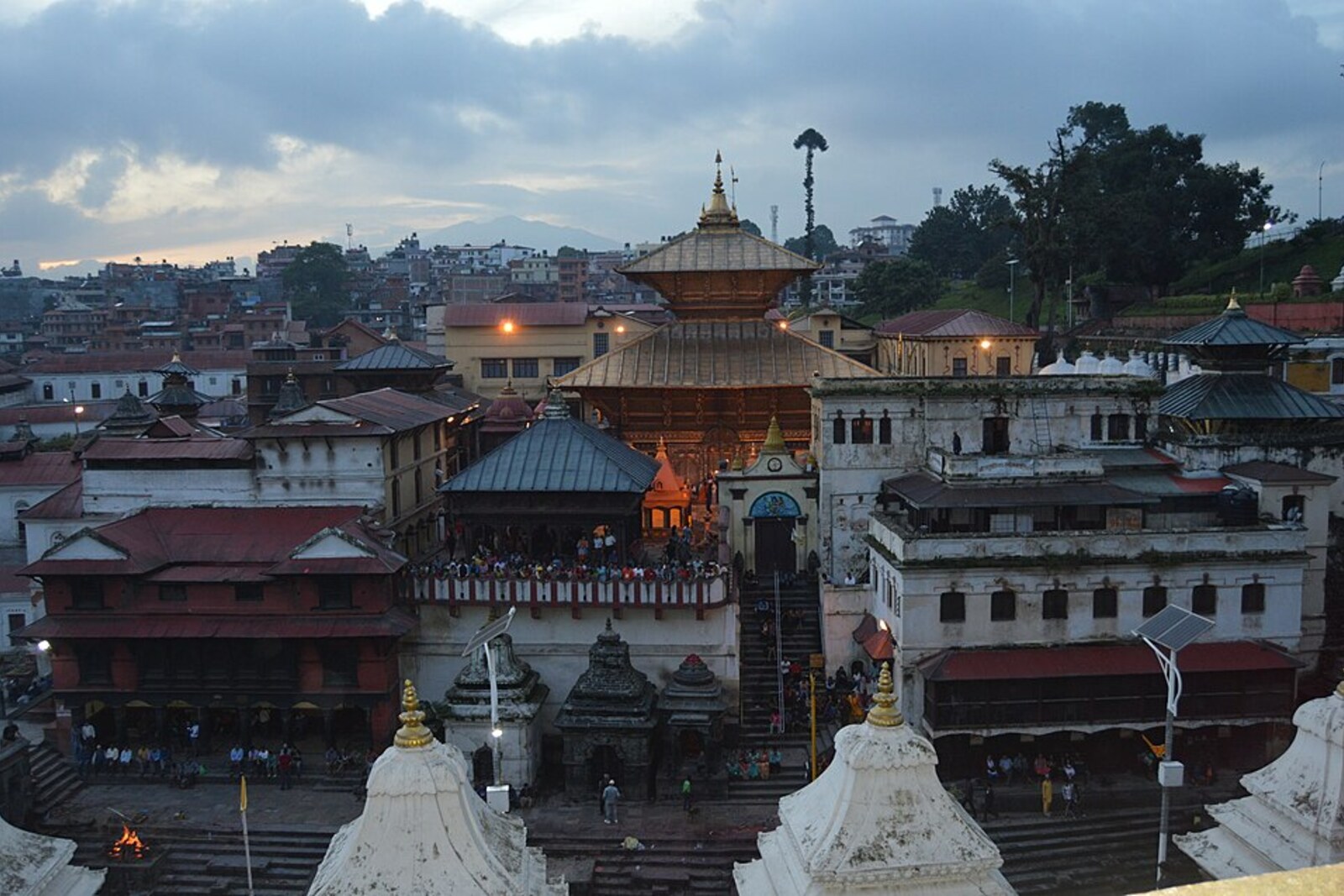
Look around first
What to notice
- Western gate
- Admission sign
- Golden two-tiered roof
- Silver doors
The story of the place
At the western gate begins the outer part of Pashupatinath Temple, and beyond it lies the main courtyard, where daily rituals are performed around a four-faced stone lingam. Above the courtyard stands a golden two-tiered pagoda, built during the reign of King Bhupatindra Malla in sixteen ninety-seven. Behind the silver doors, pilgrims seek darshan, an encounter of gazes with Shiva, revered here as Pashupati, a Form of Shiva—the lord of living beings. From the terraces on the opposite bank of the Bagmati, the golden roof above the courtyard is visible, while the lingam itself remains deep inside the shrine.
On April twenty-fifth, twenty twenty-five, the married couple Sudhir Lakshman Prabhu and Prasanna Prabhu approached the western gate—Hindu pilgrims from Florida who had come for puja, personal worship before Pashupatinath. Sudhir was seventy-five years old. He had helped establish the Jacksonville Ganesh Temple and held a leadership position in a Hindu association in northeastern Florida.
The guards asked the couple whether they really were Hindus. Their passports and driver's licenses did not state their religion. Sudhir showed a photograph of a family ceremony in India, his business card, and the mangalsutra around his wife's neck—a necklace a married Hindu woman receives at the time of marriage. He offered to recite the Gayatri Mantra from memory. The guards nevertheless decided that, based on their appearance, the couple did not look like Hindus, and did not let them in. The Prabhus left without performing puja, then sent a written complaint to the temple trust.
Beyond this boundary lies the main courtyard of Pashupatinath Temple. Its name means Shiva as Pashupati, a Form of Shiva—the lord of living beings. Pilgrims come here for darshan: an encounter of gazes with the deity, represented by a four-faced stone lingam. Hindus are admitted to the inner courtyard; everyone else sees the golden roof from the terraces on the opposite bank of the Bagmati. This is how the outer zone arose, where the story of the shrine must be told before closed doors.
Documents do not say exactly when the restriction appeared. Govinda Tandon, a former head of the temple trust, links it to a raid in the middle of the fourteenth century. At that time, the Bengali sultan Shamsuddin Ilyas Shah led an army into the Kathmandu Valley for plunder. The soldiers looted the shrines and broke the former lingam of Pashupati, a Form of Shiva, into three parts. The army left with temple valuables, and the main object of worship had to be created anew.
About a decade later, the chief official Jayasimharama Vardhana paid for the temple's restoration. In thirteen sixty, a new lingam was installed inside, and priests resumed daily rituals around it. According to Tandon's explanation, after the sacking the shrine's guardians began restricting entry so that nothing similar would happen again; it is still impossible to confirm the exact date when the rule was introduced.
The golden two-tiered pagoda above the courtyard is newer: King Bhupatindra Malla built the present building in sixteen ninety-seven. Behind its silver doors stands the lingam believed to have been installed by Jayasimharama after the sacking. At the western gate, the sign admitting only Hindus remains—the very one at which Sudhir and Prasanna Prabhu ended their pilgrimage.
Useful on site
Access to the courtyard 4:00–21:00; inner darshan according to schedule.
Checked: June 17, 2026. Check the official source before visiting.Do not try to enter through the closed entrance or argue with the guards. View the temple from accessible points, and do not obstruct queues or rituals.