 Guide On Map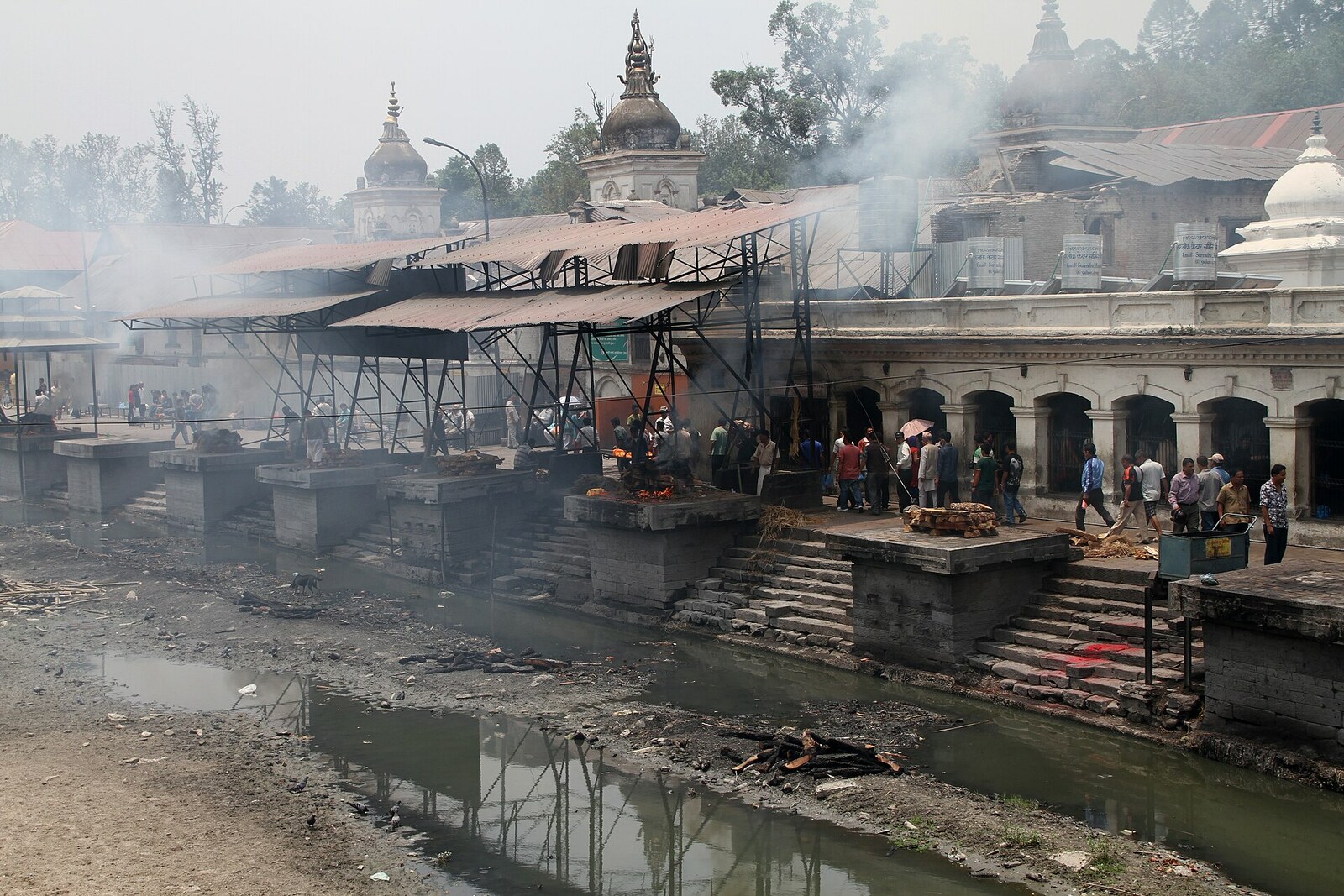
Look around first
What to notice
- The stone slab of Brahmanal
- Funeral platforms
- Bamboo poles
- Steps down to the Bagmati
The story of the place
In nineteen eighty-three, thirteen-year-old Chandra Dhakal was entrusted for the first time with carrying a cremation through to the end at Arya Ghat. He took a long bamboo pole, approached the funeral pyre, saw the body of an adult man—and ran away.
A year earlier, Chandra had come here himself looking for work. His mother died when he was two; the family had no land, and his father hired himself out to plow other people's fields. After first grade, the boy left school, and from the age of nine he worked alongside his father. At twelve, he earned three rupees by plowing, climbed onto the roof of a bus to avoid buying a ticket, and left for Kathmandu to join his uncle, who burned bodies at Arya Ghat.
At first, Chandra carried firewood to the platforms. He was paid fifteen rupees a day; he was fed there as well, and slept in an open shelter at the temple. When the firewood supplier offered to let him tend a pyre himself, his earnings would rise to seventy-five rupees per body. So after his first flight, Chandra returned. He said that he had to prove that he was capable of this work. He took the same bamboo pole and began rearranging the logs. After his first four cremations, he stopped waking from nightmares, but decades later he still maintained that it was impossible to get used to it.
His work explains the arrangement of Arya Ghat better than any ceremonial guide. First, relatives lay the body at Brahmanal—on a sloping stone slab beside Pashupatinath Temple. There, the body is washed with consecrated water, then carried to the stacked logs. A relative lights the pyre, but from then on the attendant of the ghat, the platform by the water, tends the fire: using a pole, he turns the body and shifts the wood, adds ghee if necessary, and remains at the platform until everything has turned to ash. The remains are washed into the Bagmati.
Families choose both the river and the proximity to Shiva's shrine because, according to Hindu belief, the last rites performed here help the deceased attain moksha—release from rebirth. The word “ghat” means a descent or platform by the water, while “arya” means “worthy,” “noble.” Of the two pyres here, the first, near Brahmanal, was intended for the royal family; the second, for rulers of the Rana dynasty and their close relatives.
By two thousand nineteen, Chandra counted more than twenty-seven thousand cremations that he had overseen. According to him, after the palace massacre of two thousand one, he took part here in burning the bodies of King Birendra, Queen Aishwarya, and their son Dipendra, who was declared king while he lay in a coma. The boy who had once run away from his first pyre reduced three royal bodies to ash at the platform whose name means noble.
Useful on site
The crematorium is open around the clock; rituals may take place at any time.
Checked: June 17, 2026. Check the official source before visiting.Keep a considerable distance, speak quietly, and do not photograph bodies or families. If the scene becomes unbearable, leave without feeling obliged to finish listening to the story on site.