 Guide On Map
Old City of Jerusalem: Gates, Quarters, and Holy Places
From Jaffa Gate through the Cardo and the Western Wall to the Church of the Holy Sepulchre
Guide On Map on your phone
Open the walk like a regular app
It takes about 10 seconds to install. No app store needed.
The whole path
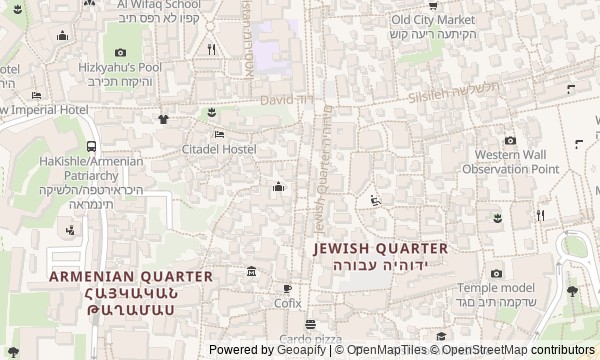
Route map
About the walk
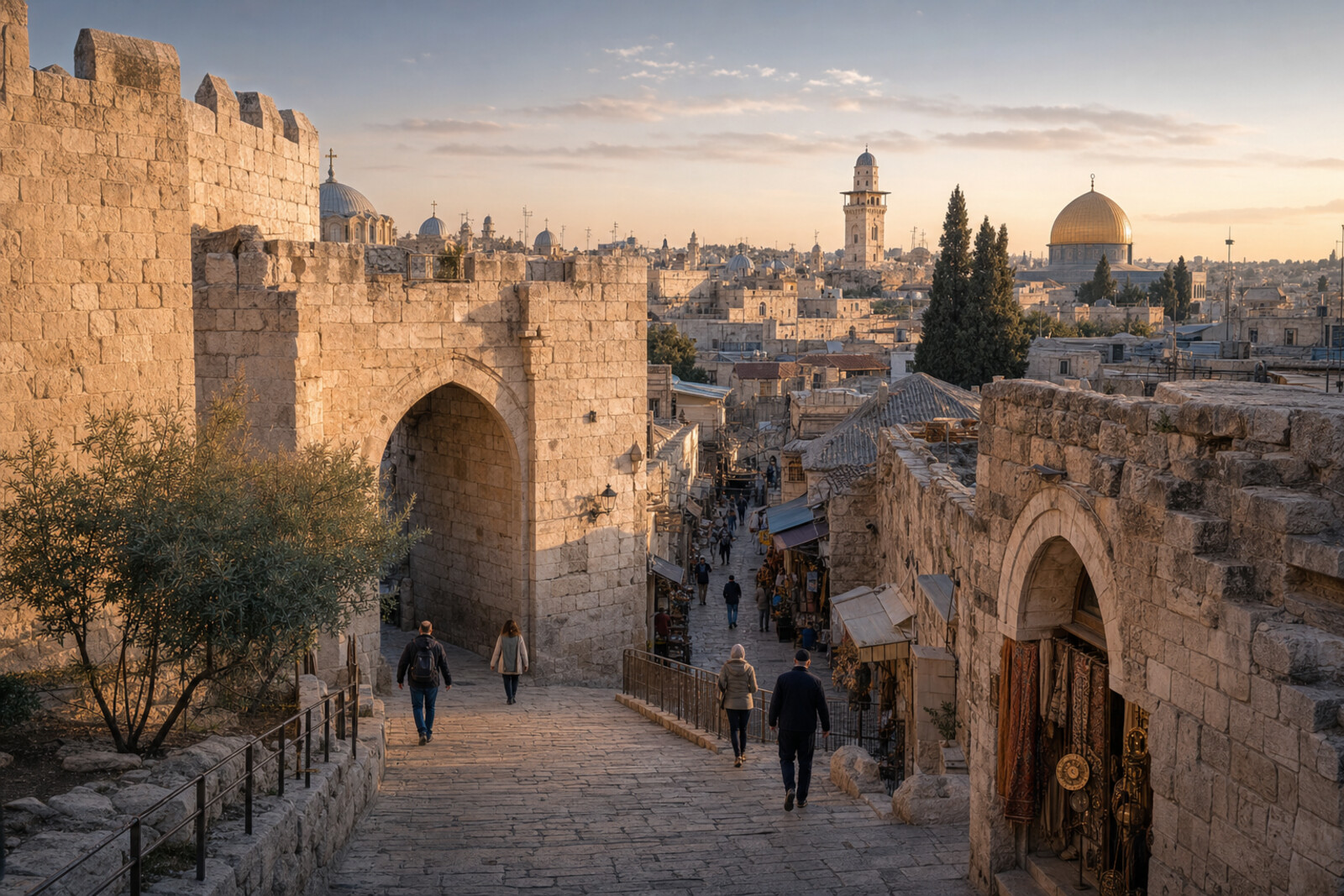
You will enter the Old City of Jerusalem through Jaffa Gate and follow the citadel into the Armenian Quarter. Then the road will lead to the excavated Cardo, Hurva Square, and down to the Western Wall. From there, you will climb into the market streets, cross Via Dolorosa, and finish at the Church of the Holy Sepulchre.
Along the way, the masonry will keep changing its age and purpose. A defensive turn will stand beside a ceremonial passage. Beneath residential courtyards, a street will appear that was first seen on an ancient mosaic. Behind a monastery wall will remain the names of boys whose journeys continued far from Jerusalem. And in a shared chapel, scholars will be given only a few days to reach a hidden rock.
The story rests on documents, transactions, and excavations. It will separate later legend from confirmed detail without arguing with faith. By the end of the walk, you will recognize the Old City of Jerusalem by its seams: where a wall was opened, where a street was raised from beneath houses, and where a holy place was kept inside a later shell.
Why this order
At Jaffa Gate, a ceremonial breach will stand beside the old defensive entrance, while the neighboring citadel will show why the western gate needed a separate fortress. From the military edge, the route continues along the wall of the Armenian Patriarchate of Jerusalem: after the struggle for the city comes the fate of people who found refuge within a closed community. The Cardo then leads out of the monastery quarter to a street found beneath later construction. Residential courtyards appear above the excavation, making Hurva the next stop—a square where a restored building still bears the name of a ruin. The descent to the Western Wall shifts the story from one community’s memory to ancient retaining masonry and continuous worship. Then the open prayer plaza gives way to Khan al-Zeit, where religious institutions depended on income from everyday goods. The turn onto Via Dolorosa joins the market to the route of Christian stations and leads to the Church of the Holy Sepulchre, where archaeology makes one final check of what was preserved beneath later paving.
Those visiting for the first time who want to connect the quarters of the Old City of Jerusalem into one clear route Those interested in religion without preaching and archaeology without museum dryness Those who like the human decisions hidden behind famous monuments
Those who want to cross the Old City of Jerusalem without stopping Those expecting only a biblical retelling or only an archaeological overview
Before you go
Wear shoes that hold firmly on smooth stone, bring water, and keep your hands free. Your clothing should be suitable for active places of worship; at entrances, follow the posted rules and attendants’ instructions. In crowds, listen with one earbud so you can hear carts, traffic, and warnings nearby. Treat the interiors of the citadel, museums, synagogue, and churches as separate visits: check their availability in advance, but do not build the whole route around getting inside—the main connections can be understood from outside as well. Do not photograph worshippers close up without permission, and do not linger in doorways, narrow passages, or in front of market stalls.
When to go
For an attentive walk, choose the first half of a weekday, when the market streets are already alive but the crowds have not yet reached their peak. Friday prayers, Saturday, major Christian holidays, and city ceremonies noticeably change access and crowd density. Before setting out, check current restrictions in the Old City of Jerusalem and allow time for security checks, processions, and queues rather than trying to race past them.
Backup plan
If an individual museum, synagogue, or church is closed, listen to the story by its facade and continue the route: no stop requires going inside. If there is a long line at the Church of the Holy Sepulchre, look first at the facade and staircase, then leave returning inside for another time. If security restricts access to the Western Wall or neighboring streets, do not look for an unofficial detour or argue at the checkpoint. Finish the walk at the last accessible stop, or return to the missed section another day.
Route conditions
Surface. Paved — 1.6 km (data covers 65% of the route)
Stairs. Flights: 4, 88 m in total
Access. Wheelchair — no; stroller — limited (stairs)
Facilities. Toilets — 14; drinking water — 7
Elevation. Ascent — 37 m; descent — 39 m
OpenStreetMap extract of June 18, 2026: database data, not a check on the ground. Data © OpenStreetMap contributors, ODbL licence
Walk plan
Open in maps ↗- 1
Jaffa Gate
Two neighboring entrances raise the route's central question: who changed the Old City of Jerusalem, and for what purpose? - 2
Citadel of David and the Moat
The last fortress of the fallen city shows how a life-saving bargain turned into a dispute among the victors. - 3
Armenian Patriarchate Road
The story of the closed monastic complex will continue far beyond Jerusalem. - 4
Cardo
The excavation explains why modern housing ended up directly above a Byzantine street. - 5
Hurva Square
The square’s name will link the present-day dome to a debt that outlived the former community. - 6
Western Wall Plaza
The masonry will show how this enormous reconstruction continued without interrupting daily worship. - 7
Khan al-Zeit and the Turn of Via Dolorosa
The commercial crossroads will connect the dispute over the oil fee with the changing route of the Christian stations. - 8
Church of the Holy Sepulchre
The finale will separate the confirmed history of the preserved rock from what will remain a matter of faith.
Route features
Everything you need stays in the browser
Progress, saves and your trip plan are stored on this device.
Add Guide On Map to your home screen so the walk opens outside the browser.
How we handle sources, maps and corrections: our editorial standards