 Guide On Map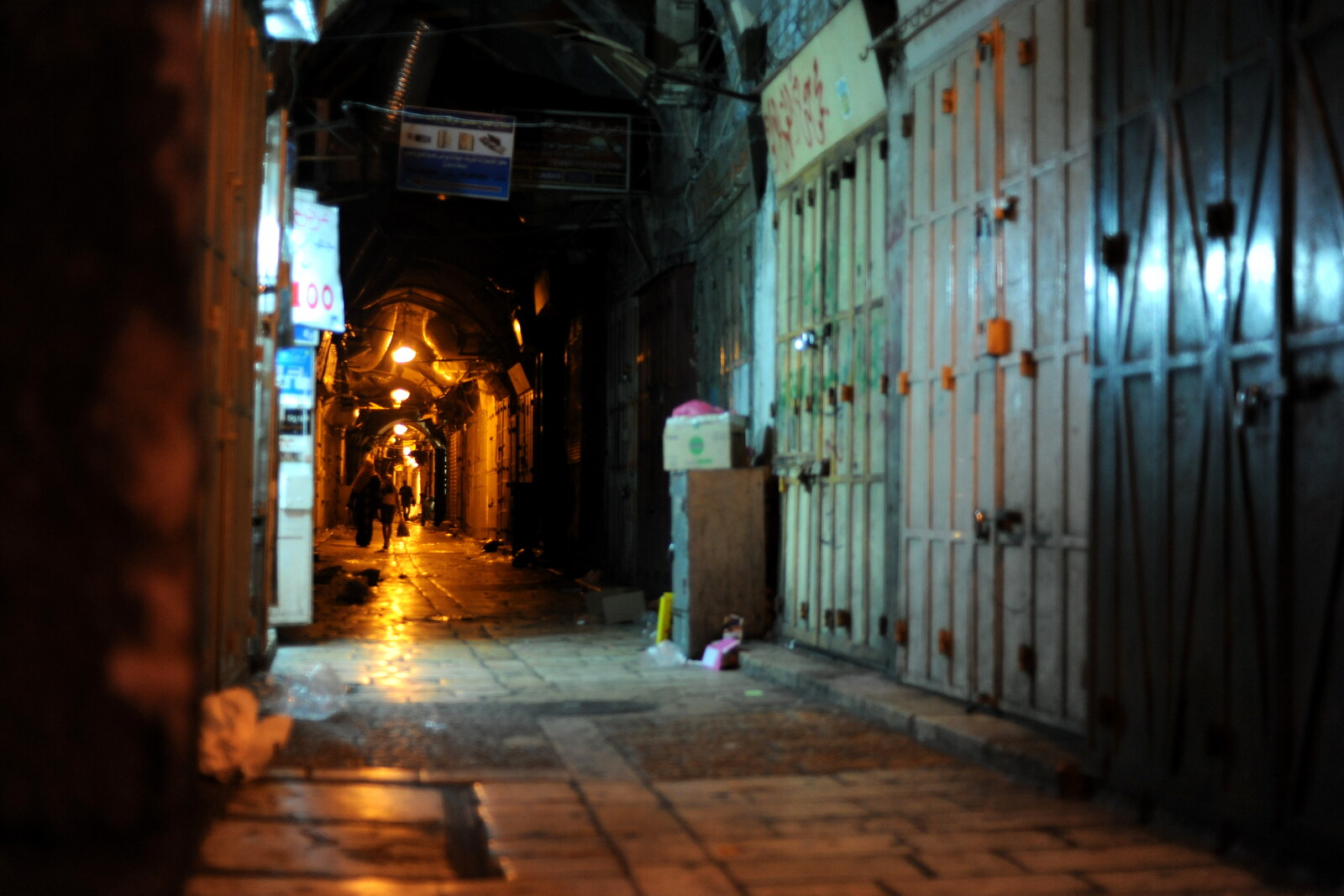
Look around first
What to notice
- Modern shops
- Door of the Franciscan chapel
- Sign of the seventh station
- Five-meter stone column
The story of the place
Behind the facades of the present-day shops, the Khan al-Zeit market continues; its old name preserves the memory of its former purpose. In this commercial passage stands a small Franciscan chapel with two prayer rooms arranged one above the other. A five-meter stone column is built into the lower one, and its base has remained from a Roman intersection of the second century. That intersection arose after the Gospel events, so the stone itself does not confirm the later pilgrims' tradition.
In the sixteenth century, an olive-oil merchant entering Jerusalem with a caravan could not sell the goods to the first buyer he met. Each camel carried four vessels; large consignments were supposed to be brought to this market street. Here stood large lever scales and there was a khan—a courtyard with warehouses—where the load was unloaded, weighed, sold, or left in storage.
Oil was used to cook food, fuel lamps, and supply Jerusalem's soapworks. It did not spoil for a long time and retained its value, so the scales' readings determined the earnings of both the visiting merchant and the warehouse owner. Three dirhams were charged for one camel load: one for weighing, two for using the khan. The revenue from the scales and the courtyard was intended for the upkeep of the city hospital.
In the early sixties of the sixteenth century, the lessee of the scales arbitrarily added another third to the fee. Oil merchants filed a complaint, and the surcharge was prohibited. The mandatory fee, however, remained. To avoid paying it, some merchants began unloading the vessels in private houses and weighing the oil directly at the soapworks. Town criers again announced the ban; violators were brought before a court, fined, and subjected to corporal punishment. Trade outside the khan continued all the same: the profit was worth the risk. In fifteen sixty-four, the official weighing fee was reduced to one dirham per camel.
The market's former specialization disappeared, but its name preserved the entire order of trade. Suq Khan al-Zeit means the market of the oil khan. Behind the modern shops lies the memory of a place where officials directed caravans and merchants tried to move their goods past the scales.
It is here that the market crosses Via Dolorosa. A sign above the door of the small Franciscan Chapel of the Seventh Station marks the seventh station—the place of Jesus's second fall, as he was being led to crucifixion according to the Christian account. The fall itself is not mentioned in the Gospels. It is a tradition that arose among medieval pilgrims: they believed that the Judgment Gate, through which the condemned were led out of the city, stood nearby.
The order of the stations changed for a long time. Before the sixteenth century, this point was considered the eighth and final stop on the streets; later it became the seventh. The Franciscans—Catholic monks who accompanied pilgrims along the Way of the Passion—acquired the plot in eighteen seventy-five. By eighteen ninety-four, they had arranged two chapels here, one above the other. The procession gained a place for prayer in the middle of a commercial crossroads.
A five-meter stone column is built into the lower chapel. Its base dates to the second century, to the time when the Roman emperor Hadrian was rebuilding Jerusalem as Aelia Capitolina. Archaeologists link the column to a tetrapylon—a structure marking the intersection of the Cardo and a cross street. It appeared later than the Gospel events and does not confirm the tradition of the fall. Behind the door marked with the seventh station, a stone marker of another intersection, laid out by the Romans about a century later, has survived.
Useful on site
Public market street; passage is possible daily, but on Fridays, during Holy Week, and under heightened security measures, movement may change sharply.
Checked: June 27, 2026. Check the official source before visiting.Listen at the edge of the passage, without blocking the stalls or the route of processions. Entry to the small chapels depends on access at the site.