 Guide On Map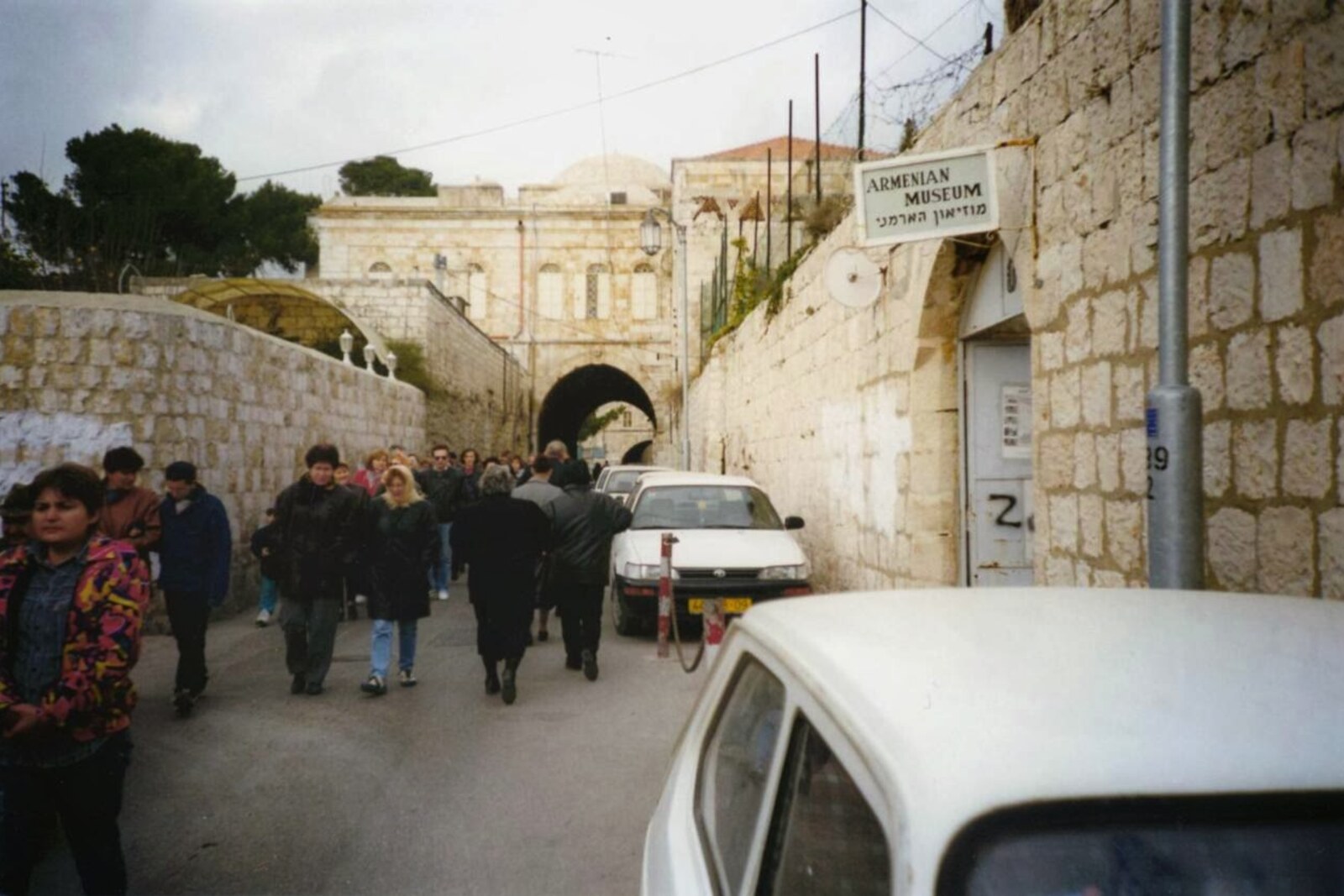
Look around first
What to notice
- Stone wall
- Patriarchate gates
- Entrance to the Mardigian Museum
- Wall inscriptions by the residents
The story of the place
The stone wall along the road hides an entire monastic town. Beyond the gates are the Cathedral of St. James, the residence of the head of the Armenian Apostolic Church in Jerusalem, a seminary, a library, a museum, and residential courtyards. This complex occupies most of the Armenian Quarter. It is from this complex that Armenian Patriarchate Road got its name.
In nineteen twenty-two, one of the buildings beyond the wall had to be urgently adapted for a different purpose. After the Armenian Genocide in the Ottoman Empire, several hundred boys who had lost their families were brought to Jerusalem. The former theological seminary was turned into the Araratian Orphanage. Benefactors fed the residents and taught them trades: once they left the orphanage, the teenagers would have to earn their own living straight away.
A wind band was assembled from among them. In nineteen twenty-four, the monastery was visited by Ras Tafari Makonnen, regent of Ethiopia and the future emperor Haile Selassie. After seeing the residents perform, he asked Yeghishe Tourian, head of the Armenian Patriarchate of Jerusalem and the person responsible for the orphans' fate, to let forty musicians go with him.
Later retellings often claim that the regent adopted all forty. In fact, the boys were taken into service. Their contract provided housing, uniforms, instruments, and wages; in return, they had to play at court ceremonies. For the residents, who had previously lived on charitable support, this meant a profession and an income of their own.
In Addis Ababa, the band was led by Kevork Nalbandian, an Armenian musician who had himself survived mass killings and exile. The forty young men became Ethiopia's first official wind band. Nalbandian wrote the country's first national anthem, and the former residents performed it at Haile Selassie's coronation in nineteen thirty. When the contract ended, most of the musicians took up the trades for which they had been trained at the orphanage; only a few continued to play professionally.
The former seminary has now become the Mardigian Museum, and its entrance opens directly onto this road. Inscriptions by the residents have survived on the walls: names, ages, hometowns, and the orphanage's name. Their writings remained beyond the gates of the patriarchate; from here, forty boys began their journey to service at the Ethiopian court.
Useful on site
Public street; best visited during daylight hours, when the open and closed courtyards are easier to distinguish.
Checked: June 27, 2026. Check the official source before visiting.Closed doors mark the boundary of residential and monastic areas: do not follow community members inside. Plan a museum visit separately.