 Guide On Map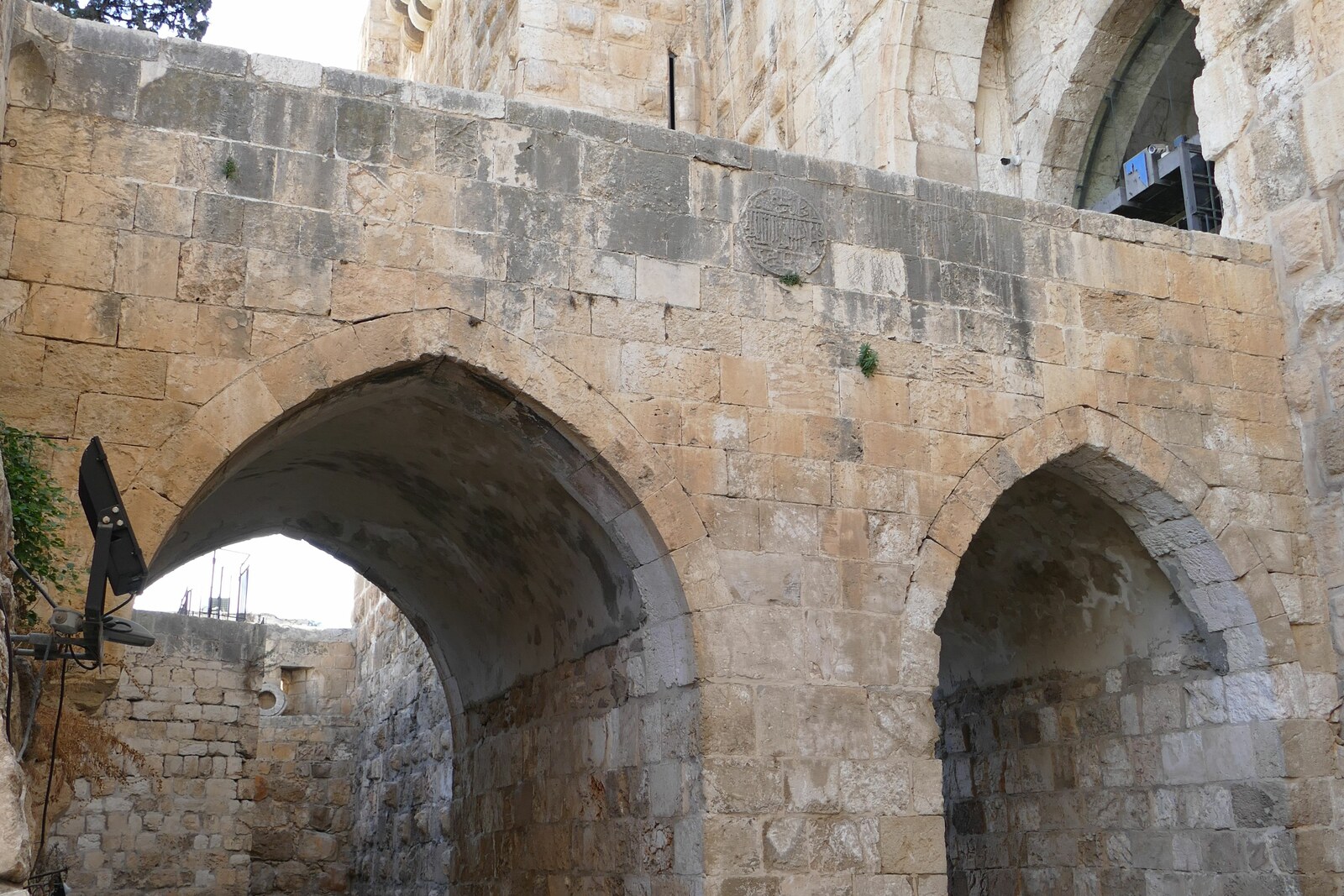
Look around first
What to notice
- Dry moat
- Massive base of the ancient tower
- Ottoman minaret
- Entrance fortifications
The story of the place
The dry moat in front of the walls still shows why a separate fortification was kept on the city's western hill. Here, the terrain did not provide as much protection as it did on other sides, and a fortress by the city wall allowed the garrison to resist even if the enemy had already occupied the streets. The present walls were assembled later, but inside remains the heavy stone foundation of the tower built under King Herod. The tall, slender minaret above it is much younger: the Ottomans raised it in the mid-seventeenth century, and in the nineteenth century the old name Tower of David was transferred to it from the ancient tower.
Raymond of Saint-Gilles entered this fortress without an assault. On July fifteenth, ten ninety-nine, his detachment took part in the siege of Jerusalem: the army of the First Crusade broke into the city, but the Fatimid governor Iftikhar al-Dawla managed to lock himself inside the citadel with part of the garrison.
Iftikhar had to hold Jerusalem until an army arrived from Egypt. For his final defense, he chose a point that builders had fortified long before him. Here, the city's western hill approached a comparatively convenient passage between valleys, so it was harder to stop attacks from this side using the natural terrain. A separate fortress beside the city wall allowed the garrison to continue resisting when the enemy had already occupied the streets.
A massacre of Muslim and Jewish residents began in Jerusalem. Iftikhar understood how an assault on the citadel would end, while Raymond, Count of Toulouse and commander of the southern Crusader detachment, wanted to receive the fortress intact. They made a bargain: the governor handed the tower over to Raymond, and Raymond guaranteed safe passage to Iftikhar and his men. Iftikhar, his bodyguards, and the surviving warriors left the city and reached Ascalon. Outside the citadel walls, they received what thousands of people on the city streets did not—the chance to surrender and stay alive.
A few days later, the prize itself put Raymond up against a different opponent. The leaders of the expedition chose Godfrey of Bouillon as ruler of Jerusalem. Raymond had previously refused to take that position, but he did not want to give up the citadel: he declared that he would remain in the city until the following Easter and that he needed the tower as his residence. For Godfrey, such a neighbor meant that Jerusalem's strongest fortification was occupied by the warriors of a rival.
Under pressure from the other leaders, Raymond agreed to transfer the fortress temporarily to Peter of al-Bara, bishop of the Syrian city of al-Bara, until a general council reached a decision. The bishop belonged to Raymond's circle, so the count expected to keep the tower for himself. Peter immediately opened it to Godfrey's men. Raymond called the bishop a traitor, left Jerusalem, and departed with his detachment for the Jordan River. Raymond lost the fortress he had received in return for guaranteeing Iftikhar's life because he trusted his own appointee.
At that time, a small triangular citadel stood here around a massive tower built under King Herod. It has not survived in its entirety. The Crusaders enlarged the fortification to its present size and surrounded it with a dry moat: there was no water in it, but its depth prevented men and siege engines from being brought up to the walls. Later rulers demolished and rebuilt the fortress, but the heavy stone base of Herod's tower remained inside the present citadel.
King David had nothing to do with it. In the Byzantine period, Christian monks and pilgrims mistakenly took the surviving tower of Herod for the palace of the biblical king and called it the Tower of David. The real ancient City of David lay much farther to the southeast. The tall, slender minaret above the citadel appeared under the Ottomans in the mid-seventeenth century; only in the nineteenth century was the old name Tower of David transferred from the massive tower to this minaret. In front of the moat stand the fortifications over which Iftikhar and Raymond bargained, and above them rises the Tower of David, built several millennia after David himself.
Useful on site
The museum is usually open: Sunday 12:00–17:00, Monday 09:00–17:00, Tuesday 09:00–20:00, Wednesday–Thursday 09:00–17:00, Friday–Saturday 09:00–15:00. Ticket offices close an hour before closing; check night shows and tours separately.
Checked: June 27, 2026. Check the official source before visiting.An outside view is enough for the story. If you want to see the museum rooms and the Kishle, check entry availability separately.