 Guide On Map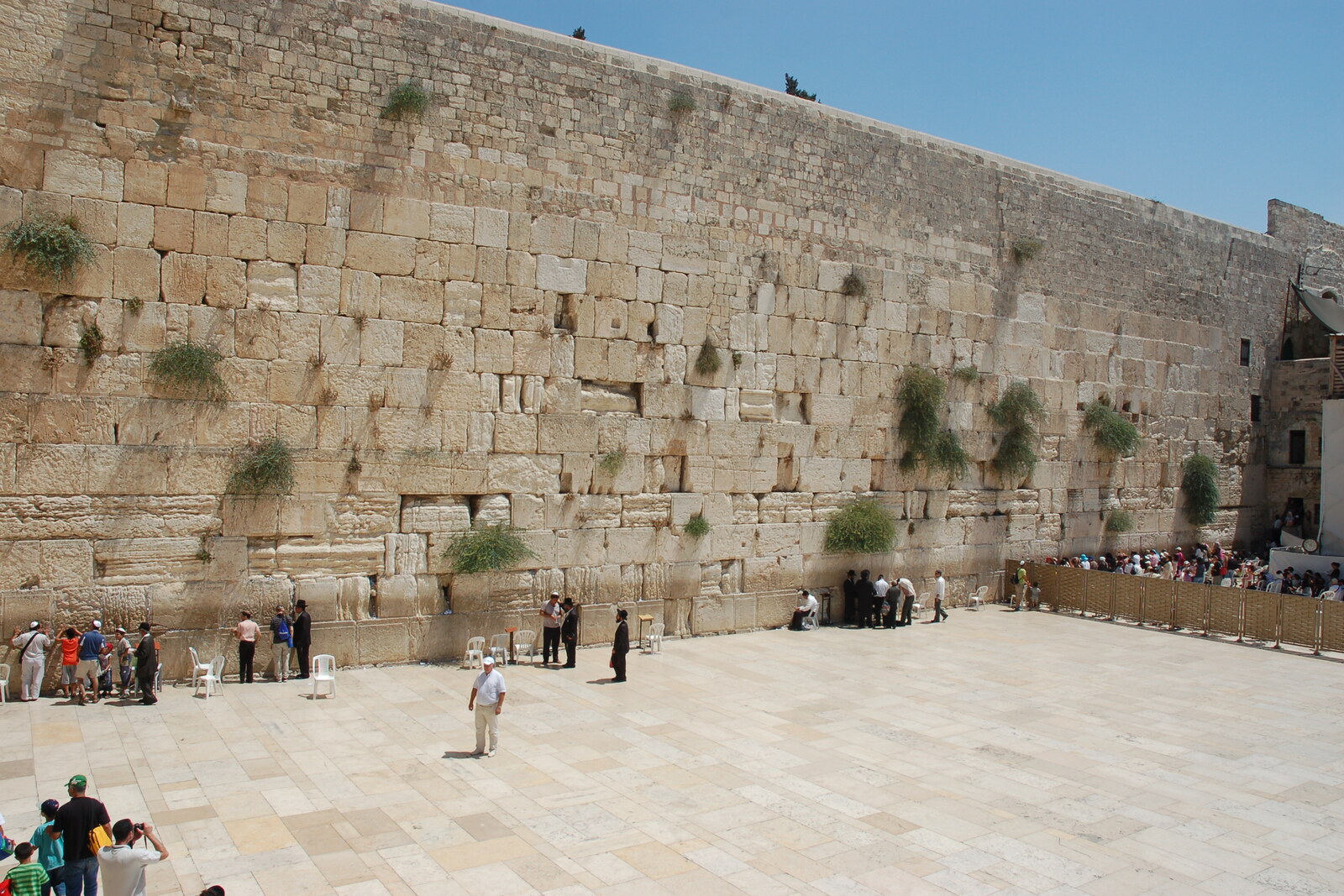
Look around first
What to notice
- Large lower blocks
- Outlined edges of the stones
- Smaller stones in the upper courses
- Slips of paper in the masonry’s cracks
The story of the place
Below the paving, the masonry extends another seventeen courses down. At plaza level lie its largest stones, with a finely carved border around their edges, while the smaller upper blocks belong to later additions. The Wall forms the western edge of a broad terrace at Temple Mount; the sanctuary stood higher up the slope, closer to the middle of this terrace. After the Temple was gone, people began coming here to pray: this was the shortest remaining route to the Holy of Holies. Now the lower part of the plaza serves as an open-air synagogue, and the notes from the cracks are buried twice a year.
King Herod began rebuilding the Second Temple with a promise that the city’s residents did not initially believe. This ruler of Judea, who gained the throne with Rome’s support, wanted to build a sanctuary capable of becoming the main monument to his reign. For the Jews, the Temple was the only place where the most important sacrifices were performed. Those gathered were afraid that the king would dismantle the old building, fail to complete the enormous undertaking, and bring worship to a halt.
Herod promised not to touch the Temple until he had prepared everything needed. Before work began, he assembled one thousand carts to transport stone, hired ten thousand experienced builders, and ordered one thousand priests to be trained in stonework and carpentry. The priests were to work in the inner chambers, where religious rules did not permit ordinary workers. The old building was dismantled section by section only once replacement materials were already lying beside it. Daily worship continued throughout.
The mountain was too small for the planned complex. The builders enclosed it with four retaining walls, filled the gaps between the slope and the masonry, and created an enormous level platform on top. Before us is its western wall. The Temple itself stood higher up, behind it, closer to the middle of today’s Temple Mount.
The work outlived Herod and continued under his successors. When it was finally completed, more than eighteen thousand Temple workers lost their income. These people lived on daily wages: even someone who had worked only one hour was paid. They asked King Agrippa II, who oversaw Temple affairs, to allow them to dismantle and rebuild the eastern colonnade. The Temple treasury would then again go toward wages.
Agrippa refused to demolish a sound structure, but he did authorize payment from the same funds for paving Jerusalem’s streets with white stone. The workers received other work. A few years later, war with Rome began, and in the year seventy Roman troops destroyed the Temple buildings. Part of the massive retaining courses on the western side remained in place.
After the Temple was gone, Jewish pilgrims came to the western edge of its former platform to pray and mourn the destruction. In Jewish tradition, this section was considered the nearest accessible place to the Holy of Holies—the inner chamber of the ancient Temple. In the nineteenth century, European travelers popularized the name “Western Wall” after seeing prayers of mourning here. In Hebrew, it is called the Western Wall, or simply the Wall.
The lower part of the plaza is now considered an open-air synagogue. Daily prayers are held here, the Torah is read, and bar mitzvahs are celebrated. The slips of paper in the masonry’s cracks are written prayers. Twice a year, they are carefully removed and buried, like religious texts that may not be thrown away.
The large lower blocks with neatly outlined edges date from the Second Temple period; the smaller stones above were added later. Beneath the present paving lie another seventeen courses of the wall that the builders lowered toward the mountain’s foundation.
Useful on site
The plaza and prayer area operate as usual, but rules of conduct, service schedules, security measures, and tunnel access should be checked on the day of your visit.
Checked: June 27, 2026. Check the official source before visiting.This is an active prayer space: go through security checks calmly, observe the separation of sections, and do not photograph people without permission.