 Guide On Map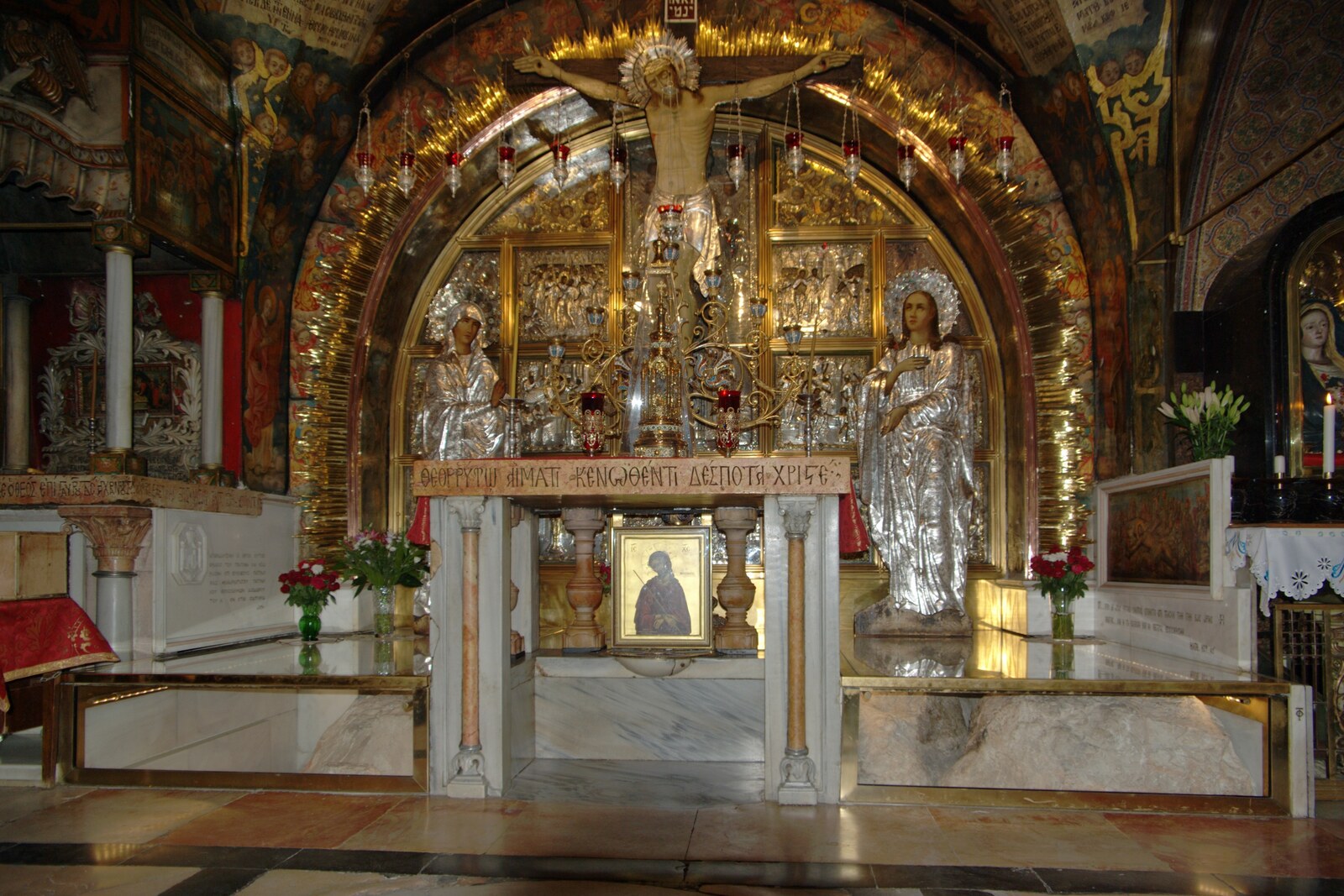
Look around first
What to notice
- Aedicule
- The church’s great dome
- Upper marble slab
- Window with a fragment of the cave wall
The story of the place
The Church of the Holy Sepulchre is arranged around a small marble chapel beneath a great dome; pilgrims enter it one at a time and bow over the upper slab. Beneath the cladding, the stone core of the cave remains, and part of its ancient wall is visible through a small window inside the chapel. In the first century, the site lay outside the city wall: Jewish tombs cut into limestone remained here from an abandoned quarry. Three centuries later, the Roman temple on this site was dismantled, and the uncovered tomb was separated from the rock so that the first Christian complex could be built above it.
On the evening of October twenty-sixth, twenty sixteen, a team from the National Technical University of Athens removed a marble slab in the cramped chamber of the Aedicule—a small chapel beneath the church’s great dome. Beneath this slab, Christians venerate a limestone burial bed, carved from the rock, on which, according to the Gospels, the body of Jesus was laid after the crucifixion. Hence the name: the Church of the Holy Sepulchre. Golgotha, where the site of the crucifixion is placed, lies under the same roof.
The work was led by Antonia Moropoulou, a professor of chemical engineering and a specialist in monument conservation. She was to reinforce the chapel, built after the fire of eighteen oh eight. Its stone cladding was separating, and since nineteen forty-seven the structure had been held together by an external iron frame. Engineers warned that the temporary support no longer guaranteed protection against collapse.
The very arrangement of the church had prevented repairs from beginning. The Greek Orthodox Patriarchate of Jerusalem and the Armenian Patriarchate of Jerusalem, together with the Franciscan Custody of the Holy Land, which represents Catholics, share the principal rights here. An Ottoman decree of eighteen fifty-two secured to the communities the chapels, altars, and hours of worship that they occupied. This arrangement is called the status quo. It also governs processions, the cleaning of the shared Aedicule, and the order of services at the tomb. Anything in the shared section can be changed only by common consent.
In March twenty sixteen, the leaders of the three communities signed such an agreement. For them, the restoration meant allowing engineers access to a shrine that each community used according to its own schedule, while not yielding its rights to the others. About fifty specialists worked mainly at night so that pilgrims could continue entering the tomb during the day.
When Moropoulou received permission to open the burial chamber, sixty hours remained for the investigation. Beneath the upper slab lay a layer of stone fill. Below it, another marble slab was found, broken and carved with a cross. Under it, the limestone burial shelf and part of the wall of the ancient cave had survived.
This discovery answered a question that cannot be resolved outside the Aedicule. In the first century, beyond the city wall of the time, there was an abandoned quarry here with Jewish tombs cut into the rock. The Gospels say that Joseph of Arimathea, a wealthy follower of Jesus, obtained permission from the Roman governor to take the body of the executed man and buried it in his own new tomb near Golgotha. The followers of Jesus believed that he rose on the third day and that the tomb remained empty.
About three centuries later, Emperor Constantine ordered the Roman temple that stood here to be dismantled. Beneath it, builders uncovered a rock-cut tomb that local Christians recognized as the tomb of Jesus. They cut away the surrounding rock, leaving the burial chamber as a separate stone core, and built the first church complex over it.
Researchers dated the mortar between the lower marble slab and the limestone bed to the middle of the fourth century, around the year three forty-five. The analysis cannot establish whose body was in this tomb, much less verify belief in the Resurrection. It showed something else: the shrine from Constantine’s time stood directly above the very limestone bed hidden inside the present Aedicule. Through centuries of destruction and rebuilding, it was not moved to a more convenient part of the church.
On March twenty-second, twenty seventeen, Moropoulou’s team handed the reinforced chapel over to the communities. The iron frame that had surrounded it for seventy years was removed, and the marble slabs were returned to their place. Now pilgrims bow over the upper slab; beneath it, in the order documented by the researchers, lie the fourth-century slab and the limestone burial bed. A fragment of the wall of the original cave has been left visible through a small window inside the Aedicule.
Useful on site
The basilica is usually open in summer 05:00–20:45, until 20:00 in October, in winter 04:00–19:00, and until 19:30 in March. During Holy Week, major holidays, and security measures, check current announcements and queues on the day of your visit.
Checked: June 27, 2026. Check the official source before visiting.Do not stand in front of the doors, and keep in mind that services and the queue take priority over the pace of the walk. Even without entering, the facade reveals the key story of this stop.