 Guide On Map
Around Bến Thành: commercial Saigon and Art Deco
From the Ho Chi Minh City Museum of Fine Arts through Bến Thành to Calmette Bridge
Guide On Map on your phone
Open the walk like a regular app
It takes about 10 seconds to install. No app store needed.
The whole path
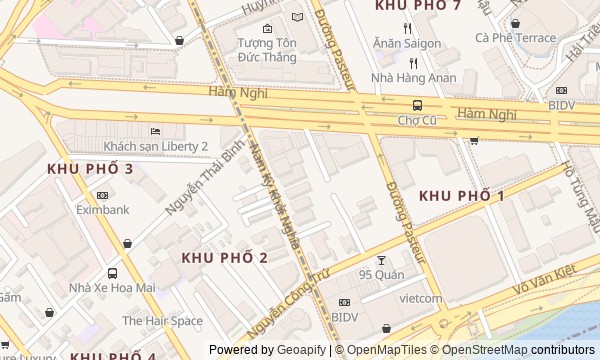
Route map
About the walk
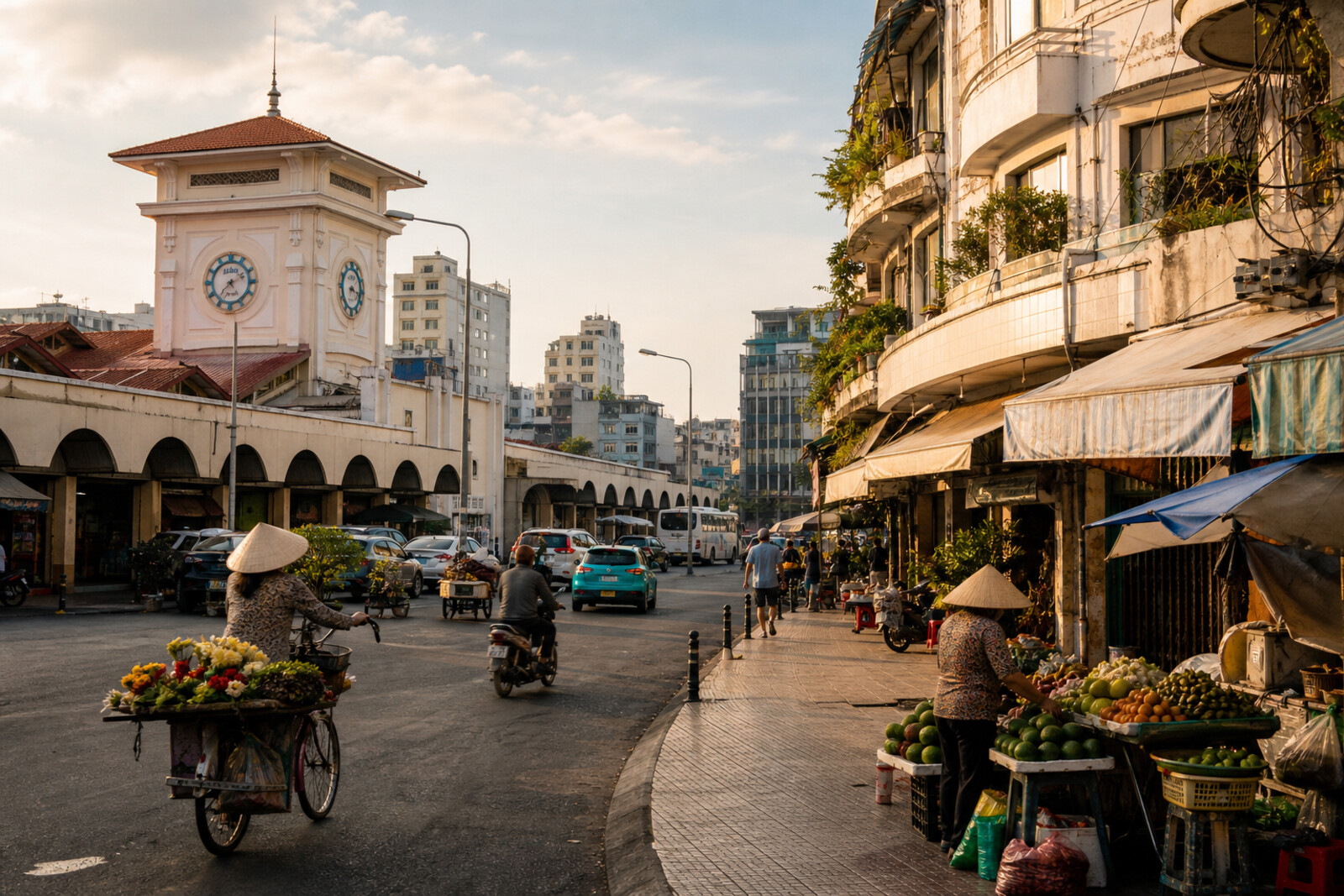
You will walk from a former family home to Bến Nghé Canal, passing hospital buildings, the square in front of Bến Thành, the market itself, and the Chợ Cũ district. The route stays close to the places where Saigon treated patients, traded, taught, and moved people.
Above the museum entrance, you will find family initials. On a hospital facade, you will not find the name the city councilors debated. Ceramic animals hang above the market gates, while above the closed door of an assembly hall are the windows of a former dormitory. At Sở Hỏa xa, you will learn why a sandy plot appeared on the sidewalk. The ending takes you to a bridge named for a doctor who started with 2 rooms.
The story moves from small traces to decisions that reshaped entire city services. No architectural lecture, no heroic posturing. By the end of the walk, you will be able to connect Bến Thành, school windows, hospital buildings, and Calmette Bridge into one story of commercial Saigon.
Why this order
At the museum, you begin with private money and a surname on the facade. At the neighboring Dejean de la Bâtie Dispensary, the same theme becomes public: personal funds go toward free care, while the city decides whose name to preserve. At the square just beyond the hospital, you will see a name travel in the opposite direction—from residents to the city map. From the space before the gates, look up at the market's ceramics: public space gives way to the building it was created for. Then you move from the new Bến Thành to Chợ Cũ, where the trading community invests not in shops but in a school. At Sở Hỏa xa, you encounter another way of bringing a city together—through tracks, a station, and passenger flows; the neighboring sidewalk adds a story of performative power. On the final descent along Calmette Street, trade and railways give way to a medical network. At the bridge, the walk ends where a doctor's name remains on the city map after his laboratory has disappeared.
Those who want to see Bến Thành beyond the market stalls Fans of urban history told through human decisions Those interested in Art Deco, Chinese native-place associations, and old institutions
Those expecting a walk devoted only to grand colonial facades Those who do not want to hear about political violence and a public execution Those who care more about shopping at the market than the district's history
Before you go
Plan for 2 hours on foot and several stops beside busy streets. Some stops remain working institutions, so you can follow the main story from the facades without going inside. Plan a museum visit separately from the walk. At the market, keep clear of passageways; at the clinic, official buildings, and Cantonese shrine, respect the work of staff, visitors, and worshippers. At the square and bridge, choose a safe place to stop, and do not listen while crossing the road.
When to go
2 hr
Backup plan
If the museum is closed or Bến Thành is too crowded, do not skip these stops: at the first, it is enough to look at the gates and the exterior of the mansion, while the market can be read from its clock tower, roof, and ceramic reliefs outside. Working government and medical buildings also do not require entry. In the old trading district, focus on the streetscape and the roof of the assembly hall without disturbing local life. If you are very tired, end the substantial part of the walk at the old market; save the bridge as a separate finale for when you can approach the canal at an unhurried pace.
Route conditions
Surface. Asphalt — 2 km; paving_stones — 66 m (data covers 90% of the route)
Facilities. Toilets — 2
Elevation. Ascent — 13 m; descent — 22 m
OpenStreetMap extract of August 25, 2026: database data, not a check on the ground. Data © OpenStreetMap contributors, ODbL licence
Walk plan
Open in maps ↗- 1
Ho Chi Minh City Museum of Fine Arts
Here, family real estate, genealogy, and a museum come together in one house. - 2
Dejean de la Bâtie Dispensary
This stop will show how a free clinic became a municipal institution and a subject of dispute over memory. - 3
Quách Thị Trang Square
Here you will trace how the memory of a schoolgirl became attached to the main space in front of the market. - 4
Bến Thành Market
The ceramic commission will bring young masters whose names did not appear on the finished work to the foreground. - 5
Old Market and Quảng Triệu Assembly Hall
The route will need the local trade association as a community that turned pooled funds into a school and a dormitory. - 6
Sở Hỏa xa — the building on Hàm Nghi
The history of the station district will explain why the authorities chose this busy sidewalk for a demonstrative punishment. - 7
Calmette Street and Bridge
The final stop will connect an ordinary road sign with a new system for producing and delivering vaccines.
Route features
Everything you need stays in the browser
Progress, saves and your trip plan are stored on this device.
Add Guide On Map to your home screen so the walk opens outside the browser.
How we handle sources, maps and corrections: our editorial standards