 Guide On Map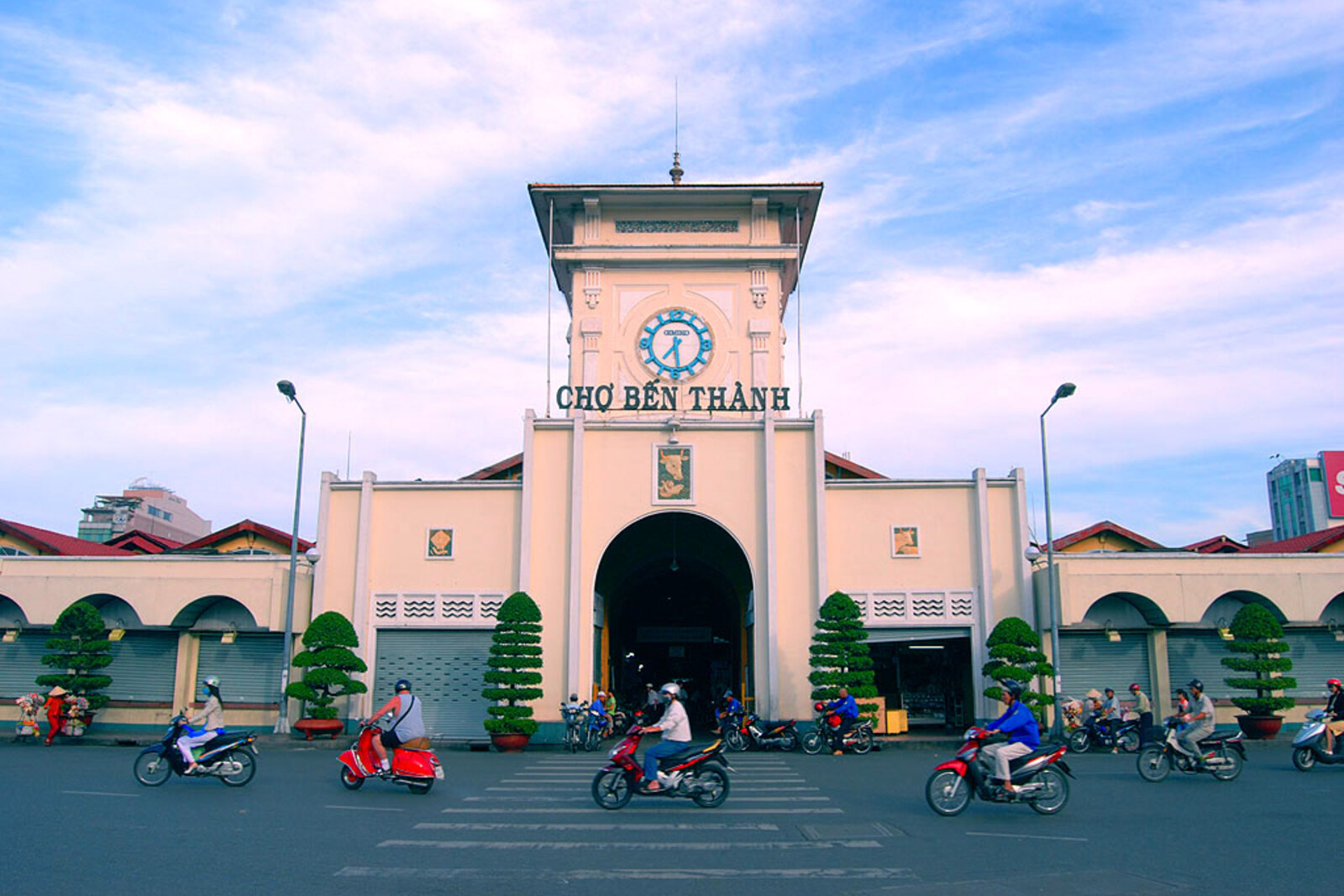
Look around first
What to notice
- Four clock faces
- Panel with a bull and fish
- Panel with a ray and catfish
- White-and-green glaze
The story of the place
The Bến Thành market stalls stand where Bò Rệt Swamp once stretched. The market was moved here from the river wharf and Gia Định Citadel when the former site no longer had enough space; the road to trading Chợ Lớn ran nearby. Four entrances lead beneath the high roof, and the stone floor here is designed for daily water and dirt: it can be washed down. The restrained facades were designed for air, rainwater drainage, and fire protection, not for a decorative appearance.
Above the southern gate, beside the clock faces, ceramic panels show a bull, a fish, a pig, and a ray. When the present pavilion opened in nineteen fourteen, these images were not on the facade.
The name Bến Thành is usually translated as “the wharf by the citadel.” The building inherited it from an earlier market near a river wharf and Gia Định Citadel. The market stalls themselves were moved here, to the site of the filled-in Bò Rệt Swamp, because the old market had become too cramped and the road to the trading city of Chợ Lớn ran nearby. The new pavilion had four entrances, a high roof volume, and a stone floor that could be washed down. The facades were left almost undecorated: the city council cared more about ventilation, drainage, and fire safety.
Only in nineteen fifty-two did a contractor commission twelve panels from the cooperative of the Biên Hòa School of Applied Arts. The cooperative lived on commissions like these. The sculptor and teacher Lê Văn Mậu was to devise images understandable without inscriptions, and he chose the goods traded under this roof: livestock, poultry, river and sea fish, and bananas.
Lê Văn Mậu modeled the reliefs directly in clay, while experienced ceramicists corrected the details. A single whole slab could not be sent into the kiln: it would warp during firing. So each image was cut into small sections, coated with local white and copper-green glazes, wood-fired, laid out by the school flagpole, and checked. Wherever a piece had bowed, Lê Văn Mậu ordered clay shaved from its back. The sections were then packed into crates and taken to Saigon.
Master Phạm Văn Nga and two recent graduates of the school, Nguyễn Chí Giang and Võ Ngọc Hào, arrived to install them. Both were about twenty years old. The contractor had left blank sections of wall above the entrances and put up scaffolding. The ceramicists assembled the images from the bottom up, held each fragment in place with braces, waited for the mortar to set, and then filled the joints.
Other commissions remained in Biên Hòa, and the senior master soon left. The twelve panels fell to the two young ceramicists. For almost two months, they worked on the four gates and slept upstairs near the entrance clocks. When Phạm Văn Nga returned, he only had a few spots to correct. Giang and Hào completed the commission and went back to Biên Hòa.
Their names do not appear on the panels themselves. In two thousand seven, art researcher Nguyễn Minh Anh tracked down both masters and recorded their account; Lê Văn Mậu had already died by then. Above the southern gate remains the market's inventory of goods assembled by them: a bull and a fish in the center, with a ray and catfish on one side, and a bull and pig on the other.
Useful on site
Day market 06:00–18:00; night trading around the market approximately 18:00–22:00.
Checked: June 26, 2026. Check the official source before visiting.Do not stand in the middle of the aisles inside; if it is crowded, the main architectural details can be clearly seen from outside.