 Guide On Map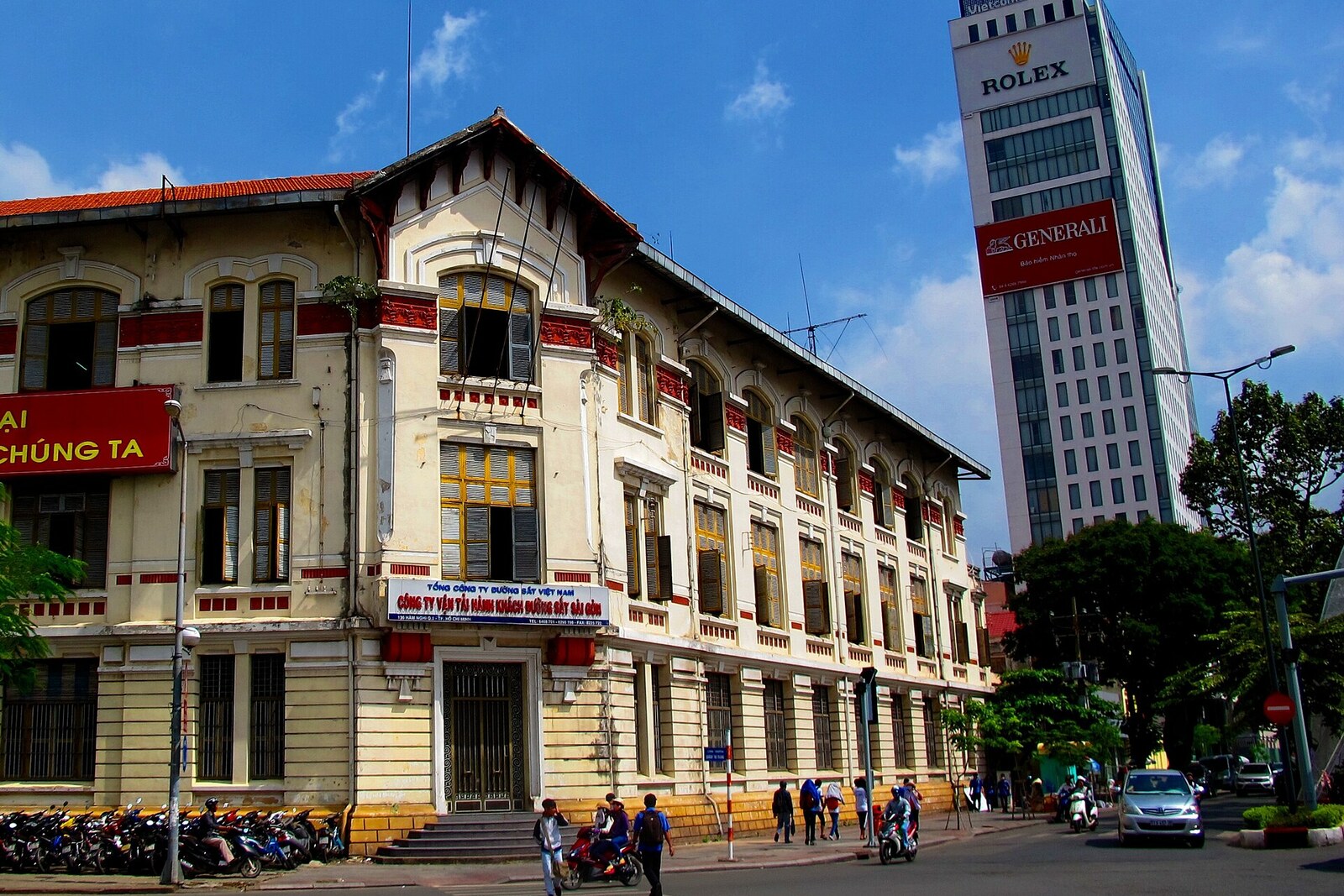
Look around first
What to notice
- Rows of shutters
- External corridors
- Main façade
- Entrance from the Hàm Nghi side
The story of the place
Divisions of the Saigon Railway still occupy these old premises on Hàm Nghi. Behind the shutters on every floor run broad open galleries: they keep the workrooms farther from the heated wall. The administration was placed directly opposite the new station after the cramped terminal by the river could no longer accommodate trains on two routes. The station was later moved out of the city center and the tracks were removed, so the main façade now faces a street without platforms.
Early in the morning of March fourteenth, nineteen sixty-six, Tạ Vinh was brought to the façade of the Railway Administration. The thirty-four-year-old businessman from Saigon's Chinese community ran the import-export company Sui Hing. He made his living by trading goods and transferring money—exactly the activities that a special court declared to be wartime speculation, illegal capital export, and bribery of officials. The court sentenced him to execution by firing squad.
Tạ Vinh asked for clemency. The prime minister of South Vietnam, Nguyễn Cao Kỳ, sought a demonstrative punishment for economic crimes and ordered the sentence carried out without delay. Soldiers and military police sealed off the area between the market, the station, and Hàm Nghi Street. Tạ Vinh's wife was held at the barrier when she tried to reach her husband. He was tied to a post on a sand-covered platform and shot by firing squad.
This platform was set up on the sidewalk by the Railway Administration in early nineteen sixty-five. The location was chosen as a warning: passengers, traders, and shoppers at Bến Thành Market passed through the square. At that time, Saigon's main station stood directly opposite the façade.
The station and the administration appeared here after an error by colonial railway officials. They expected the old terminal by the river to handle trains on two lines—to Mỹ Tho and to Nha Trang. After the northern route opened in nineteen oh four, it became clear that there was not enough room: trains departed from two separate stations. In nineteen ten, the city administration decided to bring the lines together at one new station, dismantled the locomotive depot, and allocated the cleared land for a market and a square.
The Indochina State Railway Company placed its southern Railway Administration directly opposite the future station entrance. From here, employees managed traffic, stations, and track maintenance. The administration opened in nineteen fourteen, and the station a year later. Behind the rows of shutters on every floor, wide external corridors were laid out: they kept the offices away from the heated walls. This is the source of the building's old Saigon name—Sở Hỏa xa, the Railway Administration.
Tạ Vinh's execution provoked debate far beyond Saigon. Critics warned that executing one Chinese businessman would alienate the trading community but would not eliminate corruption and inflation. By the end of nineteen sixty-six, the sand-covered platform by the façade had been removed.
The station was removed later as well: in nineteen eighty-three, railway workers moved the passenger station to Hòa Hưng and lifted the tracks from the city center. There is no longer a firing post on the sidewalk in front of the building, and no platforms opposite it. In the old offices on Hàm Nghi, divisions managing the operation of the Saigon Railway still work.
Useful on site
Exterior viewing is possible around the clock.
Checked: date not specified. Check the official source before visiting.This is a working building: view the façade from the street and do not expect unrestricted entry.