 Guide On Map
At Ghent's Origins: Rivers and the Abbey Quarter
From Portus Ganda to Saint Macharius Church
Guide On Map on your phone
Open the walk like a regular app
It takes about 10 seconds to install. No app store needed.
The whole path
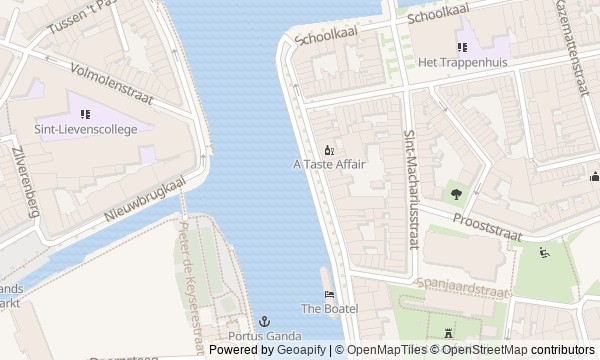
Route map
About the walk
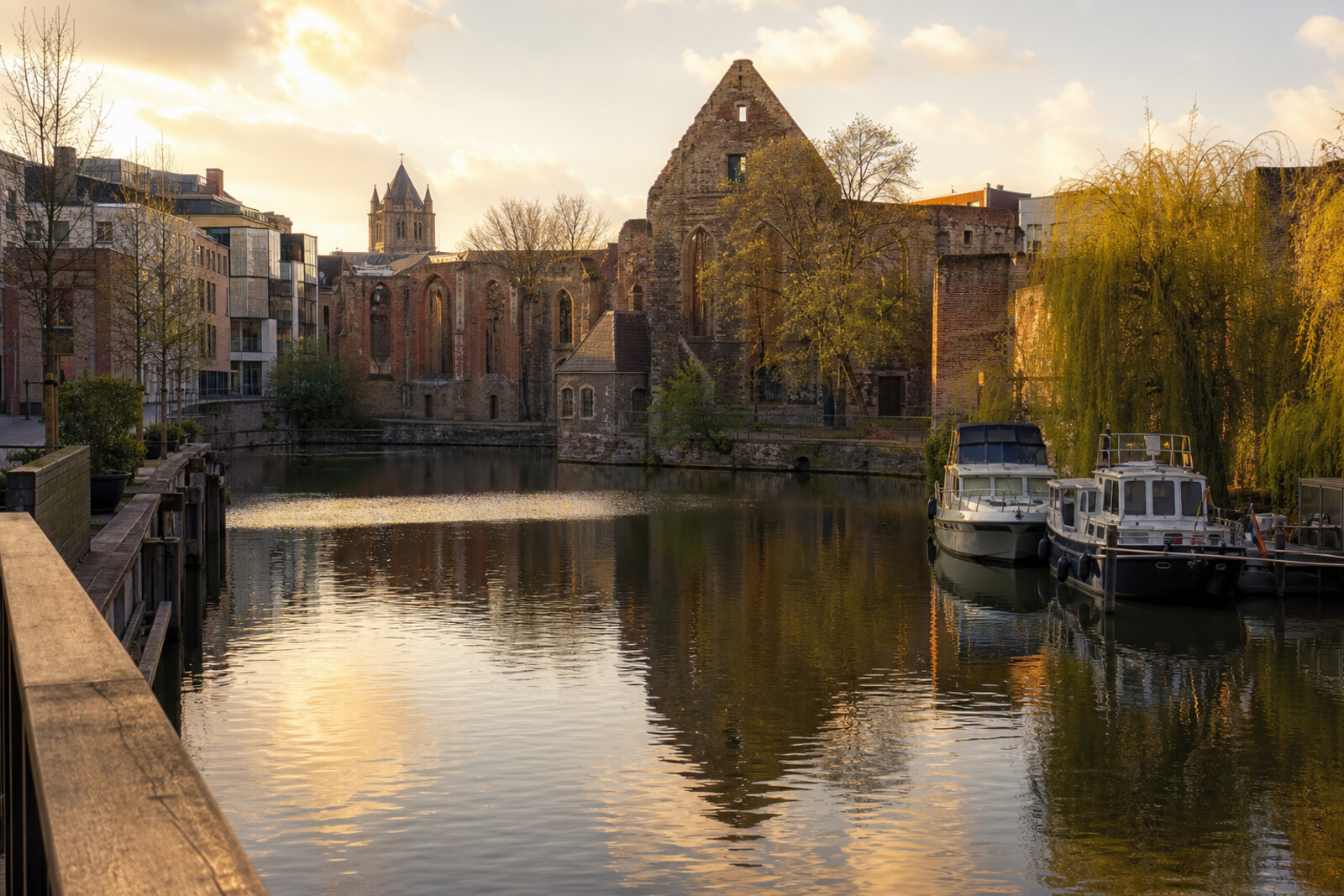
You will walk from the quays of Portus Ganda along a restored river channel to the public baths, then cross the park to abbey ruins and a red-brick church. This is the eastern edge of old Ghent: water, low embankments, grassy slopes, Art Deco, and monastic brickwork instead of the usual procession of grand squares.
Questions will come up along the way. Why will not a single bathing suit remain in the new baths by four o'clock? Why will residents bring shovels to a stretch where a river lies beneath the asphalt? And why will the columns of a vanished church begin to grow and demand trimming?
The story will stay close to details and human choices. It will separate documents from church tradition. It will show how people settled a river junction, erased its traces, and began bringing them back.
After the walk, you will be able to explain the origin of Ghent's name and read its early history in a park, a swimming pool, and fragments of walls.
Why this order
The confluence of the rivers will first explain why a settlement arose at Portus Ganda. Nearby Veermanplein will show who found work in this water hub; then De Reep will reveal the fate of the channel on which the crossing depended. The stop at the swimming pool does not follow simply because it is close by: its baths used river water and returned it already dirty. After this civic history, the route will cross the water into Coyendanspark, where trimmed hornbeams repeat the plan of a vanished monastic church. That outline leads to the abbey's actual masonry and the story of its rescue. The final church continues the abbey thread: it was named for a local saint and built over an earlier well.
Those who want to understand Ghent's origins beyond the grand center Lovers of urban history, water, and traces of vanished buildings Those who appreciate a calm story that separates fact from tradition
Those looking for a route focused only on the main cathedrals and market squares Those interested exclusively in intact medieval interiors Those who dislike retracing a short stretch along the water
Before you go
Check in advance whether access to Saint Bavo's Abbey is open: you can understand its history from outside, but its scale and layout are easier to see within. Also check whether you can visit the Van Eyck Swimming Pool and what is on at Saint Macharius Church—both buildings remain in use, so free access to their interiors is not guaranteed. Choose sturdy shoes for the ruins: the ground is uneven, and the site is officially not adapted for wheelchair access. The remaining stops can be viewed from public streets, riverbanks, and park paths.
When to go
1.5–2 hours; visiting an open abbey, the swimming pool, or an event at the church will require additional time.
Backup plan
If the abbey is closed, look at the accessible walls and openings through the fence, then linger in Coyendanspark: the hornbeam outline helps reconstruct the dimensions of the lost church without entering the site. A closed swimming pool does not break the route either—the facade still lets you discuss it as a public municipal institution, though the baths and interior will remain unseen. If Saint Macharius Church cannot be entered, end the story at its exterior Neo-Gothic mass and tower; a concert or other event should be planned separately.
Route conditions
Surface. Paved — 1 km (data covers 95% of the route)
Stairs. Flights: 2, 7 m in total
Access. Wheelchair — no; stroller — limited (stairs)
Facilities. Toilets — 3
Elevation. Ascent — 10 m; descent — 8 m
OpenStreetMap extract of June 18, 2026: database data, not a check on the ground. Data © OpenStreetMap contributors, ODbL licence
Walk plan
Open in maps ↗- 1
Portus Ganda
It will show why a trading settlement arose precisely at the confluence of the rivers and how its name passed to the city. - 2
Veermanplein
It preserves the memory of a vanished street through two occupations of its residents—a ferryman and a singer. - 3
De Reep
Shows how one city decision removed the water, while another returned it to its former course. - 4
Van Eyck Swimming Pool
Connects working-class daily life, public hygiene, and today's Art Deco interior. - 5
Coyendanspark
It will explain the hornbeam outline of the church as a trace of the punishment imposed on the rebellious city. - 6
Saint Bavo's Abbey
It will show why the ruins look at once uncovered, stabilized, and partly reassembled. - 7
Saint Macharius Church
It will show how an unverifiable legend about a pilgrim became an enduring local cult.
Route features
Everything you need stays in the browser
Progress, saves and your trip plan are stored on this device.
Add Guide On Map to your home screen so the walk opens outside the browser.
How we handle sources, maps and corrections: our editorial standards