 Guide On Map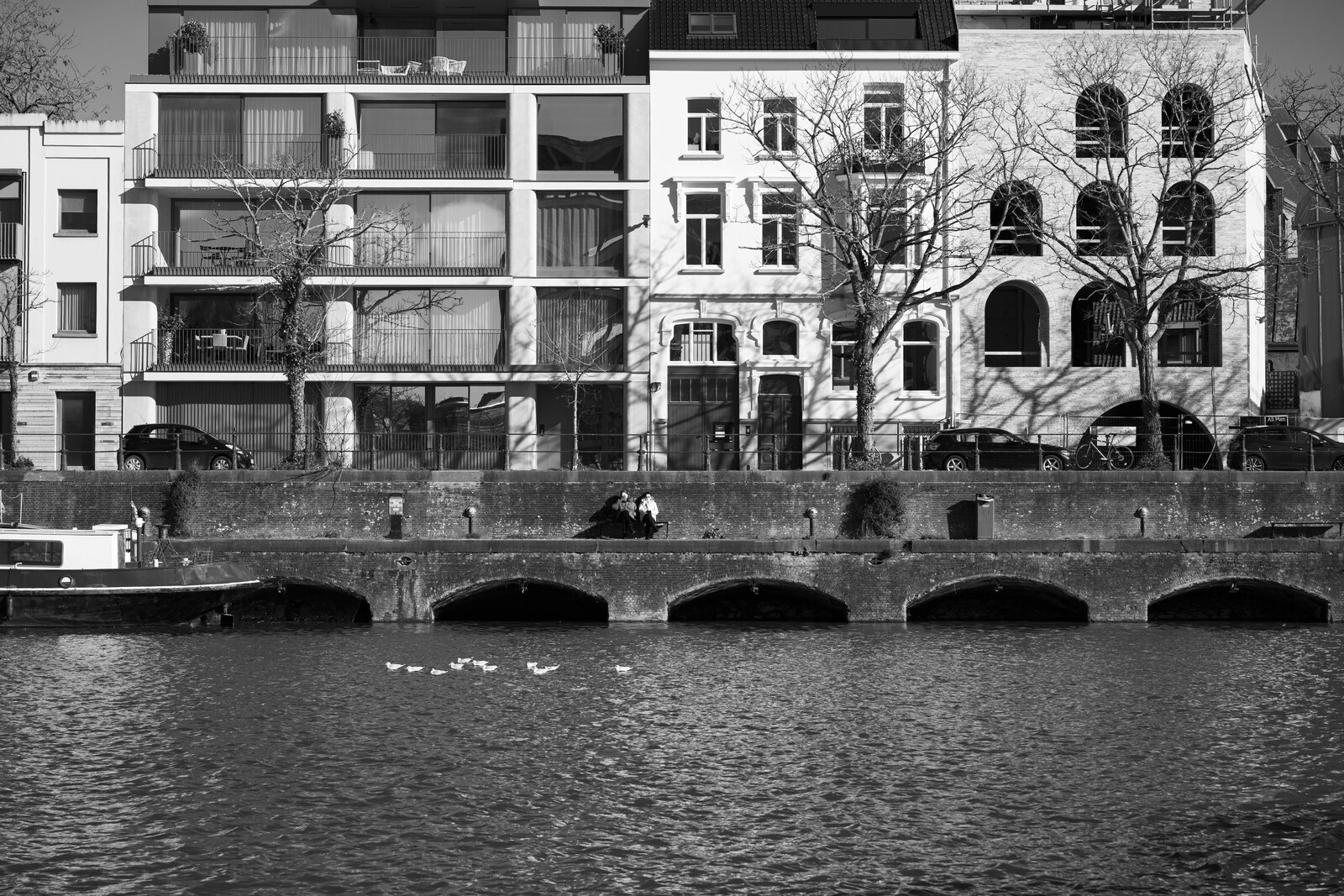
Look around first
What to notice
- Grassy slopes
- Bavobrug pedestrian bridge
- Veerkaai quay
The story of the place
Veerstraat—the Ferry Shore Street—ran where Veermanplein's grassy slopes now lie. It stretched along the Ryp, a branch of the Lower Scheldt, to its confluence with the Lys. Here ferrymen took people aboard their boats and carried them to the other bank, to the settlement by Saint Bavo's Abbey. There was no permanent bridge on this route. Residents needed a crossing, the ferryman got work, and the road to his boat got its name. Veermanplein literally means “ferryman's square.”
The street also preserved another name, this one human. On July third, eighteen forty-two, Karel Waeri, the future folk singer, was born into the family of home weavers Pierre Waeri and Pauline de Badts. When his father lost his position as an instructor at a weaving school, fourteen-year-old Karel had to earn money alongside adults. He worked as a weaver and a baker's assistant. During the cotton crisis of eighteen sixty-two, earnings became even scarcer, and Karel and his brother Jan began singing in taverns on Sundays, accompanied by a violin.
The songs proved more dependable than a trade. The brothers walked through the towns and villages of Flanders; Karel wrote new verses because audiences paid for what they had not heard before. Later, with his wife, the singer Sidonie de Meyer, he earned enough from performances for all six of their children to study at the conservatory. Karel Waeri wrote in the Ghent dialect about everyday life, mocked urban pretension, officials, and the clergy, and late in the evening performed double-entendre songs that he called “fat.”
In eighteen seventy-six, he settled on Veerstraat again. Four years later, city records listed Karel Waeri as the owner of the tavern In de Klaver—“In the Clover.” The family later moved away, but in February eighteen ninety-seven, the singer returned to the street where he had been born. He could hardly perform anymore, but he continued writing. On March fifteenth, eighteen ninety-eight, Karel Waeri died here after a short illness. A year later, his son Pieter published two hundred thirty of his father's songs; a substantial part of the rest, of which there may have been about five hundred, disappeared.
In the early nineteen seventies, the houses of Veerstraat were demolished for the Telegraph and Telephone Administration tower. Neither the house where Karel Waeri was born nor the house he returned to before his death has survived. Bavobrug, a pedestrian bridge built in two thousand seven, now crosses the water. The ferryman has long been gone as well; Veerkaai and Veermanplein remain from his landing place, and from the singer of the vanished street, the songs published by his son.
Useful on site
Open quay and city square; access may be restricted because of bicycle and pedestrian traffic.
Checked: June 30, 2026. Check the official source before visiting.Here it is more important to compare the water with the present scale of development than to look for the singer's surviving house or the old landing place: neither exists anymore.