 Guide On Map
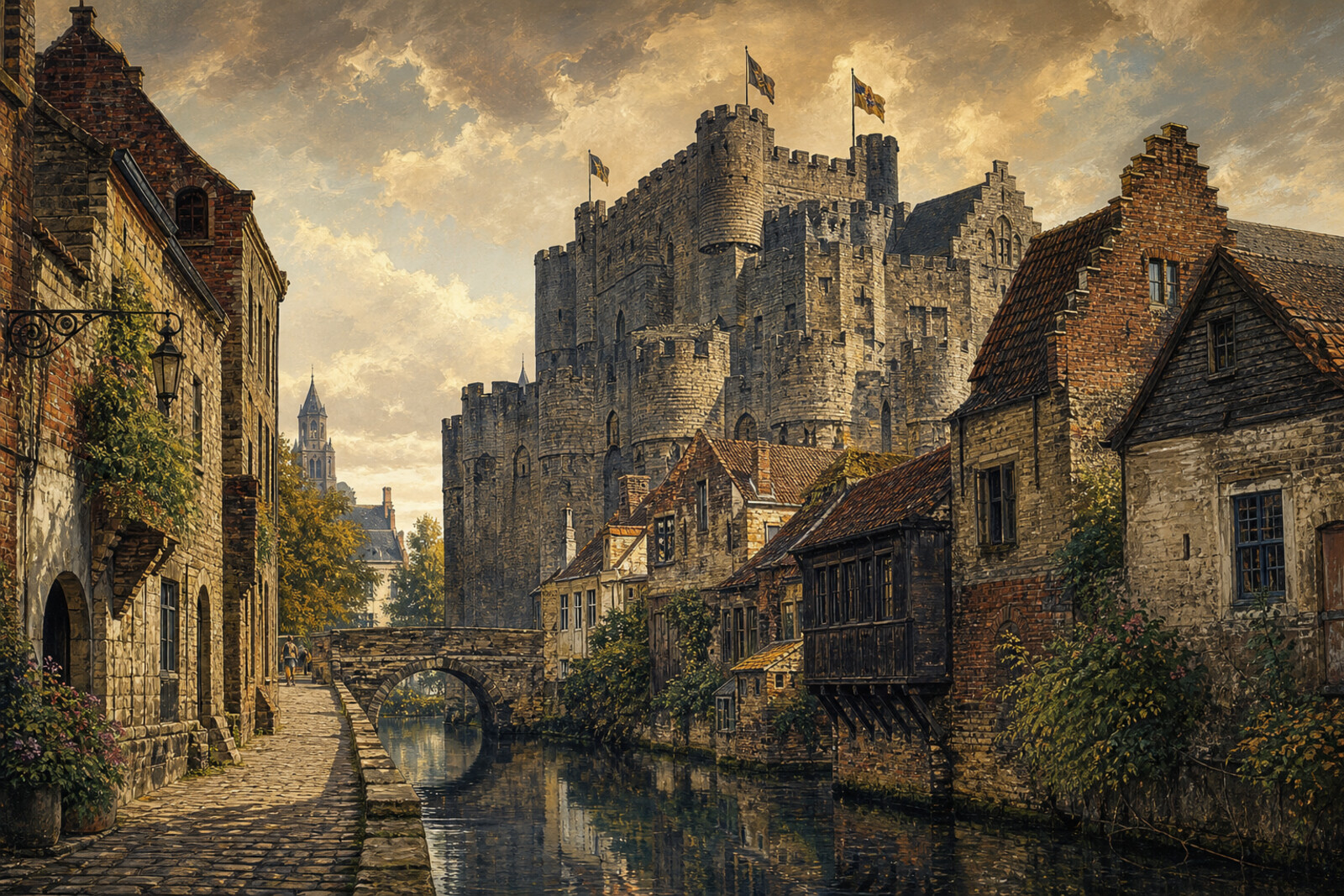
Gravensteen and Patershol: Power in Old Ghent
From Sint-Veerleplein through Patershol to Vrijdagmarkt
Guide On Map on your phone
Open the walk like a regular app
It takes about 10 seconds to install. No app store needed.
The whole path
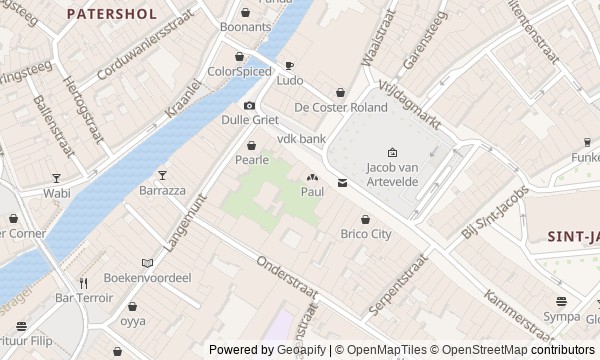
Route map
About the walk
You will begin at Sint-Veerleplein, in front of Gravensteen, and circle the northern part of old Ghent: from the Baroque gate of the Old Fish Market, along the fortress and Kraanlei, then through Patershol's narrow streets to Dulle Griet and the open expanse of Vrijdagmarkt.
On this walk, the city will not be a medieval backdrop. You will see places where power was displayed in public, trade was tucked beneath a glass roof, and a monastic concession gave an entire quarter its name. You will come across 2 lamps connected to maternity wards, a twelve-ton barrel on stone supports, and a fortress where it is hard at first to separate the twelfth century from the nineteenth.
The story will follow the documents and calmly mark where legend begins. The main turns will remain within the stops themselves. By the end, you will be able to read this part of Ghent through its gates, passages, and squares—and tell comital power from the power the townspeople bargained for themselves.
Why this order
Sint-Veerleplein first shows power before the gates of the court, while the neighboring Old Fish Market reveals the same public control in everyday trade. From the market, the route returns to Gravensteen itself: after the square of verdicts, it matters to see where those verdicts came from and which parts of the fortress were recreated later. Geldmunt then leads to Kraanlei, where a comital order gives way to a civic obligation bound to the House of Alijn. The next turn from the quay into Patershol explains the quarter through a vanished canal and a narrow monastic passage. The route leaves the alleys for Dulle Griet: beside the crafts district stands a weapon the city brought in but could not use. From the cannon, Grootkanonplein opens onto Vrijdagmarkt, where military force finally gives way to trade, civic assembly, and a legal maneuver involving English wool.
Those interested in how civic power worked in the streets Lovers of document-based stories, carefully qualified legends, and visible traces of rebuilding Those who want to connect Gravensteen and Patershol through one historical story
Those looking only for an overview of the city's best-known postcard views Those who are not comfortable with stories of execution, murder, and political violence Those expecting above all a story about architectural styles
Before you go
Wear shoes with stable soles: the route includes cobblestones, narrow passages, and, if you visit Gravensteen, stairs. Check access to the fortress and the House of Alijn separately just before the walk—streets and exterior details will remain accessible even if the interiors are closed. Headphones are useful for the audio, but in the alleys stay alert to cyclists, residents, and visitors to local establishments. Patershol is not a set piece but a residential quarter: keep your voice down, do not block doorways, and do not look into windows.
When to go
Allow 2–3 hours for the route. If you want to explore the displays at Gravensteen and the House of Alijn carefully, start with enough time to spare; without the interiors, the walk will be shorter but will retain its main dramatic arc.
Backup plan
If Gravensteen is closed, look at it from the square and around its perimeter: the keep, arrow slits, gate, and ring of walls explain the fortress's purpose on their own. If the House of Alijn is closed, focus on the facade, the old inscription, the niche with Saint Catherine, and the building's connection to the quay. In heavy rain, shorten your wandering through Patershol, but do not skip it altogether: a few alleys are enough to show the scale and closeness of the quarter. Dulle Griet and the details of Vrijdagmarkt can be viewed from outside during short pauses under cover.
Route conditions
Surface. Paved — 764 m
Facilities. Toilets — 3
Elevation. Ascent — 6 m; descent — 7 m
OpenStreetMap extract of June 18, 2026: database data, not a check on the ground. Data © OpenStreetMap contributors, ODbL licence
Walk plan
Open in maps ↗- 1
Sint-Veerleplein
This is where the route begins its story of how the count's court brought power out of the castle and onto the city square. - 2
Old Fish Market
The market’s rebuilding shows how urban order changed the everyday work of women fish vendors. - 3
Gravensteen
The castle will make it possible to distinguish the twelfth-century fortress from the medieval image assembled by later restorers. - 4
Kraanlei and the House of Alijn
The history of the almshouse will connect a family crime with a long civic obligation. - 5
Patershol
One closed passage explains how the name of a monastic corridor came to belong to an entire neighborhood. - 6
The Great Dulle Griet Cannon
The transport of an enormous bombard will reveal the gap between a military symbol and a usable weapon. - 7
Vrijdagmarkt
The finale will bring together the wool trade, a legal loophole, and the political choice of the Flemish cities.
Route features
Everything you need stays in the browser
Progress, saves and your trip plan are stored on this device.
Add Guide On Map to your home screen so the walk opens outside the browser.
How we handle sources, maps and corrections: our editorial standards