 Guide On Map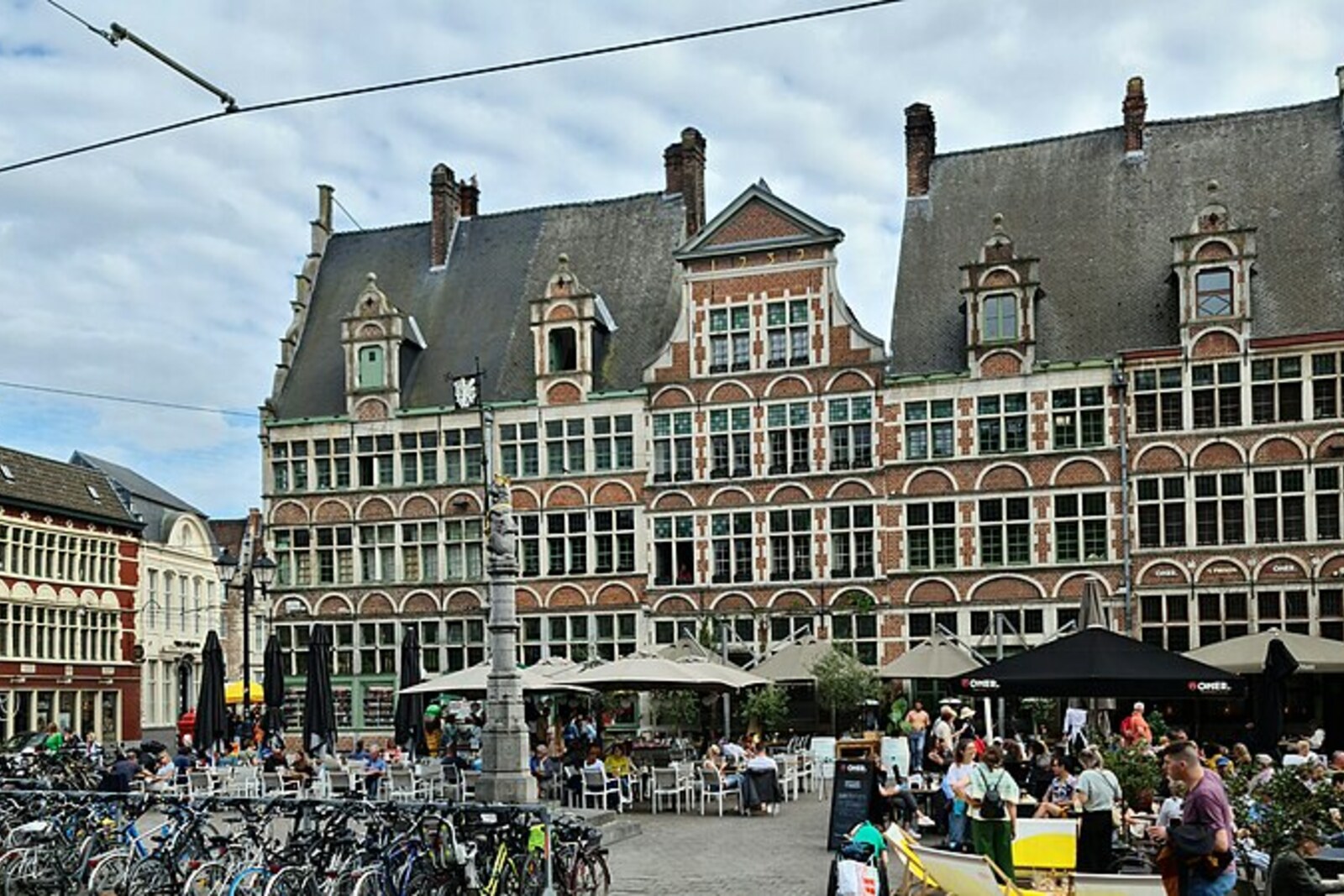
Look around first
What to notice
- Gravensteen entrance arch
- Two street lamps
- The facades around the square
The story of the place
By Gravensteen's entrance arch lies the square where the castle court came out to the city. Inside, the Council of Flanders sat, while in front of the walls its sentences were carried out in full view of the townspeople; this arrangement lasted from the beginning of the fifteenth century until the end of the eighteenth. The southern side was once occupied by the court church of Ghent's patron saint, and her name remained in the square's name. The church itself has long been gone, but fragments of its walls survive by the embankment and in the cellars of neighboring houses.
On August fourth, fifteen eighty-four, Jan van Hembyse stepped onto the scaffold at Gravensteen. He was one of the leaders of the Calvinist Republic of Ghent and had been secretly negotiating the surrender of the besieged city to the Duke of Parma. Only recently, he had been deciding Ghent's fate. Now he was being tried for treason.
A year earlier, Ghent had been almost cut off from food supplies. Alexander Farnese, the Duke of Parma and the Spanish king's governor, was occupying neighboring cities. Ghent's elders recalled Hembyse from exile: the experienced politician and leader of the radical Calvinists was to organize the defense.
Hembyse came from a wealthy patrician family and took up residence in the prestigious Hof van Wackene. He was about seventy years old. In December fifteen eighty-three, he married Anna van Huerne, who was not yet thirty. Her father served on the Council of Flanders—the highest court, which sat in Gravensteen. For both families, the marriage secured their position under the new urban order.
The blockade continued, and no help arrived. Hembyse began his own negotiations with the Duke of Parma and tried to hand Ghent over to him. The letters were intercepted. Hembyse was arrested in March; from prison, he asked Anna to take care of herself and settle the financial affairs. She was pregnant, and he already understood that he would not see the child.
The execution took place here precisely because Sint-Veerleplein served as an open space for the court and prison in Gravensteen. From fourteen oh seven until the end of the eighteenth century, the sentences of the Council of Flanders were carried out here. The scaffold was erected in front of the castle so that the punishment would take place in public. By sentence, Hembyse was beheaded with a sword, his head was displayed on a stake for an hour, and his body was left on the platform. His negotiations failed, but the siege did not end: six weeks later, Ghent nevertheless signed an agreement with the Duke of Parma.
On October thirteenth, Anna gave birth to a daughter. That same day, the girl was baptized as Anna van Imbise, daughter of Jan van Hembyse. The documents are silent about the child's later fate.
The square's name comes from another vanished structure. Veerle is the Flemish name of Saint Pharaildis, an eighth-century saint and Ghent's patron saint. On the southern side of the square stood St. Pharaildis Church, a court church dedicated to her, where canons kept parts of her relics. The church was completely demolished in seventeen thirty-six; fragments of its walls remain in the embankment and in the cellars of neighboring houses, while its name survives in Sint-Veerleplein—the square of Saint Pharaildis.
In two thousand eleven, the artist Alberto Garutti connected two local street lamps to four Ghent maternity wards. After a child is born, the parents can press a button there, and the light in the square begins to pulse slowly. Anna van Huerne gave birth to a daughter two months after the daughter's father was executed at this place.
Useful on site
The square is open around the clock. The ‘Ai Nati Oggi’ lamps switch on automatically when a child is born in Ghent.
Checked: date not specified. Check the official source before visiting.Listen where you do not obstruct passage or the work of local establishments. The lamps' pulsing is linked to births and may not appear during your stop.