 Guide On Map
How Fes el-Bali Changed
From Bab Bou Jeloud along Talaa Kebira to al-Qarawiyyin and Place Seffarine
Guide On Map on your phone
Open the walk like a regular app
It takes about 10 seconds to install. No app store needed.
The whole path
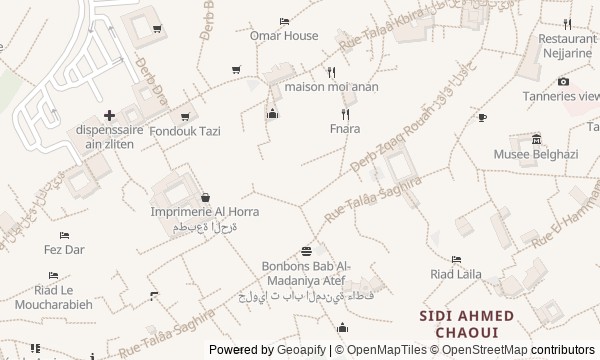
Route map
About the walk
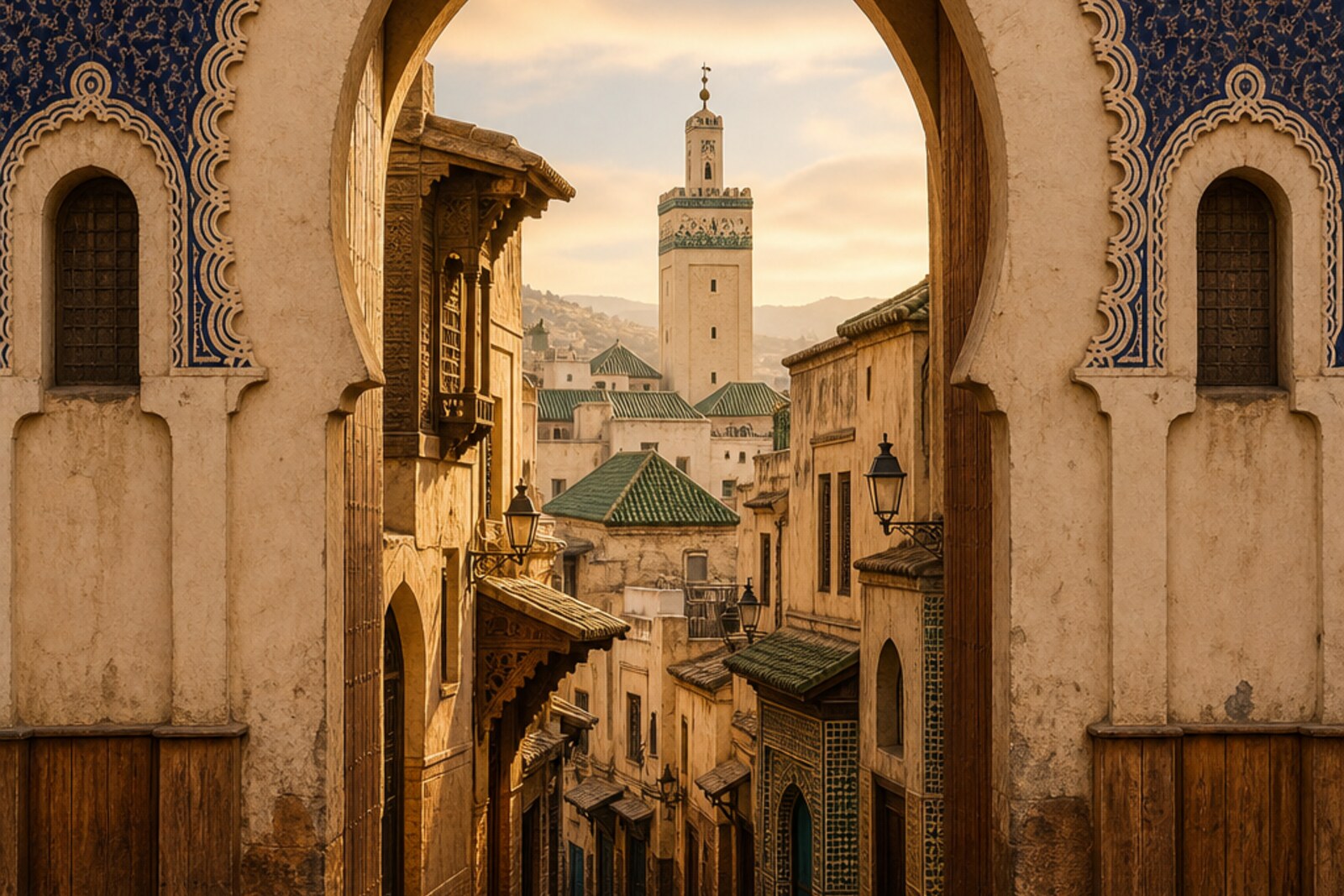
You will enter Fes el-Bali through the blue facade of Bab Bou Jeloud and descend Talaa Kebira toward al-Qarawiyyin, then on to the brass workshops of Place Seffarine.
Along the way come sultans' madrasas, a clock house without a mechanism, a trading inn with a carved portal, a market, and the threshold of the main mosque. But this walk will not become a list of masterpieces. You will trace how people cleared space for a straight road, secured a room and food for a student, saved an entire connected quarter, and adapted an imported object to local demand.
The stories include documents, lost details, and versions that will not be allowed to pass as facts. Why did a medieval city gain its main western entrance only in the twentieth century? What can a single discovered inscription change? The answers remain within the stops.
After the walk, you will be able to pass through this part of Fez again and point out where stone beauty grew out of bargaining, calculation, doubt, and handwork.
Why this order
The straight passage through Bab Bou Jeloud places you on Talaa Kebira, a route whose flow of people the new gate once changed. Bou Inania Madrasa stands high on the descent, so the sultan's school, Dar al-Magana, and the main trading street appear together. Staying on Talaa Kebira after the facades takes you from a gesture of government to the story of a person for whom this road became a way out of Fez. Lower down, the trading street leads to Nejjarine Square: the former inn shows where a visiting merchant left goods, while nearby Al-Attarine Madrasa shows where an arriving student was housed. From Al-Attarine Madrasa, al-Qarawiyyin is only a few steps away: the residence becomes clear beside the center for which it was built. The final stretch along the complex to Place Seffarine returns the story from scholars to craftspeople—to the place where an imported form was adapted to local demand.
Those entering the depths of Fes el-Bali for the first time Those who care about money, labor, and urban decisions behind the ornament Those who like separating documents from later legends
Those expecting an overview of all of Fez's main monuments Those looking above all for a story about decorative styles Those who do not enjoy dense historical narratives and disputed versions
Before you go
Wear shoes with reliable grip: slopes, steps, and polished stone feel more demanding than the route's short distance suggests. Before setting out, check current access to Bou Inania Madrasa, Al-Attarine Madrasa, and the Nejjarine Museum of Wooden Arts and Crafts—interior visits should not be treated as guaranteed. Choose modest clothing for religious and educational spaces, and speak quietly. In trading passages, keep to the side, do not stop in doorways, and do not block porters or shoppers. Photograph craftspeople and sellers close up only with permission; shop windows, facades, and wider views do not need to turn a working day into a photo shoot.
When to go
Leave extra time not for the distance but for the density of impressions: you will want to linger by portals, clock bowls, the fountain, and working workshops. Daylight helps you read the street and courtyards, and you are more likely to hear Place Seffarine while the craft shops are busy at work. Check the current hours of individual interiors on the day of your walk.
Backup plan
A closed door does not diminish the route. At Bou Inania Madrasa, focus on the portal and the thirteen bowls of Dar al-Magana; at Al-Attarine Madrasa, read the modest entrance and its close relationship with the market. Treat al-Qarawiyyin as an exterior stop from the start: what matters are its many thresholds and the way passages, shops, and schools converge on them. If the Nejjarine Museum of Wooden Arts and Crafts is inaccessible, the square still holds together its carved portal, fountain, and carpenters' market. If the brassworkers are not working, look at the old vessels, small workshops, and the square's closeness to the madrasa: even without the ringing, the scale of the craft quarter is clear.
Route conditions
Surface. Paved — 1.9 km (data covers 97% of the route)
Facilities. Toilets — 2; drinking water — 5
Elevation. Ascent — 9 m; descent — 76 m
OpenStreetMap extract of June 18, 2026: database data, not a check on the ground. Data © OpenStreetMap contributors, ODbL licence
Walk plan
Open in maps ↗- 1
Bab Bou Jeloud
Here you will see how a single straight passage redirected people and trade at the western edge of the medina. - 2
Bou Inania Madrasa and Dar al-Magana
This stop connects a sultan's struggle for recognition with a residential school and a lost system for marking prayer time. - 3
Talaa Kebira
The street will carry the route from sultanic politics to the personal decision of a man who had to follow his own advice. - 4
Nejjarine Square
Here, the rescue of one building becomes the story of restoring an entire connected quarter. - 5
Al-Attarine Madrasa
This stop will show the everyday conditions that made long-term study beside al-Qarawiyyin possible. - 6
The Threshold of al-Qarawiyyin
At the entrance, the later tradition about the foundress must be distinguished from the evidence of the ancient inscription. - 7
Place Seffarine
The finale will show how an imported form gave Fez craftsmen a new product and a new guild name.
Route features
Everything you need stays in the browser
Progress, saves and your trip plan are stored on this device.
Add Guide On Map to your home screen so the walk opens outside the browser.
How we handle sources, maps and corrections: our editorial standards