 Guide On Map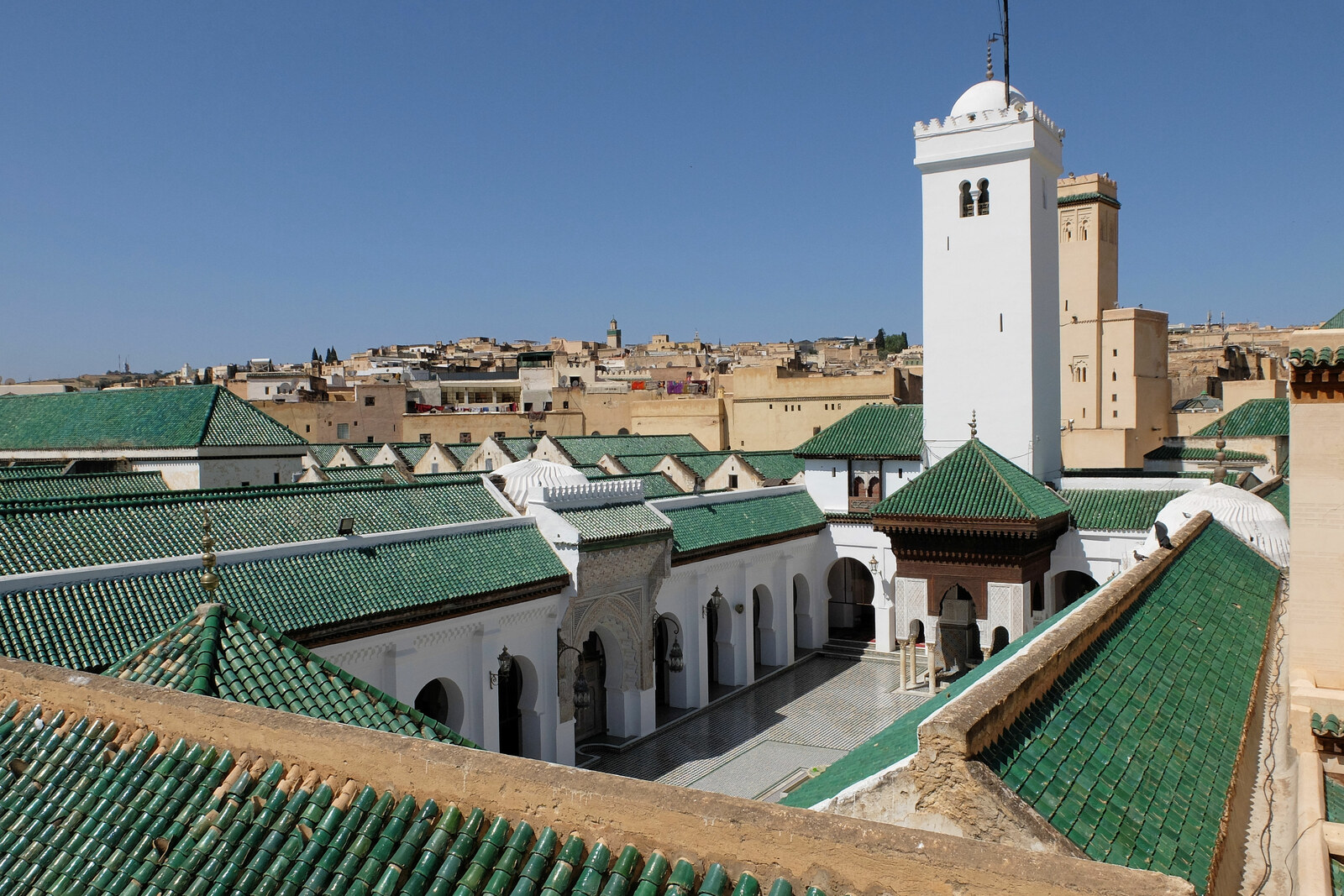
Look around first
What to notice
- Heavy door leaves
- Bronze fittings
- The northern entrance, Bab al-Ward
- Stone threshold
The story of the place
The massive doors of the northern Rose Gate lead into a mosque where prayers have been performed for centuries. Scholarly life gradually took shape beneath its vaults as well: teachers studied the Qur'an, law, and Arabic grammar with their students, while those arriving from elsewhere were housed in neighboring madrasas. The present threshold dates from a later expansion, and many rebuildings separate it from the first small prayer house.
“al-Qarawiyyin” means “the people of Kairouan.” In the early ninth century, this was the name for people from Kairouan, a city in what is now Tunisia. After the uprising of eight hundred twenty-four, some of the families there left their homeland and settled in this part of Fez. They formed their own quarter, and its name passed to the mosque.
A later Fez chronicle links the mosque’s foundation to the family of one of the settlers. Muhammad al-Fihri became wealthy through trade and left his daughter Fatima a large inheritance. She herself was not involved in trade. According to tradition, around eight hundred fifty-nine Fatima decided to spend all her father’s money on a prayer house for the community from Kairouan. The chronicler adds that she fasted until the work was completed, then was the first to pray in the finished mosque. All this was written down almost five centuries after the supposed events, so the story of Fatima cannot be presented as indisputable fact.
In any case, there was a mosque here in her time. al-Qarawiyyin gradually became a center of learning: scholars sat inside with their listeners, studying the Qur'an, law, and Arabic grammar. Later, neighboring madrasas were built for students arriving from elsewhere, including Al-Attarine Madrasa. The modern word “university” gathers together this long history, although Fatima, if the tradition is true, founded a prayer house, not an educational institution of the modern kind.
During repairs in the twentieth century, a wooden board with an ancient inscription was found beneath layers of plaster. It named another founder—Dawud ibn Idris, the ruler of this part of Fez—and another date: eight hundred seventy-seven. Some researchers believe the board was later moved here from another mosque. Others accept it as the original foundation inscription, and Fatima al-Fihri as a heroine of city tradition.
The present threshold also appeared later than the supposed foundation. The bronze fittings on the heavy leaves of the main northern entrance, Bab al-Ward, the Rose Gate, were made when the mosque was enlarged in the twelfth century. The original prayer house has been absorbed by later rebuilding. From the history of the first settlers, the name of the entire complex remains: al-Qarawiyyin, the mosque of the people of Kairouan.
Useful on site
An outdoor stop by default. Do not plan on the main prayer hall being accessible to non-Muslims; check access to the library and separate areas locally.
Checked: June 30, 2026. Check the official source before visiting.Do not count on visiting the interior spaces; do not block the doors, and respect those going to pray.