 Guide On Map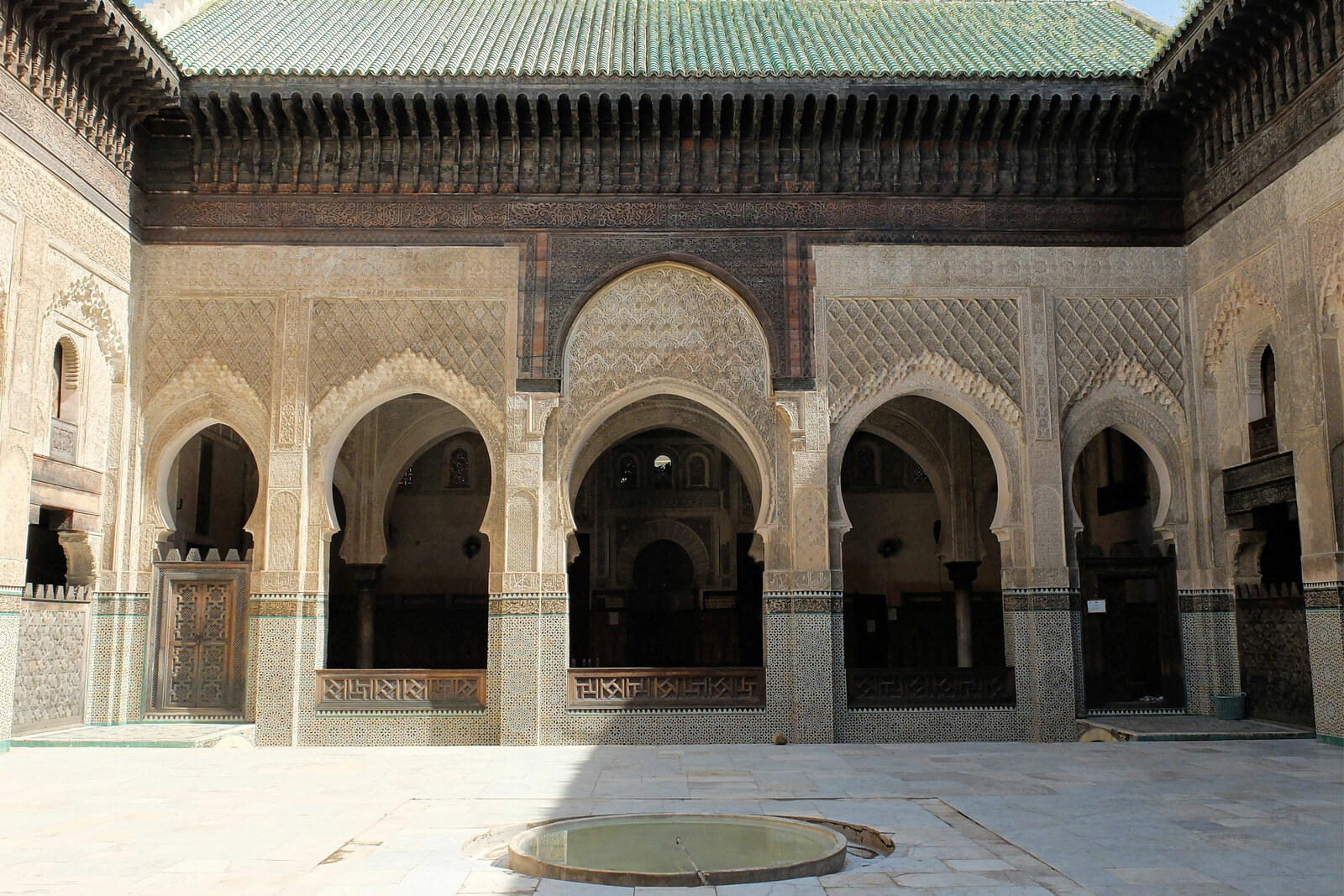
Look around first
What to notice
- The madrasa's minaret
- Twelve windows of the House of Clocks
- Carved cedar brackets
- The courtyard with rooms above the galleries
The story of the place
Above the narrow street opposite the minaret stretches a façade with twelve empty little windows and carved cedar brackets: water clocks once operated behind them, marking the time for calls to prayer. Students of Islamic law lived inside the madrasa, and their rooms rose above the courtyard. The school also served as a large neighborhood mosque, where people gathered for communal Friday prayer and the sermon. The copper bowls have been removed from the façade and the mechanism is lost, but the House of Clocks is still recognizable by its little windows.
Bou Inania Madrasa bears the name of its founder, the Marinid sultan Abu Inan Faris. When he began building this madrasa, his father had until recently occupied the throne, and Abu Inan himself was a rebellious son.
In thirteen forty-eight, his father, Sultan Abu al-Hasan, was defeated near Kairouan. Abu Inan had previously governed the conquered city of Tlemcen, but after his father's army was routed, he hurried to Fez and proclaimed himself sultan. Abu al-Hasan survived, gathered supporters, and tried to regain the throne. His son sent troops against him, defeated him, and drove him into the High Atlas. There, ill and left with almost no money or men, Abu al-Hasan abdicated in favor of his son and died in the spring of thirteen fifty-one.
Construction here began on December twenty-eighth, thirteen fifty—the very winter when the struggle between father and son was coming to an end. Abu Inan needed recognition from Fez's ulema, meaning theologians and scholars of law. They regarded the Marinid rulers warily: they considered them military outsiders lacking in learning and piety.
The sultan offered what the daily lives of scholars and their students depended on. He built a residential school of Islamic law, assigned it income-producing properties, housed students in rooms above the courtyard, and provided for their upkeep. Young men could study for years on a modest stipend, then become judges, teachers, and officials. Teachers were appointed with the court's support; together with the graduates, the sultan's influence spread from Fez to other cities.
A legend later arose that Abu Inan was tormented by guilt over the war with his father and asked theologians how to atone for what he had done. They supposedly advised him to remove a rubbish dump in the upper part of the medina and build a school in its place. This is a legend, not an established reason for choosing the site. The documented decision of the sultan was preserved by an inscription inside: he ordered the madrasa to be built and listed in detail the property whose income was to pay for its operation.
Officially, the institution was called al-Mutawakkiliyya, after Abu Inan's title, “one who relies on God.” In everyday use, his personal name took hold. The sultan also gave the school the status of a Friday mosque: the whole neighborhood could gather here for communal prayer and hear the sermon. A minaret and a preacher's pulpit were added for this purpose. Other Moroccan madrasas could have prayer halls, but Bou Inania Madrasa received the full schedule of a large mosque.
The house opposite was also under the madrasa's authority. Dar al-Magana means “House of Clocks.” Prayer times had to be determined at the mosque, and the sultan ordered a water clock to be installed above the street. A muwaqqit, the official who calculated prayer time, watched over it and announced the hour to the muezzin.
By May sixth, thirteen fifty-seven, the clock was already operating. Behind twelve small windows, a device of a reservoir, float, ropes, and weights moved. At the end of each hour, the next shutter opened and a metal ball fell into a copper bowl. Daylight was divided into twelve parts from sunrise to sunset, so the length of such an hour changed in summer and winter; the flow of water had to be adjusted by season.
Eight months after the clock was completed, Abu Inan was strangled by his own vizier. The scholars never moved the main center of learning here: over time, al-Qarawiyyin retained precedence. On the façade of Dar al-Magana, the small windows and carved cedar brackets can now be seen; the bowls have been removed, and the mechanism itself is lost. The name al-Mutawakkiliyya has also disappeared from everyday speech. The madrasa is still called Bou Inania Madrasa, after the son who began building it in the winter of his father's abdication.
Useful on site
Paid visitor entry is usually during the daytime; exact hours, breaks, and access to individual areas vary, so check the sign and ticket desk at the door on the day of your visit.
Checked: June 30, 2026. Check the official source before visiting.The House of Clocks can be viewed from the street; enter the madrasa only when access is open, and keep quiet.