 Guide On Map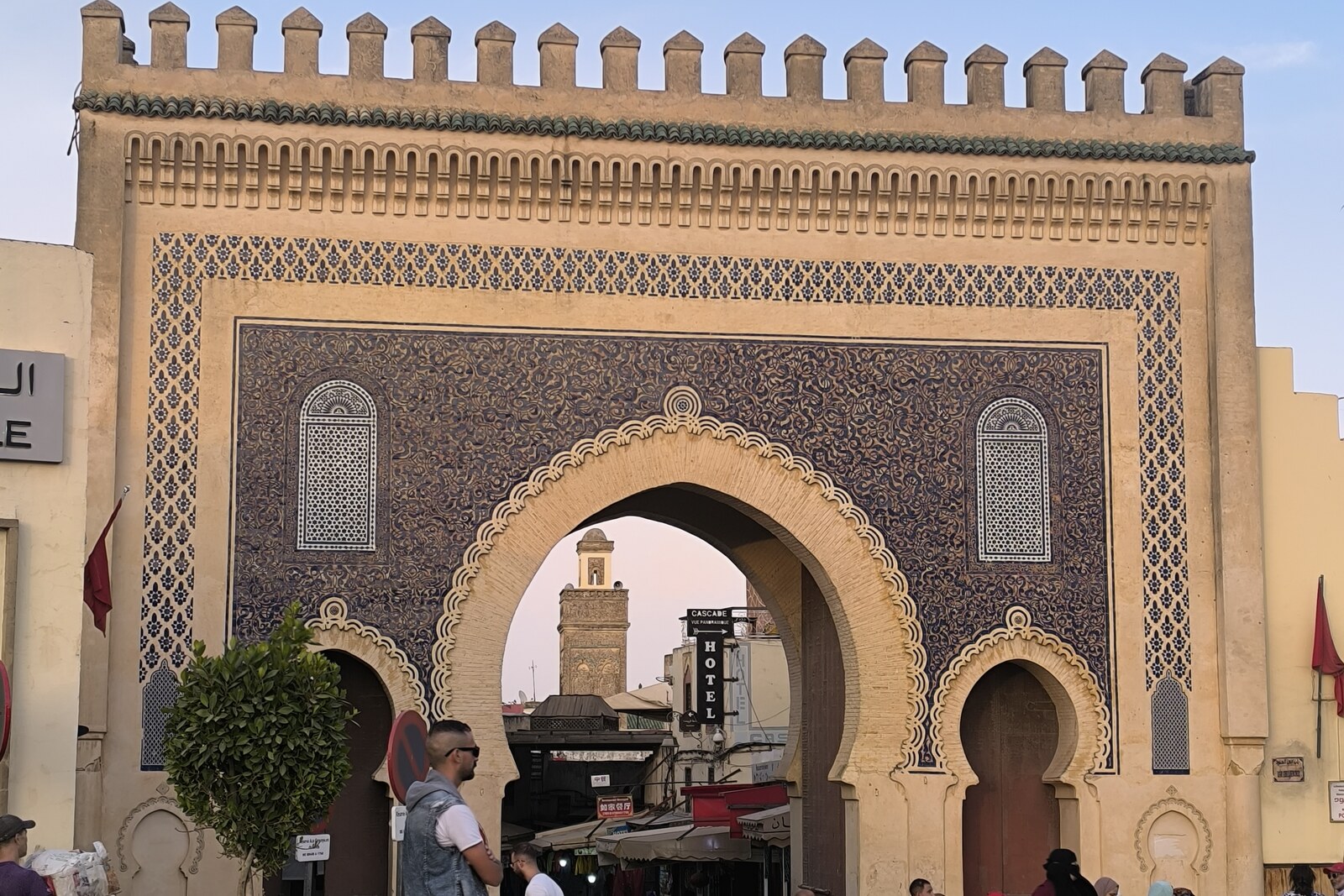
Look around first
What to notice
- The large central arch
- Blue geometric zellij
- Green zellij on the inner facade
- The walled-up old entrance on the left
The story of the place
According to a common explanation, the name Bou Jeloud came from an old name for the place associated with the garrison: troops assembled on the square by the wall, soldiers spent the night along the fortifications, and a large stable stood in the middle. Later, caravans and merchants replaced them, but the military name remained with the square, the quarter, and the gate. The outer facade is faced with blue geometric tilework, while on the inner side of the wall the pattern turns green. The closed opening on the left still preserves the former way of entering, with a turn along the wall.
In December nineteen twelve, Captain Mellier, head of Fez's municipal services, showed the city council a new route between Fes el-Jdid, New Fez, and Fes el-Bali, Old Fez. The road was meant to run into the wall right here, and the wall needed a broad, straight passage. The result of that decision is the present three gates with their large central arch.
Before Mellier, people entered the medina through the neighboring opening. It survives to the left of the blue facade, but it is now closed. The old gate probably appeared as early as the twelfth century. The passage inside turned along the wall and led onto Talaa Kebira from the side. That bend kept attackers from rushing into the city at full speed and allowed guards to inspect those entering. The captain needed the opposite: to take people straight through and give the new road a ceremonial ending.
Drawing a straight line proved easier than clearing the land for it. A stable and three shops stood where the future passage would be. The city bought the stable for one thousand eight hundred duros. The shops were more difficult: they belonged to a habous, a religious charitable fund that lived on income from its real estate. Its administrators agreed to give up the premises only if they received other shops in the same district. After negotiations, the council met that condition.
On February seventh, nineteen thirteen, builders struck the first blow with a pickaxe. Mellier allotted thirty-five thousand Hassani pesetas to the work and explained the expense simply: the gates had to be worthy of Fez and its city council. The estimate was not enough—another ten thousand were needed. Three horseshoe arches, a straight passage, and facades assembled from forms familiar to Fez's craftsmen appeared in the wall. By the city fair of nineteen sixteen, they were covered with geometric zellij: blue predominates on the square side, green on the medina side.
At first, the new structure was called the city council's gate, the New Gate of Bou Jeloud, and even the French Gate. The old local name took hold. According to a common explanation, “Bou Jeloud” is a colloquial alteration of “Abu al-Junud,” associated with soldiers and the garrison. Troops assembled on the large square west of the wall. Small rooms stood along the fortifications, where passing soldiers spent the night, and a large stable stood in the middle of the square. Later, caravans and merchants took their place, but the military name remained with the square, the quarter, and the new gate.
The straight entrance also changed the geography of trade. The old turn directed people onto Talaa Kebira; the new opening brought the flow closer to the fork of the two main descents. Shoppers began using Talaa Sghira, and some merchants moved after them. So the captain's drawing affected more than the wall: some shops were demolished, the habous received others in exchange, and the owners of the new shops found themselves beside the main entrance.
Now the main western route into Fes el-Bali passes through the three arches, while vehicle traffic usually ends at the medina boundary. To the left remains the walled-up medieval entrance, where people once turned along the wall. Under the central arch, the road runs straight ahead—where the stable and three revenue-yielding shops stood before Mellier's negotiations.
Useful on site
The street gates and the exterior viewing point are accessible without a ticket; morning or late afternoon is best for reading the facade, but the passage remains in use at all times.
Checked: June 30, 2026. Check the official source before visiting.View the gate from the side of the main flow, and do not linger inside the passages.