 Guide On Map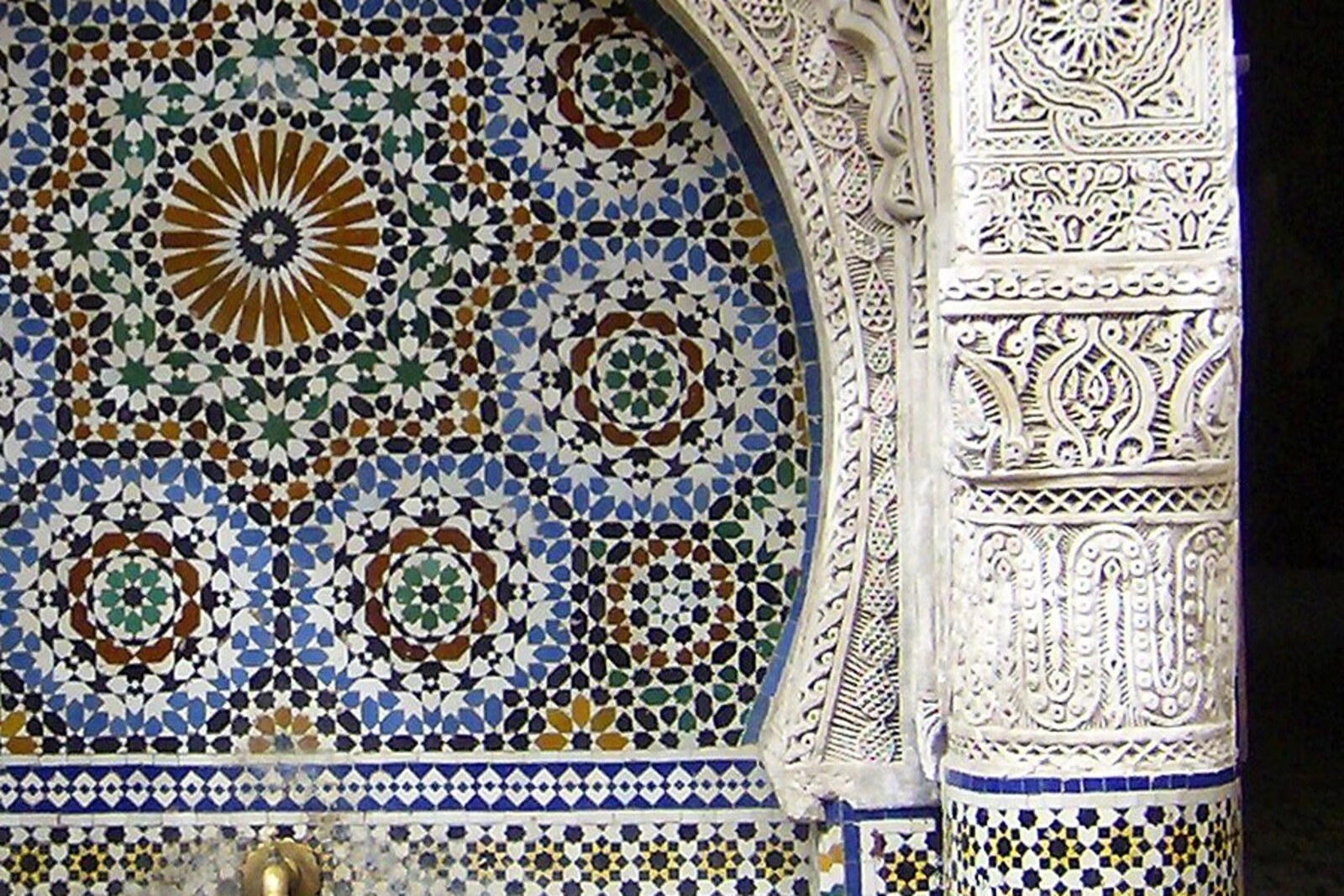
Look around first
What to notice
- The funduq's carved portal
- The fountain's rectangular basin
- The courtyard's three-tiered galleries
- The large metal weighing apparatus
The story of the place
The square was named after the carpenters' workshops: in old Fes, craftsmen in the same trade were settled together so that raw materials, customers, and orders would not get lost in the maze of market rows. Behind the carved portal stands a funduq with three-tiered galleries around its courtyard; visiting merchants kept their pack animals and goods below and spent the night on the floors above. To the right, by the fountain, a rectangular basin watered animals staying in the courtyard.
In the early nineteen nineties, there was no museum behind the carved portal. Funduq al-Najjarin—a city inn and warehouse for visiting merchants—had already served as a police station, then a hostel, and by the nineteen seventies it had been abandoned. Its foundations were sinking, its ceilings and floors were collapsing, and the stucco and wood carving could have disappeared along with the building.
The funduq was built in seventeen eleven, under Sultan Moulay Ismail. A merchant entered here with a pack animal and goods. The animals were left below, the goods were stored in rooms on the first floor, and their owners spent the night in rooms above the courtyard. A large metal weighing apparatus was used to check the weight of what had been brought in, and a city official collected a special trade levy here. Some rooms were used to store valuable goods from the sultan's treasury. Behind the decorated portal stood a regulated trading courtyard, where a visitor could keep and sell what sustained him.
The name “Nejjarine” means “carpenters.” It arose from the craftsmen whose workshops occupied the neighboring market rows as early as medieval Fes. Craftsmen in the same trade were gathered together: this made it easier to deliver raw materials, find customers, and pass orders from one workshop to another. The fountain on the right joined this system only in the nineteenth century. Sultan Moulay Abd al-Rahman ordered it built almost a century after the inn opened. Its rectangular basin served as a watering trough, especially for the animals of merchants staying at the funduq.
When the complex began to fall apart, the Fes entrepreneur Mohammed Karim Lamrani decided to pay for its restoration from the fortune he had earned in trade and industry. He entrusted his daughter, Saida Lamrani, with directing the work and preparing a museum of wooden crafts in the former trading courtyard.
The restorers quickly discovered that it was impossible to save just one funduq. Its load-bearing walls are connected to neighboring houses; the collapse of one part could have brought down the whole block. So, from nineteen ninety to nineteen ninety-six, craftsmen reinforced the inn itself, the square, the fountain, the mosque, the carpenters' rows, and the living quarters above the shops. On May twenty-third, nineteen ninety-eight, the Lamrani Foundation opened Morocco's first museum devoted entirely to working with wood.
In its courtyard, the galleries where merchants slept, the rooms where they locked away their goods, and the large metal weighing apparatus have survived. Beyond the gates remain the shops of the craftsmen who gave the square its name; inside, their trade has become the museum's theme.
Useful on site
The square and fountain can be viewed from outside; the museum in the former funduq has separate hours, which should be checked separately and should not be considered essential to the route.
Checked: June 30, 2026. Check the official source before visiting.The façade and fountain can be seen from the square; check separately whether the museum courtyard can be visited.