 Guide On Map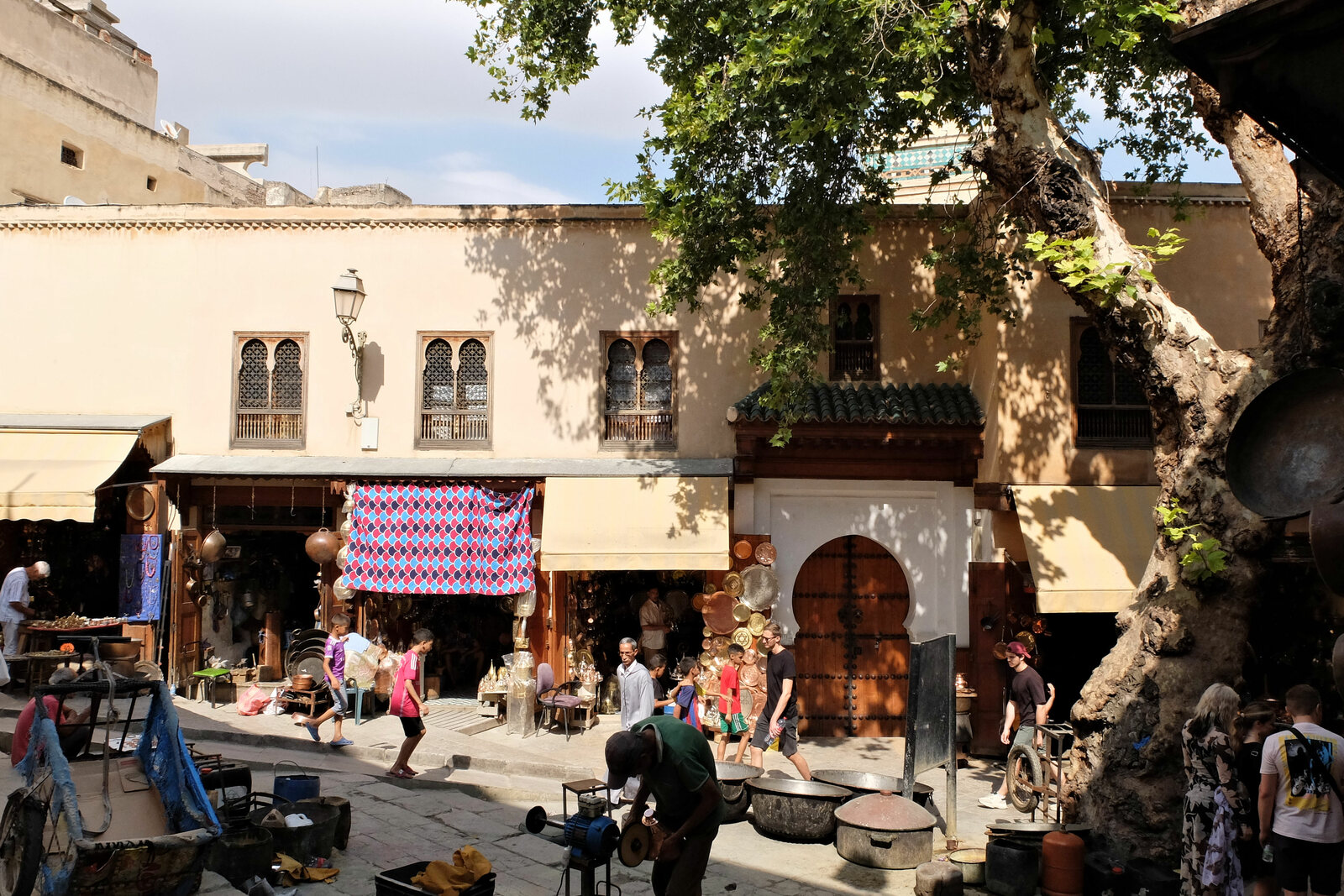
Look around first
What to notice
- Large copper cauldrons
- Copper vessels outside workshops
- Open workshops
- Chased patterns on tableware
The story of the place
Large copper cauldrons stand by the open workshop doors; the nhaisiya, masters of red copper, now repair worn-out utensils more often than they hammer out new ones. These cauldrons are rented out for large family celebrations. The name Seffarine remains from the seffara, who worked with brass and made doors, lamps, jugs, and trays. Their guild rules tied workshops to this quarter and limited their number, so the making and sale of copperware remained on the square for a long time.
At the beginning of the twentieth century, the coppersmiths of this square began melting down old, well-made objects to make a new type of tableware. Otherwise, they risked being left without orders.
Previously, two guild associations stood side by side on Place Seffarine. The seffara worked with yellow metal—brass: they made doors, lamps, trays, and jugs. The nhaisiya, masters of red copper, made cauldrons, buckets, and kitchenware. The square took its name from the seffara. Guild rules tied craftsmen to their quarter, limited the number of workshops, and held back innovation. That is how the making and sale of copperware became established here.
Then English manufacturers began taking customers away from Fez craftsmen. Teapots, trays, and other metal tableware were brought from Manchester to Morocco. Suppliers sometimes put Arabic marks on it so that its foreign origin would not stand out. At first, wealthy families used English tea sets; then tea became part of everyday life. Demand grew, but the money went to those who brought in ready-made tableware.
Around nineteen ten, some of the craftsmen of Seffarine broke with the old order. They began copying European tea utensils, adapting them to local habits, and created a new association—the suwayniya, meaning makers of trays. Even old, high-quality objects went into the crucibles: metal was needed for the goods people now bought. The suwayniya quickly separated from the older guilds and opened workshops throughout the medina.
During the Second World War, supplies from Europe weakened, and Fez craftsmen took over the market that had opened up. In nineteen forty-six, one of them brought a mechanical lathe to Fez, having seen it at an Italian's in Tunisia. The craftsmen of Et-Taj began producing copies of Wright teapots from Manchester in series. The body and shape remained English, while Fez craftsmen still applied the pattern by hand with a graver and a chasing tool. Thus, an object of foreign origin became a familiar Moroccan teapot and provided work for a new guild.
The suwayniya gradually displaced even the old professional name, seffara. It survived in the name of the square, though craftsmen are now hardly ever called that. On Place Seffarine itself, the nhaisiya, masters of red copper, are chiefly what remain: many no longer make tableware from scratch but repair old copper vessels. The large cauldrons outside the workshops are still rented for crowded family celebrations. The square's name preserves the masters of yellow metal; by its walls stand the cauldrons of the masters of red copper.
Useful on site
Open square; for the crafts story, come during working daylight hours, but do not promise noise and open workshops as guaranteed.
Checked: June 30, 2026. Check the official source before visiting.Stay outside the working area, be prepared for sharp noise, and ask permission before photographing craftsmen.