 Guide On Map
Edinburgh New Town: Order and Private Calculation
From St Andrew Square through George Street and Charlotte Square to Moray Place
Guide On Map on your phone
Open the walk like a regular app
It takes about 10 seconds to install. No app store needed.
The whole path
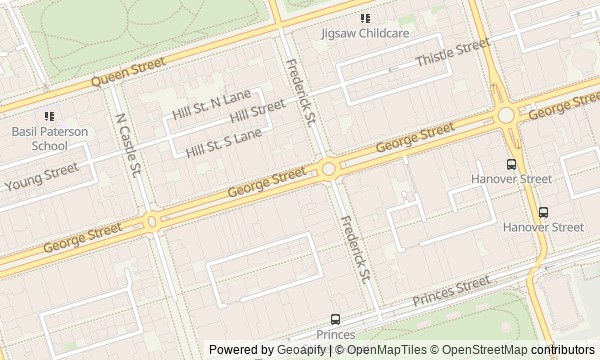
Route map
About the walk
You will cross Edinburgh New Town from St Andrew Square along ceremonial George Street, then turn onto narrow Rose Street, emerge at Princes Street Gardens, and finish among the private gardens of Charlotte Square and Moray Place.
The scale will keep changing as you go. First come a square, a bank, and public rooms. Then a courtyard beside the first houses, a number above a former cinema, a commercial facade, and railway tracks below the lawns. By the end, the continuous stone walls will break apart into individual homes.
This will not be a lecture on Georgian style. Instead, it follows order back to human decisions: why a church vanished from its own square, what made a secret author stand before his guests, why two teenagers returned for a silent screening, and what bill remained after a social season.
By the end of the walk, the grid of Edinburgh New Town will no longer look like a finished drawing. You will see the deals, lawsuits, and debts that still determine where its houses, gardens, and railway lines stand.
Why this order
St Andrew Square sets out the original plan and immediately shows how a private buyer changed it. Next, Assembly Rooms explains what kind of society filled the new facades and by what rules it accepted its own. From the ceremonial hall, the route returns to Thistle Court, where it becomes clear how the whole development began with one small courtyard. After the first houses, Rose Street reveals the service street where an independent cultural life later took shape. The descent to Princes Street leads to the grid's southern edge, defined by a court, gardens, and the railway. The climb to Charlotte Square completes the original plan with a square of unified facades and a private garden. Georgian House narrows that facade to the budget of one family. Moray Place widens the scale again: there, the same calculation was applied to an entire former estate.
Those who want to understand Edinburgh New Town, not just photograph its facades Lovers of urban history, architecture, and private biographies Those who have already seen Edinburgh Old Town and are looking for another Edinburgh
Those expecting a castle, medieval alleys, and legends of Edinburgh Old Town Those looking for a route mainly through interiors Those who do not enjoy stories about property, debts, and lawsuits
Before you go
The entire route can be done outdoors, and that is what you should plan for. Do not count access to Assembly Rooms and Georgian House as a guaranteed part of the walk: if you want to go inside, check official information in advance and plan that visit separately. Do not use the central gardens in residential squares as a shortcut, and respect the locked gates. On George Street and Princes Street, you will have to deal with traffic several times, so cross only at marked crossings. Weather quickly changes the feel of the open squares, so bring a waterproof layer and shoes suited to long walks on hard surfaces.
When to go
Set out in the first half of the day: Rose Street will be quieter, and slanting light will make it easier to see the rhythm of the windows, the corners of the squares, and the depth of the basement levels. Allow extra time for stops at monuments and facades, and do not include a separate interior visit in the main time estimate.
Backup plan
If Assembly Rooms or Georgian House are closed, the route still holds together. At the rooms, focus on how the ceremonial entrance separates invited visitors from the street. At house number seven, compare the matching outer shell of the neighboring buildings with the story of different owners, servants, and altered rooms. Use the time you save not for a random replacement, but for a slow circuit of Charlotte Square and a careful look at the form of Moray Place from the accessible sidewalks.
Route conditions
Surface. Paved — 2.3 km (data covers 94% of the route)
Facilities. Toilets — 4
Elevation. Ascent — 8 m; descent — 27 m
OpenStreetMap extract of June 18, 2026: database data, not a check on the ground. Data © OpenStreetMap contributors, ODbL licence
Walk plan
Open in maps ↗- 1
St Andrew Square
This stop raises the route's central question: who really controlled the geometry of the New Town. - 2
Assembly Rooms
The rooms show how fashionable society could turn a private secret into a public fact in a single evening. - 3
George Street
The courtyard of the first houses takes the grand street back to the time when the first developer had to be enticed with a cash reward. - 4
Rose Street
This stop adds a homemade cinema and its unexpected street audience to the aristocratic grid. - 5
Princes Street
The southern edge of the grid shows how the view from private windows became a garden and a transport corridor. - 6
Charlotte Square
The square shows how a shared facade and a private garden had to be adapted for a large monument. - 7
Georgian House
One address reveals how many servants, expenses, and debts social status required. - 8
Moray Place
The finale will extend the family calculation to an entire block, where the landowner set the facades, payments, and access to the garden in advance.
Route features
Everything you need stays in the browser
Progress, saves and your trip plan are stored on this device.
Add Guide On Map to your home screen so the walk opens outside the browser.
How we handle sources, maps and corrections: our editorial standards