 Guide On Map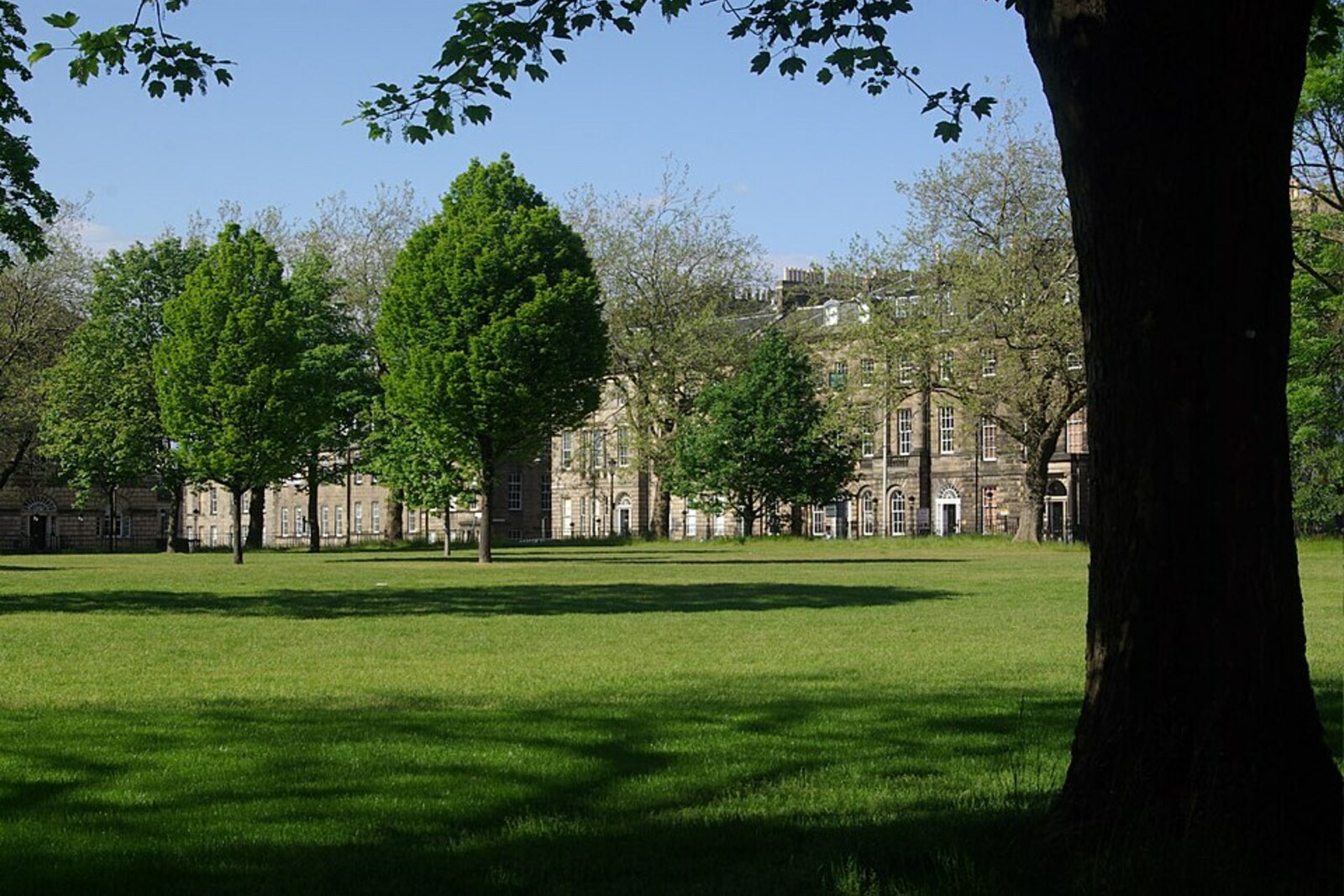
Look around first
What to notice
- Equestrian figure of Prince Albert
- Granite pedestal
- Reliefs on the pedestal
- Octagonal garden
The story of the place
Charlotte Square lies at the western edge of the first phase of the New Town. Robert Adam set the overall design of the facades, while the owners of the plots built and fitted out the houses separately, so that from the street the private houses look like one long ceremonial frontage. Behind the railings, the octagonal garden has survived, belonging to the owners of the surrounding properties.
Charlotte Square first appeared in Craig’s plan as St George Square. But the developer James Brown had already given a similar name to another square, south of the Old Town, in honor of his brother George. So that the two addresses would not be confused, in seventeen eighty-six the city council renamed the western square after Queen Charlotte of Mecklenburg-Strelitz, the wife of George the Third.
The first phase of the New Town ended here. The council commissioned Robert Adam to design the facades, and buyers of the plots had to follow his drawings. Each person built and fitted out a house separately, yet from the street several houses came together as a single palatial facade. At the center was a garden for the owners of the surrounding properties. It remains private today.
The original garden was round. Its current shape was determined by the monument to Prince Albert. After her husband’s death in eighteen sixty-one, Queen Victoria demanded that Scotland’s memorial to Albert should stand apart from other statues. From sixty designs, she chose the equestrian figure by John Steell.
For Steell, this was the major commission of his career. He earned his living through monumental sculpture and ran in Edinburgh the first Scottish foundry established specifically for large bronze statues. He received the commission in eighteen sixty-five, but the royal choice alone was not enough: the committee could not raise the money and spent almost ten years arguing about the site.
In eighteen seventy-one, the owners of the houses in Charlotte Square began pressing for the monument to be placed in their garden. Here Victoria’s condition was met literally: Albert would have a separate space and would close the vista along George Street. There was still a shortage of money. The Duke of Buccleuch, one of the project’s patrons, pledged to cover the missing two thousand pounds himself. His money did not have to be spent: after the guarantee, donors contributed the full amount within a few months.
For the monument, the round garden was turned into an octagon. At its center they installed a granite pedestal with reliefs, including Victoria and Albert’s wedding and the opening of The Great Exhibition. Above them, Steell placed Albert on horseback, in a field marshal’s uniform.
On August seventeenth, eighteen seventy-six, Victoria came to Charlotte Square and unveiled the monument. After the ceremony, she knighted Steell. In her personal diary, the queen recorded a very different assessment of his major work: the horse seemed stocky to her, and Albert’s figure heavy, too small for the horse, and unlike her husband.
Behind the railings still stands that same bronze: chosen by Victoria from a design, criticized by her after its unveiling, and bringing John Steell a knighthood.
Useful on site
The square is open for passage; the central garden is private, and the buildings are accessible only according to their functions and events.
Checked: June 29, 2026. Check the official source before visiting.View the ensemble from the perimeter, and do not use the garden as a shortcut; residential and official buildings require distance.