 Guide On Map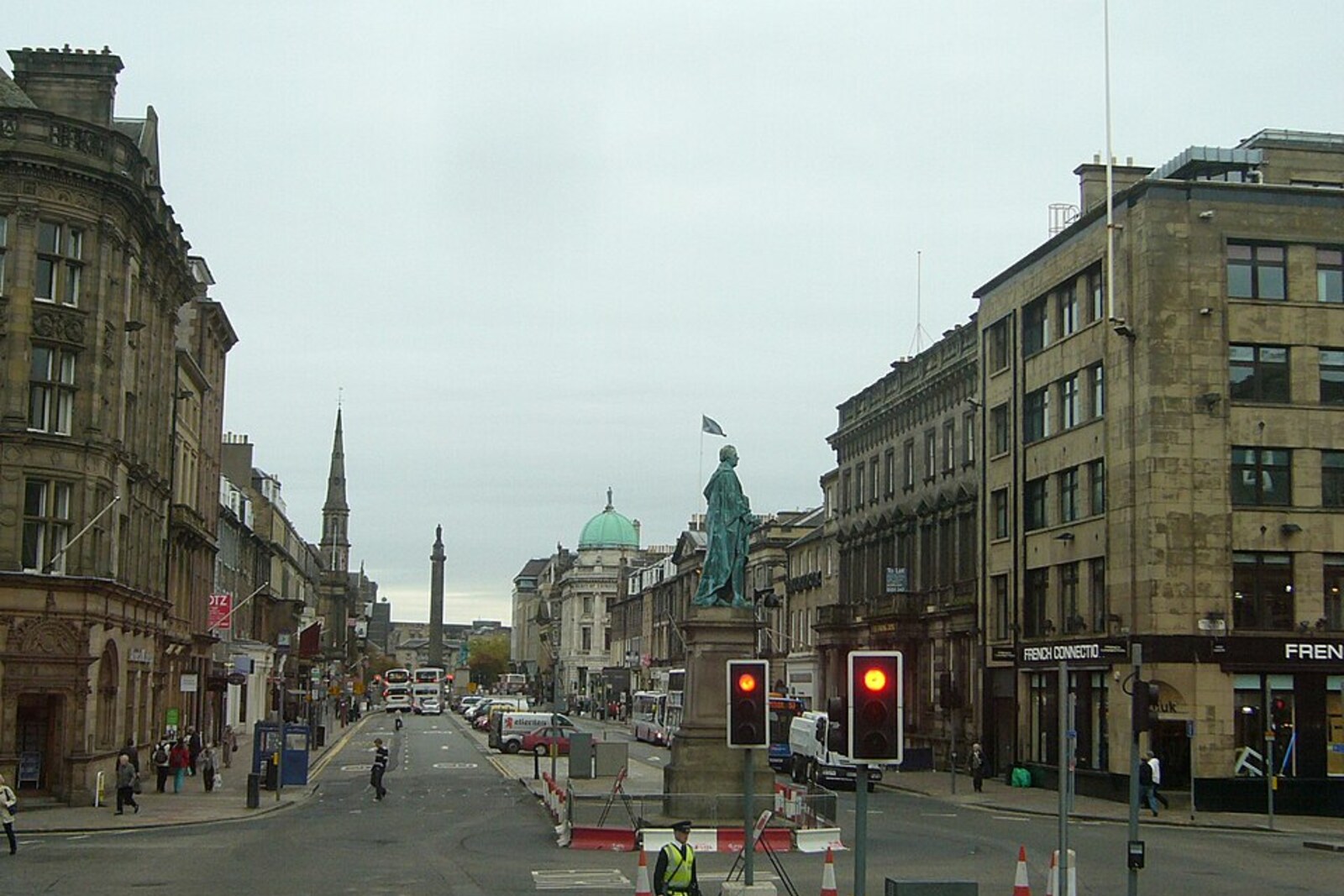
Look around first
What to notice
- Two pairs of houses in Thistle Court
- A small inner courtyard
- The broad line of George Street
The story of the place
The broad, straight George Street runs along the crest of the New Town, preserving its symmetrical pattern. Residential houses first stood along it; then merchants altered the ground floors, cutting separate entrances and enlarging windows for shopfronts. Later, banks and insurance companies combined former houses into offices, which is why shops, restaurants, and financial institutions stand side by side here. At the eastern end, behind the facades, a small courtyard remains in Thistle Court, with two pairs of old houses.
On October twenty-sixth, seventeen sixty-seven, the architect James Craig personally laid the first stone of the New Town. This happened at the eastern end of George Street, in what is now Thistle Court. There were no future neighbors around yet, and the first developer had to be lured with a cash reward.
Edinburgh's council wanted to move well-to-do townspeople from the cramped Edinburgh Old Town to the open ridge to the north. A competition was announced for the new district. Craig, a twenty-six-year-old stonemason's apprentice, saw it as a rare chance to enter the profession. He studied at a charity school, could not afford the European journey usual for an aspiring architect, and had no money to set up on his own.
Craig placed the district's widest street along the middle of the ridge. On an early print of the plan, it was marked without a name—simply as Main Street. After revisions, the council approved the design, awarded Craig a gold medal, and made him an honorary citizen of Edinburgh. In the autumn of seventeen sixty-seven, the architect took the drawing to London to King George the Third.
By this presentation, the streets had already received names from the ruling family. George Street was named after George the Third himself, Queen Street after his wife, Queen Charlotte, Princes Street after their sons, and Hanover Street recalled the royal dynasty. Rose Street and Thistle Street, the streets of the Rose and the Thistle, stood for England and Scotland. The council and Craig turned the addresses of the new district into a public declaration of loyalty to the British Crown.
Royal approval still did not mean that people would want to live here. The plots seemed far from the settled city, and the municipality promised twenty pounds to whoever began building first. The developer John Young risked money for this reward. Craig laid the foundation stone for Young's house, but Young built not the grand terrace along the street that the plan envisaged, but two pairs of houses around a small courtyard. These very buildings in Thistle Court are considered the oldest surviving houses in the New Town.
After Young, buyers did come after all. George Street was built up with residential houses, but by the end of the eighteenth century merchants had begun cutting separate doors into the ground floors and enlarging windows for shopfronts. Later, banks and insurance companies combined several former houses into large offices. Thus the originally residential street became a place of shops, restaurants, and financial institutions, while preserving the width and symmetry of Craig's plan.
The famous drawing did not bring the architect a fortune. In his final years, he was constantly borrowing money, and in seventeen ninety-five he died in debt. His Physicians' Hall on George Street was later demolished, but the street grid remained almost the one he had shown the king.
The bronze monarch at the intersection with Hanover Street can be misleading: it is George IV, George the Third's son, and the monument appeared much later. George Street bears the father's name, while the New Town's first building risk can still be found behind its eastern facades, in the small courtyard of Thistle Court.
Useful on site
The street is publicly accessible around the clock; venues and offices keep their own hours.
Checked: June 29, 2026. Check the official source before visiting.The landmarks are in different parts of the street; view them from the pavement and use crossings at busy intersections.