 Guide On Map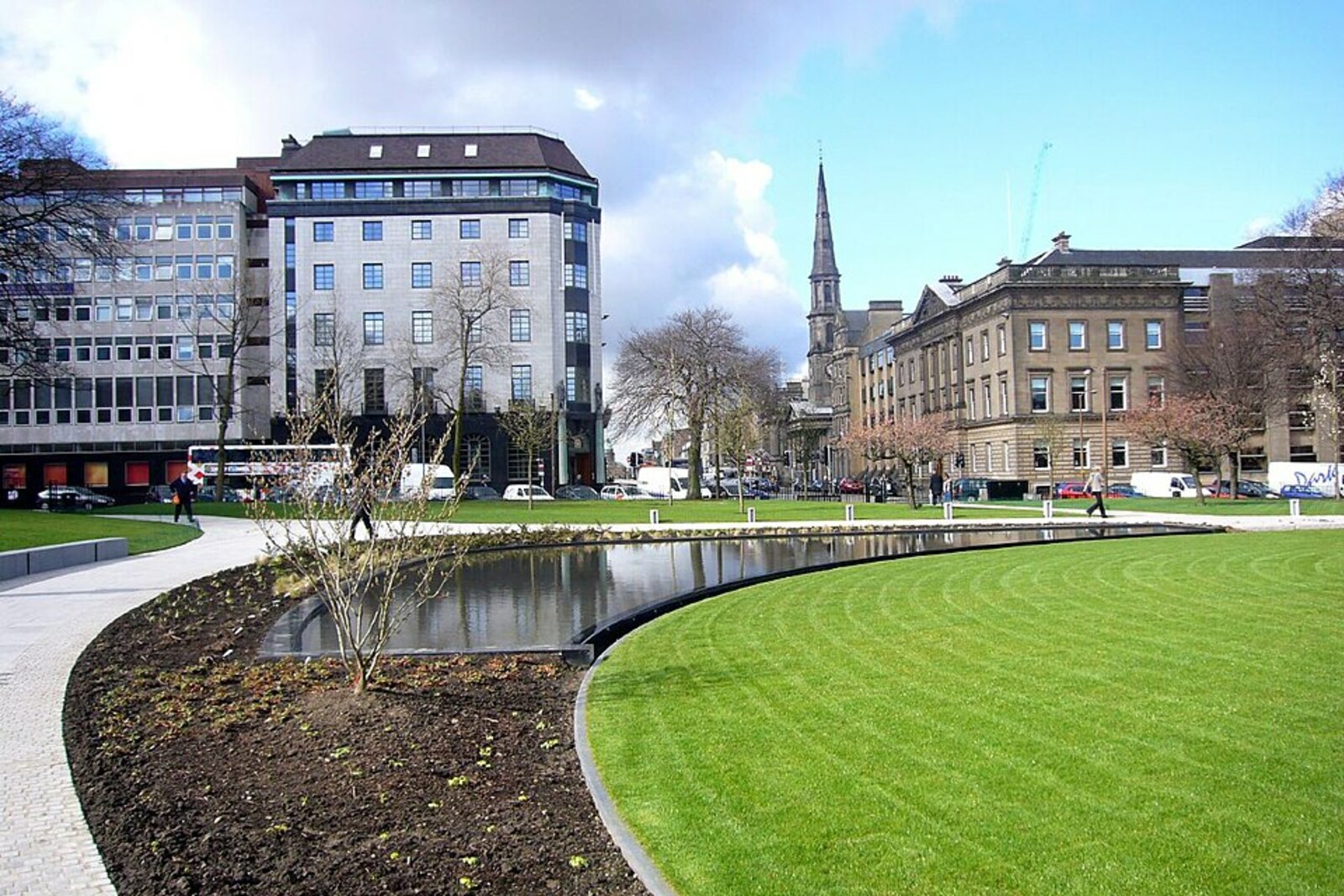
Look around first
What to notice
- The light-colored facade of the mansion
- Four Corinthian columns
- The pediment with the golden royal coat of arms
The story of the place
The eastern end of the New Town's main straight street is closed by a square conceived as the counterpart to the western one. Its name refers to Scotland's patron saint, while at the opposite end of the line England's patron saint is recalled: the streets and squares here were assembled into a single set of symbols for the two parts of the kingdom. Above the light-colored facade, a golden coat of arms is visible, left from the time when the house served the office that collected state duties; later, it was expanded into a banking complex.
On the east side of the square stands a light-colored mansion with four Corinthian columns and a golden royal coat of arms on its pediment. James Craig had set aside this site for a church.
Craig was a young, little-known architect when the city council commissioned him to plan a new Edinburgh. The council wanted to move wealthy families, on whom trade and city revenues depended, beyond the cramped confines of the Old Town. In July seventeen sixty-seven, the council approved Craig's plan: three straight streets, blocks of equal width, and a square at each end of the main line.
The names formed a single set. Craig dedicated the eastern square to Saint Andrew, an apostle, a disciple of Christ, and Scotland's patron saint. He named the western one for Saint George, England's patron saint. George Street ran between them, named for King George the Third; the service streets received the names of the Scottish thistle and the English rose. The two squares were to have churches of the respective saints facing each other. So the name St Andrew Square referred both to Scotland and to a particular building at the end of the vista.
Sir Lawrence Dundas laid claim to the site intended for the church—a military supplier, Edinburgh's member of Parliament, and a man who needed a capital-city house to match his new position. Dundas made his fortune supplying the British army during the Jacobite rising and the Seven Years' War: he was responsible for food and equipment for the troops, and invested the profits in land and real estate. Dundas helped steer through the Parliament of Great Britain an act allowing Edinburgh to extend its municipal boundaries, owned land east of the future square, and managed to obtain the plot set aside for the church.
In seventeen seventy-one, he commissioned William Chambers to design a large town mansion. Three years later, the house was ready. The church had to find another site: it opened on the north side of George Street in seventeen eighty-four. Dundas received the best address in the new district, while the square retained the name of the saint whose church was no longer there.
After Dundas's death, his son inherited the mansion. In seventeen ninety-four, the Excise Office, which collected state duties, bought the building; that was when the golden royal coat of arms appeared on the pediment. In eighteen twenty-five, the Royal Bank of Scotland acquired the house and gradually expanded it into a banking complex.
St Andrew's Church stands on George Street. Its place on St Andrew Square is occupied by the bank.
Useful on site
Private garden open for public passage; access and individual routes may change because of events.
Checked: June 29, 2026. Check the official source before visiting.View the garden and the space around the column only from open paths; do not go around closed sections of the fence.