 Guide On Map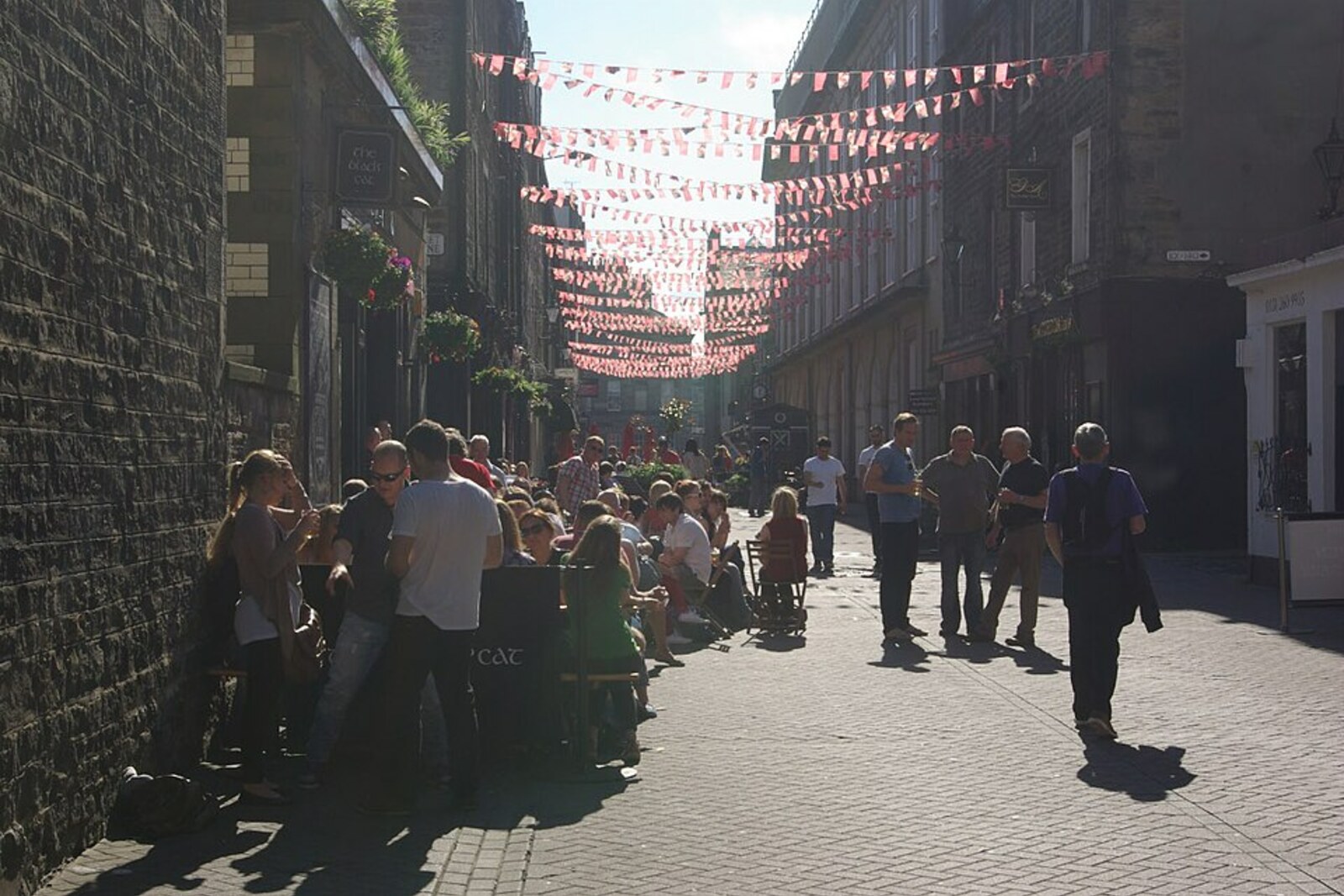
Look around first
What to notice
- Number 91 on the facade
- Pedestrian paving
- Ground-floor shop windows
The story of the place
Rose Street was given its name in seventeen eighty-four. The city magistrates named the two narrow streets between the New Town's formal lines after national emblems: the rose represented England, while the neighboring thistle on Thistle Street represented Scotland. More modest three-story houses were built here than on George Street and Princes Street. The ground floors gradually filled with shops and pubs; now it is a pedestrian shopping street.
In nineteen fifty-four, above one of the shops, at number ninety-one, Margaret Tait set up a cinema. Tait was a doctor and an independent filmmaker. To buy film stock and make films without a producer, she took temporary medical posts across Great Britain; while traveling, she sometimes slept in her car. She paid for almost all her films herself.
After studying in Rome, Tait brought her own short films and films by her fellow students to Edinburgh, but there was nowhere to screen them. During the large Edinburgh International Festival, the city filled with audiences willing to move from one performance to another. Tait decided to draw some of that audience to Rose Street. In the largest room, she installed a projector, cut two small windows into the wall, and turned the adjoining room into a projection booth. One friend helped connect the switches and wires, and another sent a poster. That was how the unofficial Rose Street film festival began.
Tait was wary of the local residents. She herself called Rose Street at the time harsh and hoped that children from the street would not be interested in unfamiliar films. About a week later, three or four children came upstairs. They sat through the program and brought others the next day. When the children began to disturb the evening audience, Tait set aside a separate screening for them.
That same evening, two teenagers who were always standing in the doorway opposite came into the cinema. They probably wanted to show the younger children that the ban on children no longer applied to them. During the screening, the amplifier lamp burned out, and the films were left without sound. The teenagers did not leave: it would have been awkward to go back out to the children after only a few minutes. They watched the entire program in silence, returned the following evening to see it with sound, and a day later brought two friends. Tait got exactly the audience she had feared, and she came to know the people who lived on this street. She kept the festival small and independent.
Two years later, Tait made the short film Rose Street—about the everyday life of those very houses, shops, workers, and children. In the early nineteen seventies, the old buildings began to be dismantled and replaced with retail blocks, and the street was turned into a pedestrian zone. By then, the negative of the first film had been lost. To preserve the remaining copy, Tait inserted it whole, including the titles and film ends, into a new color film, On the Mountain, in which she showed the rebuilt Rose Street. Before leaving, she also filmed the rooms above number ninety-one.
That number is still on Rose Street. The little cinema behind it has long been gone, while the street Tait filmed before the rebuilding remains inside another of her films.
Useful on site
The street is open around the clock; in the evening it may be noisy because of venues and deliveries.
Checked: June 29, 2026. Check the official source before visiting.Do not linger in venue doorways or obstruct deliveries; the full point of the stop is accessible from the street.