 Guide On Map
Old Dubrovnik: the republic's main line
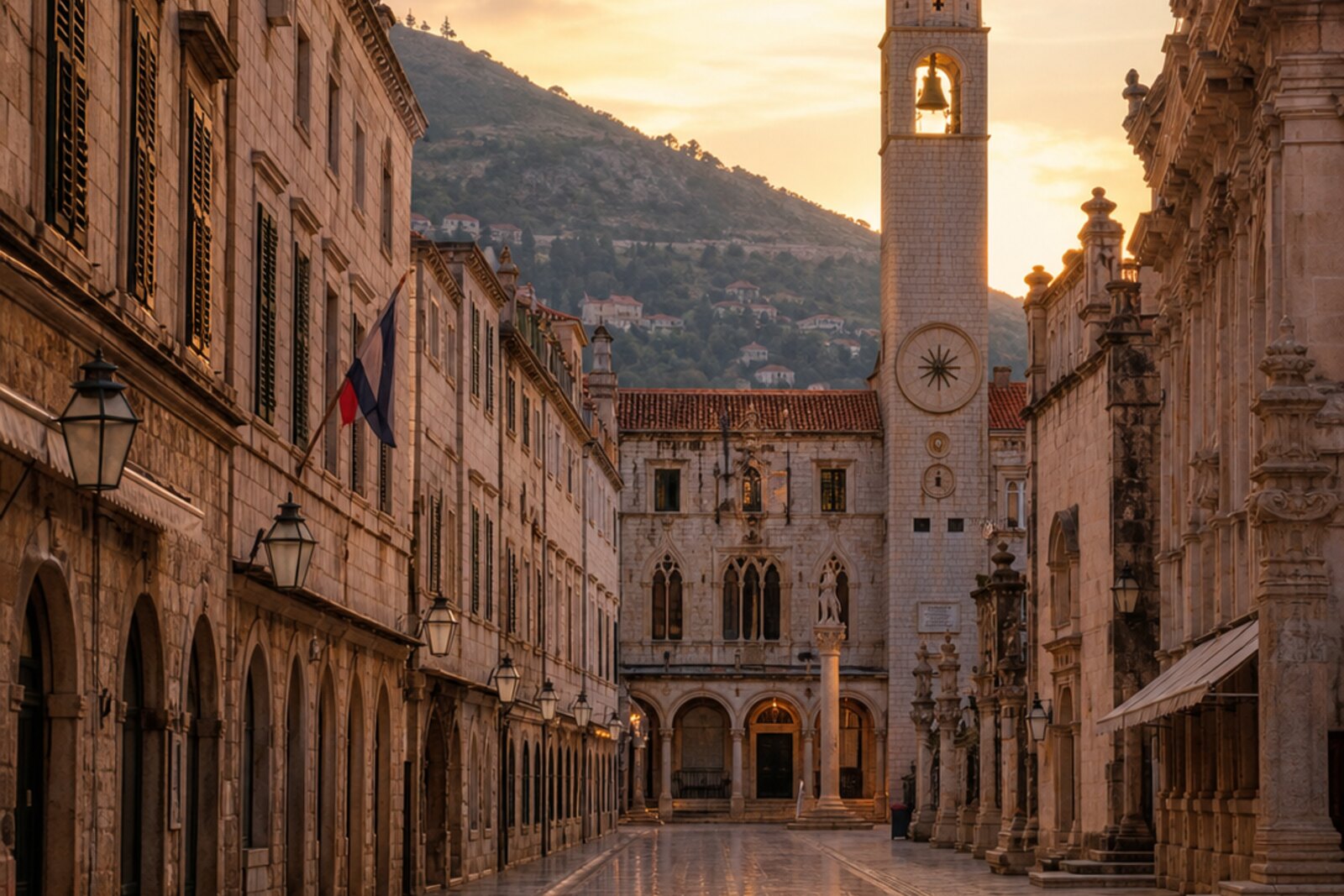
Along Stradun and through Luža Square—from Pile Gate to Ploče Gate
Guide On Map on your phone
Open the walk like a regular app
It takes about 10 seconds to install. No app store needed.
The whole path
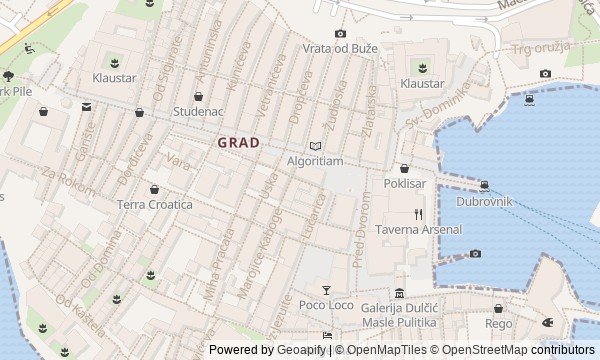
Route map
About the walk
You will enter the Old Town through Pile Gate and cross it from end to end: along Stradun, through Luža Square and the cathedral-and-palace quarter, to Ploče Gate.
Beyond the western gate, the route follows the places without which the republic could not have existed: the waterworks, the trading street, the square where decisions were made, the cathedral, and the palace. At the fountain, the contractors' final payment will matter more than the decoration. At Luža Square, it will all begin with borrowed tableware. In the palace, a life sentence will collide with a task no one else is left to carry out.
The narrator will unpack these cases calmly, separating later chronicles and legend from what the documents confirm. The answers will appear where arches, mascarons, matching facades, and stone bridges still remain.
By the end, you will be able to explain how Dubrovnik managed water, trade, and power—and why the fate of the republic was decided twice at the city gates.
Why this order
Pile Gate opens the route where the republic controlled its western entrance—and where that control first cracked. Just beyond it, the fountain reveals the other side of the same system: the city even checked how much water made it inside the walls. From the waterworks' acceptance point begins Stradun, a trading street brought back to life after disaster with matching municipal facades. It leads to Luža Square, where practical order gives way to public justice and the decisions of the councils. From the square, the route turns toward 2 central post-earthquake tasks: first the rebuilding of the Cathedral of the Assumption of the Virgin Mary, then the neighboring Rector's Palace, where secular power was assembled again. From the palace, the road continues to the eastern exit. Ploče Gate closes the route as Pile Gate's counterpart: at one entrance the republic lost its independence; at the other, it could not win it back.
Those who want to understand the workings of the Republic of Ragusa through places and human decisions Those interested in urban disasters, rebuilding, and struggles for power Those who prefer document-based stories to grand legends
Those looking for a walk only along the fortress walls Those wanting an overview of beaches and sea views Those who prefer a light list of sights without political history
Before you go
Most of the story is available in the streets and in front of the facades, so you can take the route without buying a general ticket. The atrium of Rector's Palace, the bust of Miho Pracat, and the museum rooms require a separate visit; check the conditions with Dubrovnik Museums in advance. The cathedral is an active church, and access to the interior and treasury may depend on services and the church schedule. Choose shoes with good grip: polished limestone becomes especially slippery after rain. At the gates and on Stradun, do not stop in the middle of the flow—step to the edge of the passage or into a square to listen.
When to go
Start in the morning, when it is easier to make out the small details at Pile and the fountain, or after the daytime crowds have thinned. Leave extra time for the full route: the busiest stretches sometimes have to be covered more slowly than the distance suggests.
Backup plan
If Rector's Palace is closed, listen to the story by the portico: the building's position between the square, the harbor, and the neighboring public spaces already explains its role, and you can save the museum visit for another day. If the cathedral is closed, look at the facade and dome rather than trying to enter during a service; the treasury is not necessary to continue the route. In rain, shorten long stops on open Stradun and Luža Square, but move carefully and do not rush over wet stone. In heavy crowds, it is easier to play the audio a little away from the sites themselves, then return to the details after the story.
Route conditions
Surface. Paved — 1.1 km (data covers 89% of the route)
Stairs. Flights: 4, 49 m in total
Access. Wheelchair — no; stroller — limited (stairs)
Facilities. Toilets — 7; drinking water — 5
Elevation. Ascent — 13 m; descent — 14 m
OpenStreetMap extract of June 25, 2026: database data, not a check on the ground. Data © OpenStreetMap contributors, ODbL licence
Walk plan
Open in maps ↗- 1
Pile Gate
Here you will see how a promise of free passage turned into the end of an independent state. - 2
Large Onofrio's Fountain
This stop will show how the city accepted a complex engineering project and made contractors answer for water losses. - 3
Stradun
Here, the post-disaster reconstruction will appear as a series of practical decisions about shops, housing, and the city treasury. - 4
Luža Square
The square is needed to see how a conversation overheard by chance became a public matter of the Republic of Ragusa. - 5
Cathedral of the Assumption of the Virgin Mary
The cathedral will show how a ruined city managed a major construction project through letters, calculations, and disputes with craftsmen. - 6
Rector's Palace
Here, a single act links murder, a life sentence, and emergency rule after the earthquake. - 7
Ploče Gate
The final stop explains why driving out the French garrison did not restore the republic to Dubrovnik.
Route features
Everything you need stays in the browser
Progress, saves and your trip plan are stored on this device.
Add Guide On Map to your home screen so the walk opens outside the browser.
How we handle sources, maps and corrections: our editorial standards