 Guide On Map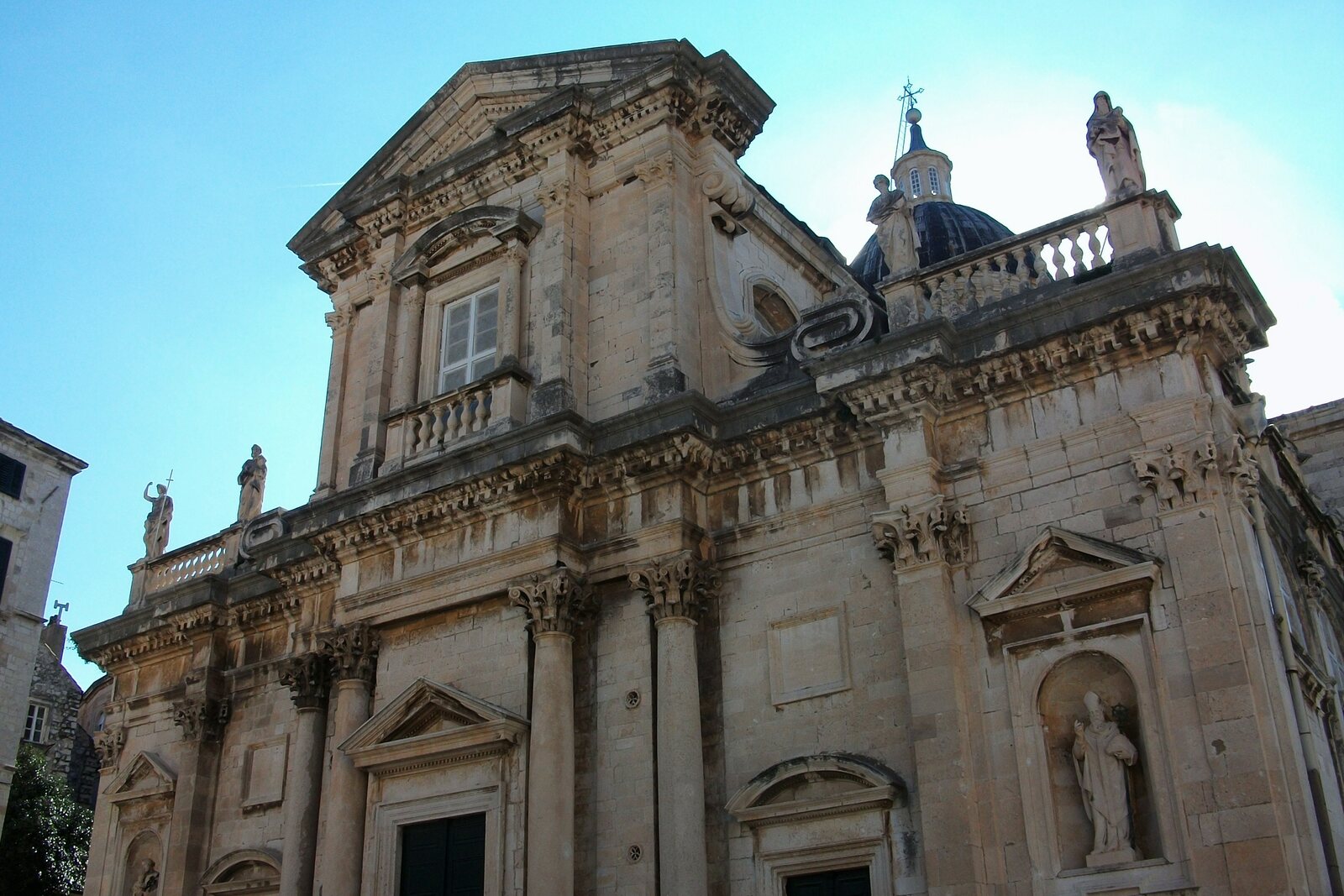
Look around first
What to notice
- Façade columns
- Stone cornices
- Carved details
- The polyptych above the high altar
The story of the place
The light-stone façade with columns, cornices, and carvings belongs to the main church of old Dubrovnik. The bishop officiates here, so the church has cathedral status and remains the setting for the city's most important services. The present building took shape over decades: stone was ordered separately for it, and its columns and carved details were calculated. Above the high altar, the polyptych of the Assumption of the Virgin Mary has survived, and from it the church received its dedication.
Two months after the earthquake of sixteen sixty-seven, Dubrovnik senators ordered the cathedral ruins cleared. The Romanesque basilica that had stood here collapsed so completely that no attempt was made to restore it. With it, the city's main church disappeared—the church that housed the archbishop's cathedra and held the most important services.
The senators turned for help to Stjepan Gradić, a Dubrovnik priest and diplomat in Rome. Gradić had lived there since sixteen fifty-three, served as keeper of the Vatican Library, and represented the Republic of Ragusa at the papal court. His work consisted of books, letters, and negotiations with people able to provide money or send craftsmen. After the earthquake, this became his chief resource: he asked the pope and European dignitaries for help, finding funds, food, building materials, and specialists.
Gradić insisted on an order for reconstruction: first housing for those left homeless, then the Rector's Palace and the cathedral. In sixteen seventy-one, he commissioned a design for a new church from the Roman architect Andrea Buffalini and began directing the construction from Rome. Gradić selected craftsmen, arranged their employment and journey to Dubrovnik, and sent the senators calculations and dimensions for stone details.
When the Genoese builder Paolo Andreotti announced that he himself would determine the quantity and finishing of the stone, Gradić sent the Senate of the Republic of Ragusa a separate treatise on travertine quarries. A hired architect, he wrote, must carry out the client's decisions rather than take the client's place. In this way, the librarian on the other side of the Adriatic Sea controlled the dimensions of the columns, cornices, and carved details now visible on the façades.
The Republic spent more than fifty thousand ducats on the cathedral. Gradić oversaw the work until his death in sixteen eighty-three and did not see the finished building. Construction was completed by the Dubrovnik stonemason and architect Ilija Katičić in seventeen thirteen—thirty years after the death of the man who commissioned the design.
For the high altar, the senators needed an image that matched the cathedral's ancient dedication. They turned to the Brotherhood of St Lazarus, which brought together wealthy Dubrovnik merchants trading in the Balkans and the Eastern Mediterranean. The Brotherhood owned the polyptych “Assumption of the Virgin Mary,” painted by Titian and his workshop for their Church of St Lazarus outside the city walls. The merchants gave the original to the new cathedral and received a copy for their church.
In the central painting, the Virgin Mary rises into heaven above the apostles. This subject explains the church's dedication. The original, which the Brotherhood transferred after the earthquake, still stands above the high altar; beneath it, the bishop officiates, and it is his cathedra that makes this church the Cathedral of the Assumption of the Virgin Mary.
Useful on site
The cathedral is an active church: enter quietly and do not view the interior during services. Visits to the treasury depend on a separate schedule, so do not count on one without checking in advance.