 Guide On Map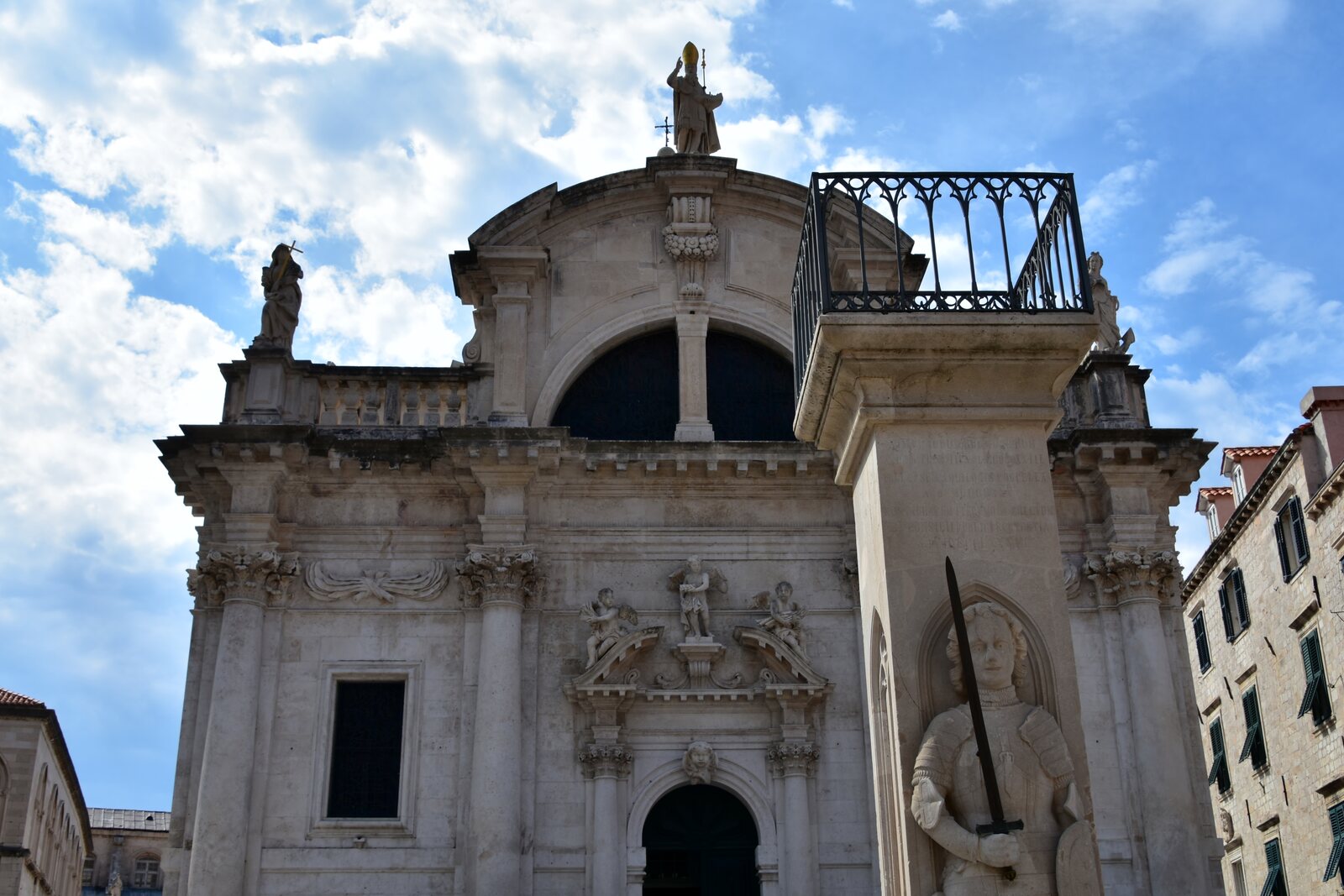
Look around first
What to notice
- The stone pillar with the relief of Orlando
- The open Luža Bell Tower
- Sponza Palace
- The stone knight's forearm
The story of the place
Luža is the name of the square in front of Sponza Palace: it was named after the open bell tower, whose single bell gathered the councilors and warned the city of fire. At the edge of the square stands a stone pillar with a relief of the medieval knight Orlando. Before it, another pillar stood here, beside which court decisions were read out and convicts punished; the length of the stone forearm served merchants as a measure. After strong winds, the old relief was placed in a new stone support and returned several meters from its former location.
On March ninth, fourteen hundred, the wife of a Dubrovnik craftsman came to the patrician Nikola Gučetić to borrow tableware. She had once served in his household, but now her husband was gathering guests and did not have enough bowls for everyone. Gučetić asked who the tableware was needed for. When he heard the names of the guests, he paid the woman to remember the conversation at the table.
That is how a later Dubrovnik chronicle tells the story. That year, many residents left the city because of an epidemic. Four young patricians wanted to take advantage of this: the brothers Nikolica and Jakša Džamanić, as well as Lovro and Šimun Bodača. Their families belonged to the nobility, but according to the chronicler, the brothers no longer had enough money for their customary way of life. They planned to seize the city gates, let armed men in from Trebinje and Popovo Polje, and rule Dubrovnik themselves.
Their contact, Miloš, came to dinner with four companions. Miloš was to meet a messenger from neighboring Bosnian nobles at the gates and receive a letter with final instructions. The craftsman's wife overheard this plan and told it to Gučetić the next morning.
Gučetić suffered from gout and could not go himself. He had himself carried to the palace, where the Minor Council was in session, and demanded that the councilors be summoned at once. The woman was questioned, the conspirators were seized, and a trusted man was sent to the gates in Miloš's place. He gave the agreed signal and received a letter confirming the arrangement with accomplices outside the walls.
Historians still have not established which neighboring rulers actually supported the conspiracy; the chronicle is contradictory at this point. The outcome is known more precisely. On March tenth, the four patricians were beheaded and their property was confiscated. Their bodies were displayed for three days beside the stone pillar—the kar—in the middle of what is now the square. The name of the woman whose account began the exposure, and what became of her afterward, have not survived in the records.
The kar stood here because as many people as possible had to see the council's decisions. Goods were sold nearby, decrees were read aloud, and public punishments were carried out. Later, an open bell tower, the Luža Bell Tower, was built over the passage near Sponza Palace. It was called Luža, from the Italian word “loggia.” Its bell summoned the councilors and warned residents of fire; the bell tower's name passed to the entire square.
In fourteen nineteen, the Minor Council ordered the old kar to be replaced with a new pillar. Orlando, a commander of Charlemagne who died in seven hundred seventy-eight and became a hero of medieval songs, was carved on it as a knight. Legend credits him with saving Dubrovnik from the Saracens near Lokrum, but there is no historical evidence for this story.
The choice of Orlando is linked to King Sigismund of Luxembourg, the republic's patron. In Brandenburg, which Sigismund knew, such figures were erected where townspeople had their own court. Orlando in Dubrovnik inherited the old kar's function: sentences were announced beside him, convicts were tied to the pillar, and the length of the knight's forearm became a measure for merchants.
The present relief of Orlando was carved for the pillar of fourteen nineteen. After wind toppled the pillar in eighteen twenty-five, the old knight was built into a new stone body and returned to the square only in eighteen seventy-eight. It was placed several meters to one side and turned to face north. The conspirators' bodies lay not at the present base, but at the predecessor of Orlando, which stood closer to the middle of Luža Square.
Useful on site
All the main details are visible from the square. To avoid getting in the way of people crossing it, choose a spot at the edge and approach the column separately after listening.