 Guide On Map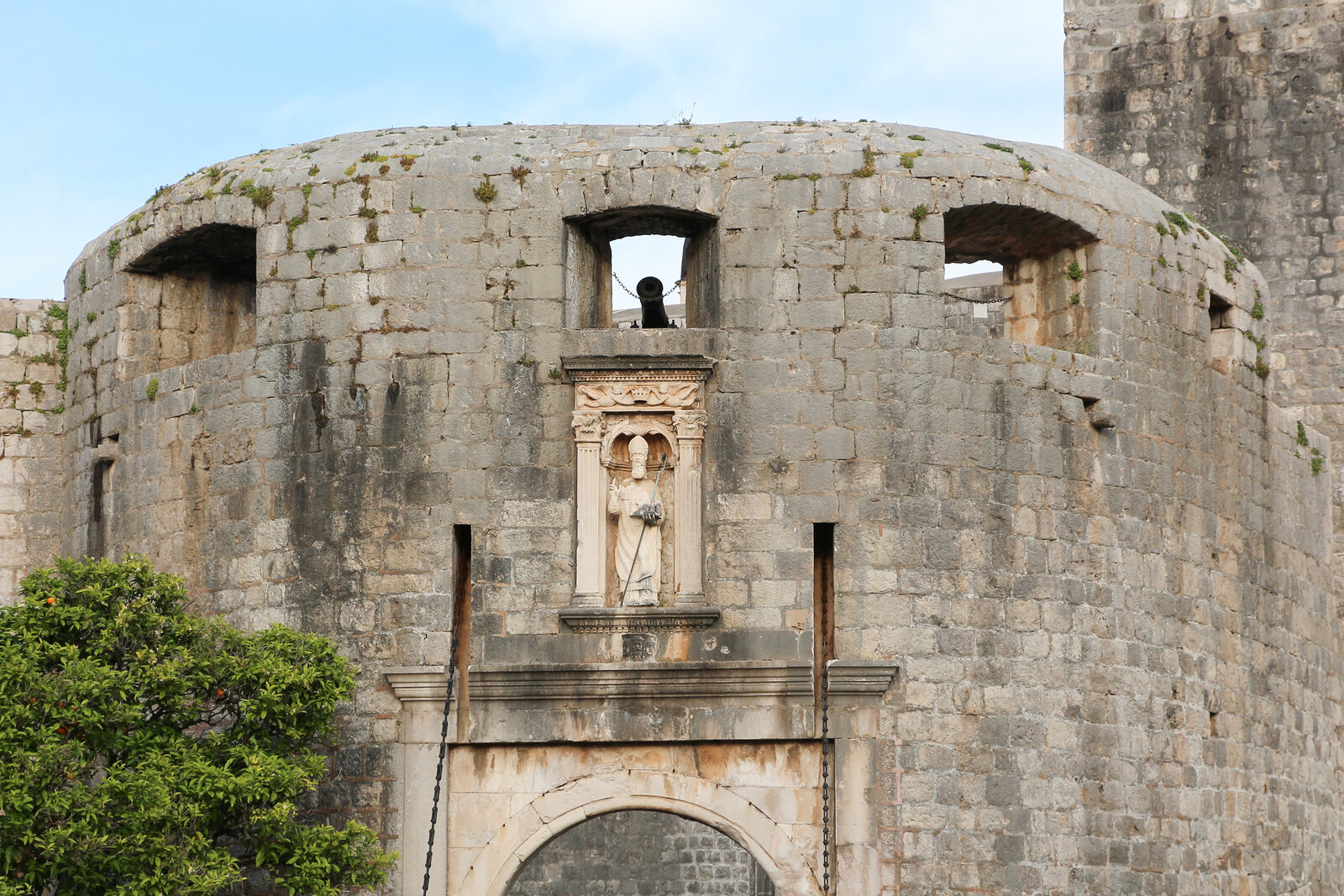
Look around first
What to notice
- Stone St Blaise with a model of the city
- Outer arch
- Semicircular fortification
- Inner gate
The story of the place
Every evening, the wooden section of the bridge in front of this gate was raised, its leaves were locked, and the keys were handed to the rector—the monthly elected head of the Republic of Ragusa. The local name, “Vrata od Pila,” means the gate on the Pile side, the western suburb beyond the wall. The main overland road into the city passed through the outer arch, the semicircular fortification, and the second gate.
In the spring of eighteen oh six, the fate of the republic depended on whether these gate leaves would be opened. After Napoleon’s victories, France received Dalmatia and the Bay of Kotor, but Kotor was occupied by Russian troops. Between them lay small, neutral Dubrovnik, which European documents called Dubrovnik. Its merchants lived by maritime trade: the neutral flag allowed them to enter the ports of countries at war with each other.
The senators understood that allowing the French army to pass through the capital would destroy this protection. They proposed carrying the soldiers by ship along the coast, bypassing the city. The French generals assured them that they respected the republic’s independence. However, Napoleon had already ordered General Jacques Alexandre Law de Lauriston to occupy Dubrovnik and disarm its inhabitants.
On the morning of May twenty-seventh, Law de Lauriston brought about eight hundred soldiers to Pile Gate. Two senators met him at the entrance and escorted him to the rector and the Minor Council. The general announced that, by the emperor’s order, he would occupy all the fortifications, but promised to preserve the republic’s freedom. Dubrovnik’s rulers handed over the keys. The gate leaves were thrown open, the soldiers passed through the gate, and immediately occupied the towers, bastions, and other entrances to the city.
Law de Lauriston demanded one million francs from the republic. To raise the money, the senators ordered silver from churches and monasteries to be melted down into coins, and assets held in foreign banks to be sold. The monasteries were turned into barracks and public palaces into warehouses. Then Russian and Montenegrin detachments approached Dubrovnik, and the French had to shut themselves inside the walls together with thousands of refugees. The besiegers cut the water supply; the siege was lifted only on July sixth, when the French general Gabriel Molitor brought reinforcements and drove them back from the city.
The French soldiers did not leave after that. Law de Lauriston forbade Dubrovnik ships to sail under the flag of St Blaise, the republic’s patron saint, and then demanded that his banner be removed from the city square. The Senate of the Republic of Ragusa refused. On January thirty-first, eighteen oh eight, the French commander Auguste Marmont read out the decree abolishing the Republic of Ragusa.
The stone St Blaise still stands in the niche above the outer arch of Pile Gate, holding a model of the city in his hands. Below him runs that very western entrance through which the senators admitted soldiers who had promised only to pass on.
Useful on site
No admission ticket is required. There is constant two-way traffic at the gate, so listen at the edge of the platform and do not stop in the narrow passage.